






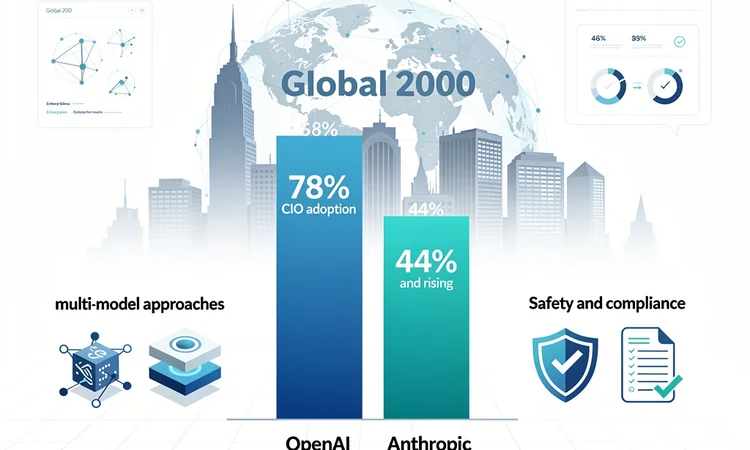
In the rapidly evolving world of enterprise artificial intelligence, a clear hierarchy is emerging among corporate technology leaders, with OpenAI maintaining a commanding lead while Anthropic’s Claude demonstrates remarkable momentum that has industry insiders questioning how long the current order will hold. A comprehensive survey of 100 Global 2000 companies reveals that 78% of Chief Information Officers have deployed OpenAI models in production environments, compared to Anthropic’s 44% adoption rate—yet the latter figure represents a surge that has caught many observers by surprise and suggests a fundamental shift in how large enterprises are approaching their AI strategies.
The data, reported by Andreessen Horowitz , paints a nuanced picture of the enterprise AI market that goes far beyond simple market share numbers. While OpenAI’s ChatGPT and GPT-4 models have become nearly ubiquitous in corporate settings, Anthropic’s rapid ascent from relative obscurity to nearly half the adoption rate of the industry leader represents one of the most significant competitive developments in enterprise software in recent years. The survey results indicate that many organizations are not choosing between providers but rather implementing multi-model strategies that hedge against vendor lock-in while optimizing for different use cases across their operations.
What makes Anthropic’s performance particularly noteworthy is the velocity of its growth trajectory. Founded in 2021 by former OpenAI executives including siblings Daniélle and Dario Amodei, the company has positioned itself as the safety-conscious alternative in the generative AI space, emphasizing constitutional AI principles and more predictable, controllable outputs. This positioning has resonated strongly with enterprise customers in regulated industries such as financial services, healthcare, and legal sectors, where the risks of AI hallucinations or unpredictable behavior carry significant compliance and reputational consequences.
The Multi-Model Strategy Reshaping Enterprise Architecture
The survey data reveals that the enterprise AI market is not shaping up as a winner-take-all scenario but rather as an ecosystem where multiple providers serve complementary roles within corporate technology stacks. According to eWeek’s analysis , companies are increasingly adopting a portfolio approach to AI models, selecting different providers based on specific requirements such as reasoning capabilities, context window length, cost efficiency, and domain-specific performance. This trend mirrors the evolution of cloud computing, where multi-cloud strategies became standard practice despite initial predictions that one or two providers would dominate entirely.
The financial implications of this multi-model approach are substantial. Organizations are investing heavily in the infrastructure and expertise required to manage multiple AI platforms simultaneously, including developing internal frameworks for model evaluation, governance protocols that work across providers, and training programs that ensure employees can leverage the strengths of different systems. Industry analysts estimate that large enterprises are allocating between $5 million and $50 million annually to their AI initiatives, with a significant portion dedicated to the integration and management of multiple model providers rather than simply licensing fees.
Anthropic’s Strategic Bet on Emerging Markets
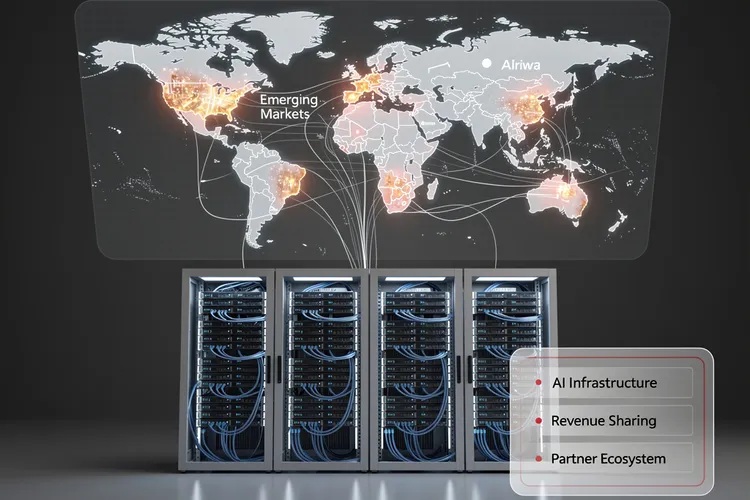
While much attention has focused on competition in North American and European markets, Anthropic has made a calculated strategic decision to prioritize emerging markets, particularly India, as a cornerstone of its enterprise growth strategy. Inc42 reports that Anthropic views India not merely as a customer base but as central to its entire enterprise AI roadmap, recognizing that the country’s combination of technical talent, rapidly digitizing economy, and cost-conscious business culture creates unique opportunities for AI adoption at scale.
India’s significance to Anthropic’s strategy extends beyond market opportunity to encompass talent acquisition and product development. The company has established significant engineering and research operations in Indian cities, tapping into the country’s deep pool of AI researchers and machine learning engineers. This approach contrasts with OpenAI’s more concentrated focus on its San Francisco headquarters and represents a bet that distributed global teams will prove essential to building AI systems that work effectively across diverse cultural and linguistic contexts. The India strategy also provides Anthropic with a testing ground for deployment patterns that may prove relevant to other emerging markets in Southeast Asia, Latin America, and Africa.
The Safety Narrative as Competitive Differentiation
Anthropic’s emphasis on AI safety and constitutional AI has evolved from a philosophical stance to a concrete competitive advantage in enterprise sales. Corporate buyers, particularly those in risk-averse industries, have grown increasingly concerned about the potential liabilities associated with deploying AI systems that may produce biased, harmful, or legally problematic outputs. Anthropic’s Claude models, designed with built-in safeguards and more transparent reasoning processes, have found particular traction among legal departments and compliance officers who must sign off on AI deployments.
The company’s approach to safety goes beyond marketing rhetoric to encompass technical architecture decisions that differentiate its products from competitors. Constitutional AI, Anthropic’s signature methodology, involves training models to follow explicit principles and values, making their behavior more predictable and aligned with corporate policies. This technical approach has translated into measurable business advantages: according to the Andreessen Horowitz survey , companies cite reduced risk of reputational damage and easier regulatory compliance as primary factors in choosing Anthropic alongside or instead of other providers.
OpenAI’s Incumbency Advantages and Vulnerabilities
Despite Anthropic’s impressive gains, OpenAI’s 78% adoption rate among Global 2000 CIOs reflects substantial incumbency advantages that will be difficult to overcome. The company’s early mover advantage with ChatGPT created widespread brand recognition and user familiarity that extends from consumer applications to enterprise deployments. Many organizations report that their initial AI projects began as grassroots initiatives by employees using ChatGPT for productivity enhancement, which then evolved into formal enterprise agreements as IT departments sought to bring these activities under proper governance and security frameworks.
However, OpenAI’s dominance also creates vulnerabilities that competitors are actively exploiting. The company’s relationship with Microsoft, while providing substantial financial backing and distribution through Azure, has raised concerns among enterprises about vendor concentration risk and potential conflicts of interest. Some CIOs express wariness about deepening dependencies on the Microsoft ecosystem, particularly in organizations that have made strategic commitments to Google Cloud Platform or Amazon Web Services. This dynamic has created opportunities for Anthropic, which has positioned itself as a more neutral partner available through multiple cloud providers.
The Economics of Enterprise AI Deployment
The financial models underlying enterprise AI adoption are evolving rapidly as organizations move from experimental pilots to production-scale deployments. eWeek’s reporting indicates that pricing strategies vary significantly between providers, with some emphasizing volume discounts for large-scale deployments while others focus on premium pricing for specialized capabilities or enhanced support. These economic considerations are increasingly influencing provider selection, particularly as organizations scale from processing thousands to millions of AI interactions monthly.
The total cost of ownership for enterprise AI extends well beyond model licensing fees to encompass infrastructure costs, fine-tuning expenses, integration with existing systems, and the human capital required to manage and optimize AI deployments. Organizations report that for every dollar spent on model access, they typically invest two to three dollars in surrounding infrastructure and personnel. This economic reality has created opportunities for providers who can reduce these ancillary costs through better tooling, more efficient models, or superior integration capabilities. Anthropic has focused particularly on reducing fine-tuning costs and improving out-of-the-box performance for common enterprise use cases, which resonates with cost-conscious technology leaders.
The Regulatory Environment and Compliance Considerations
As AI systems become more deeply embedded in business operations, regulatory scrutiny has intensified across multiple jurisdictions, creating new selection criteria for enterprise buyers. The European Union’s AI Act, various U.S. state-level AI regulations, and emerging frameworks in Asia are forcing companies to evaluate AI providers not just on technical capabilities but on their ability to support compliance with evolving legal requirements. This regulatory complexity has generally favored providers like Anthropic that have built compliance and auditability into their core product architecture rather than treating it as an afterthought.
The compliance advantage extends to data governance and privacy considerations, which have become paramount concerns for enterprises handling sensitive customer information or operating in regulated industries. Organizations report that Anthropic’s willingness to offer on-premises deployment options and more granular data handling controls has proven decisive in certain procurement decisions, particularly in financial services and healthcare where data sovereignty requirements are stringent. These factors suggest that as AI regulation matures, technical capabilities may become table stakes while compliance features and deployment flexibility emerge as key differentiators.
Looking Ahead: The Battle for Enterprise AI Supremacy
The enterprise AI market is entering a critical phase where early adoption patterns will begin to solidify into longer-term strategic relationships and platform dependencies. While OpenAI’s current lead appears substantial, the 44% adoption rate achieved by Anthropic in a relatively short timeframe demonstrates that enterprise buyers are actively seeking alternatives and willing to invest in multiple providers simultaneously. This dynamic suggests a market structure more akin to enterprise software categories like CRM or ERP, where multiple strong players coexist, rather than the near-monopolies that emerged in some consumer technology categories.
The next twelve to eighteen months will likely prove decisive in determining whether Anthropic can sustain its momentum and continue closing the gap with OpenAI, or whether the incumbent’s advantages will allow it to extend its lead despite the challenger’s impressive gains. Much will depend on factors including the pace of model capability improvements, the evolution of regulatory requirements, and the success of each company’s enterprise go-to-market strategies. For CIOs and technology leaders, the emergence of viable alternatives to OpenAI represents a welcome development that increases negotiating leverage, reduces vendor lock-in risks, and ensures continued innovation through competitive pressure. The enterprise AI arms race has truly begun, and the outcome remains far from certain.






Leave a Reply
Your email address will not be published.