

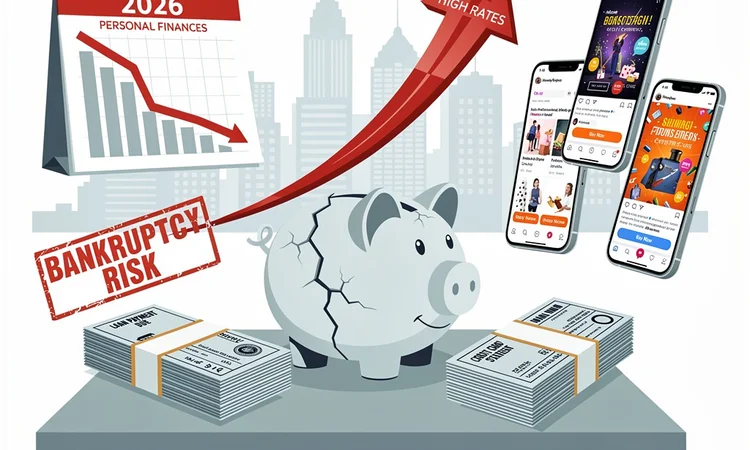
NEW YORK – On the surface, the economic life of a young American is a flurry of digital transactions and aspirational spending, broadcast daily on platforms like TikTok. But beneath the veneer of trendy hauls and financial self-help mantras like “girl math,” a precarious financial reality is taking shape, leading seasoned industry analysts to sound an alarm about a potential wave of personal bankruptcies cresting by 2026.
This isn’t idle speculation. It’s a forecast rooted in a toxic cocktail of macroeconomic pressures and generation-specific behaviors. The resumption of federal student loan payments in late 2023 added a significant monthly burden back onto the budgets of millions. This coincided with the Federal Reserve’s aggressive interest rate hikes, which have pushed credit card APRs to record highs. For a generation that increasingly relies on revolving debt to manage cash flow, this has turned minor balances into major financial drags. “You have a situation where a lot of people are going to be in financial distress,” Ed Flynn, a consultant at the American Bankruptcy Institute, warned in an interview with Business Insider , suggesting a “tsunami” of filings could be on the way.
A Perfect Storm of Economic Pressures
The data paints a concerning picture of deteriorating financial health among younger consumers. According to the Federal Reserve Bank of New York’s Quarterly Report on Household Debt and Credit, total credit card debt in the U.S. has swelled to $1.13 trillion. More troubling, however, are the delinquency rates. The report for the fourth quarter of 2023 revealed that for borrowers aged 18-29, the percentage of credit card balances transitioning into serious delinquency (90 days or more past due) shot up to 9.36%, a rate not seen since the first quarter of 2011, as noted by the New York Fed . This signals that the primary buffer for many young adults—credit—is beginning to buckle under the strain.
These delinquencies are a direct consequence of budgets stretched thin by persistent inflation and the aforementioned renewal of student debt obligations. While wage growth has occurred, for many it has not kept pace with the rising costs of essentials like housing, food, and transportation. The result is a shrinking pool of discretionary income that is increasingly diverted to servicing high-interest debt rather than building savings or wealth, creating a cycle that is difficult to escape and pushes individuals closer to insolvency.
The Digital Accelerant: Social Media and ‘Dopamine Spending’
Compounding these traditional economic woes is the powerful, and often pernicious, influence of social media. Platforms like TikTok and Instagram have become de facto financial advisors for millions of young people, but the advice is often wrapped in the logic of consumerism. Trends like “girl math” playfully justify extravagant purchases, while an endless stream of influencer content normalizes a lifestyle far beyond the means of the average viewer. This creates immense social pressure to spend, a phenomenon some psychologists label “dopamine spending”—the pursuit of a short-term mood boost from a purchase, facilitated by the frictionless nature of e-commerce and digital wallets.
This environment has proven to be fertile ground for the explosive growth of Buy Now, Pay Later (BNPL) services. Integrated seamlessly into online checkouts, services like Klarna, Afterpay, and Affirm offer the illusion of affordability by splitting payments into smaller, interest-free installments. For a generation wary of traditional credit cards, BNPL presented itself as a more responsible alternative. However, the ease of use encourages users to juggle multiple payment plans simultaneously, making it difficult to track overall debt and leading to a high incidence of missed payments, which can incur fees and damage credit scores, a risk highlighted by a Forbes Advisor analysis of the sector.
Searching for Solvency in Viral Counter-Trends
In response to this mounting pressure, a counter-movement has emerged from the same digital platforms. The “loud budgeting” trend, which went viral on TikTok, encourages transparency and vocalness about financial limitations and savings goals. Instead of quietly declining an invitation, one might say, “I can’t, it’s not in my budget—I’m saving for a down payment.” This reframes frugality as a proactive and empowering choice rather than a source of shame, aiming to dismantle the social pressure to overspend. Proponents see it as a necessary antidote to the culture of consumption.
While admirable, the question for financial institutions and credit experts is whether these behavioral shifts are potent enough to counteract the powerful macroeconomic forces at play. A recent survey from TransUnion found that 57% of U.S. consumers remained optimistic about their household finances for the coming year, but it also noted that cutting back on discretionary spending and building up savings were top priorities. This indicates a widespread awareness of financial fragility, though the chasm between intention and the ability to execute, especially when burdened by high-interest debt, remains significant.
The View from the Bankruptcy Bar
For bankruptcy professionals, the current conditions feel like a prelude. The lag between the onset of financial distress and a formal bankruptcy filing is typically 18 to 24 months. Consumers will often exhaust all other options first—draining savings, borrowing from family, and falling delinquent on multiple accounts—before seeking legal protection. This is why experts like Flynn are pointing to 2025 and 2026 as the period when the consequences of today’s high debt loads and interest rates will fully manifest in court filings. The system is bracing for an influx of younger filers, many of whom may have little experience with the legal or long-term credit implications of such a proceeding.
The nature of their debt may also complicate matters. While bankruptcy is effective at discharging unsecured debts like credit card balances and personal loans, federal student loans are notoriously difficult to discharge, requiring a separate, arduous legal process known as an adversary proceeding. This means that for many young people, bankruptcy may only offer a partial solution, leaving them to contend with significant student debt even after other liabilities are wiped clean. This reality is a critical consideration for both debtors and the financial services industry that will manage the fallout.
Implications for Lenders and the Credit Economy
For the industry insiders—banks, credit unions, and fintech lenders—this looming wave of insolvencies presents a multi-faceted challenge. The immediate concern is the prospect of rising charge-offs, which directly impact bottom-line profitability. Financial institutions are already tightening their underwriting standards for unsecured credit in response to the climbing delinquency rates. This could, paradoxically, push more vulnerable consumers toward less-regulated, higher-cost lending alternatives, potentially exacerbating their financial distress.
In the longer term, lenders must re-evaluate how they model risk for a generation whose financial lives are deeply intertwined with the digital world. Traditional credit scoring may not fully capture the risks associated with BNPL stacking or the volatility of income from the gig economy. The potential for increased regulatory scrutiny, particularly around the marketing and transparency of BNPL products, is also growing, as regulators like the Consumer Financial Protection Bureau (CFPB) have taken a keen interest in the sector, according to reports from outlets like Bloomberg . The coming years will be a crucial test of the resilience of not only young American consumers, but also the credit systems that have both enabled their spending and exposed them to unprecedented levels of risk.






Leave a Reply
Your email address will not be published.