








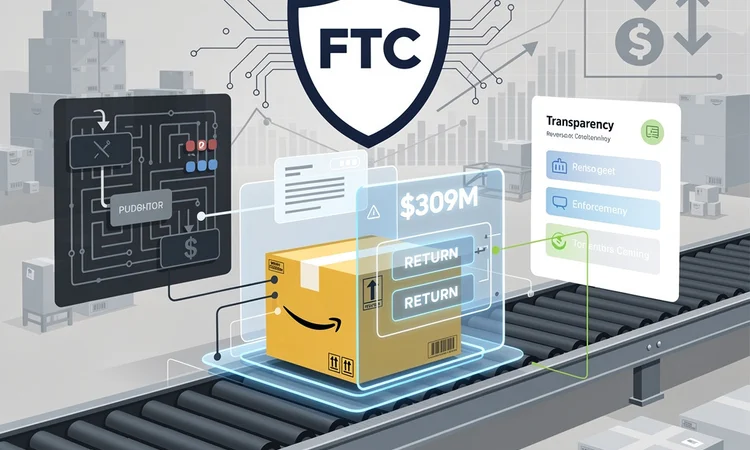
The era of frictionless, consequence-free e-commerce returns has hit a substantial regulatory wall. Amazon.com Inc. has agreed to a $309 million settlement to resolve allegations regarding its return policies and the transparency of restocking fees, marking one of the most significant consumer protection payouts in the retailer’s history. For industry observers, this settlement is not merely a line item in a quarterly earnings report; it acts as a bellwether for the tightening regulatory environment surrounding "dark patterns" and the operational realities of reverse logistics. The settlement addresses claims that the e-commerce giant obfuscated deduction fees from customer refunds, effectively shifting the soaring costs of return processing onto the consumer without adequate disclosure.
While Amazon has long been the gold standard for customer obsession, this payout signals a shift in how the company balances user experience with the brutal economics of returns. The allegations centered on the user interface (UI) design during the return initiation process, which regulators argued misled consumers into believing returns were entirely free, only for restocking or shipping fees to be deducted from the final refund amount. As reported by Slashdot , the $309 million fund will be distributed to affected U.S. shoppers, closing a chapter on a dispute that highlights the friction between interface design and consumer transparency laws.
The Mechanics of Obfuscation and Dark Patterns
At the heart of the complaint is the concept of "dark patterns"—user interface design choices that coerce, steer, or deceive users into making unintended decisions. In this specific case, the scrutiny focused on the granularity of the "estimated refund" screen. Industry insiders familiar with e-commerce UX flows know that the distance between a "Free Returns" banner and the fine print regarding third-party seller restocking fees can be legally perilous. The settlement implies that Amazon’s systems did not sufficiently flag when a specific return reason or method would trigger a deduction, effectively blindsiding the consumer at the point of credit issuance.
This creates a significant precedent for the broader e-commerce sector. Retailers have historically relied on the Terms of Service to cover the nuances of restocking fees, particularly for electronics or opened goods. However, this settlement suggests that passive disclosure is no longer sufficient. The Federal Trade Commission (FTC) has been increasingly aggressive under Chair Lina Khan regarding digital deception, and this payout reinforces the mandate that material terms—specifically those affecting the consumer’s wallet—must be presented unavoidably within the transaction flow, not buried in a hyperlink.
The Economic Imperative of Returns Mitigation
To understand why Amazon pushed the envelope on return cost recovery, one must look at the macroeconomics of reverse logistics. During the pandemic boom, returns were a manageable operational expense offset by massive volume. As growth normalized, the cost of processing a return—shipping, inspecting, repackaging, and potentially liquidating—began to erode margins. Industry data suggests that the cost to process a return can range from 20% to 65% of the cost of goods sold (COGS). By subtly passing some of these costs back to the consumer, Amazon was attempting to plug a multi-billion dollar leak in its fulfillment network.
The settlement forces a re-evaluation of this strategy. Amazon has already begun implementing more overt measures to curb serial returners, such as flagging "frequently returned" items and charging fees for returns made via UPS Store drop-offs when a free option like Whole Foods is available. These overt measures are legally safer than the hidden deductions that led to the $309 million fine. As noted in broader coverage of retail trends by CNBC , the shift from "growth at all costs" to "profit protection" is driving retailers to end the era of free returns, but they must now do so with explicit transparency to avoid regulatory wrath.
Regulatory Scrutiny and the Khan Doctrine
This settlement cannot be viewed in isolation from the wider antitrust and consumer protection war being waged by the FTC against Big Tech. The agency has explicitly targeted the manipulative use of design to undermine consumer choice. While the "Prime" cancellation lawsuit focused on the friction of leaving the ecosystem, this returns settlement focuses on the financial opacity within it. The message to the industry is clear: friction designed to save the company money (by discouraging returns) or generate revenue (by hiding fees) will be treated as a deceptive trade practice.
For legal departments at major retailers like Walmart, Target, and Best Buy, the Amazon settlement serves as an expensive case study. It necessitates a complete audit of the returns UX. Every step of the digital return merchandise authorization (RMA) process must now be scrutinized for clarity. If a consumer selects "Changed Mind" versus "Defective," the dynamic update of the refund total must be instantaneous and prominent. The days of adjusting the refund amount post-receipt at the fulfillment center without prior explicit consent are effectively over.
Operational Fallout for Third-Party Sellers
A critical, often overlooked aspect of this development is its impact on Amazon’s third-party marketplace (3P) sellers. These sellers, who account for more than 60% of units sold on the platform, often bear the brunt of return costs. The settlement likely stems, in part, from the complex interplay between Amazon’s A-to-z Guarantee and the individual return policies of 3P sellers. When Amazon enforces a refund on behalf of a seller but fails to transparently communicate the seller’s restocking fee to the buyer, it creates a dissonance that results in consumer complaints.
Moving forward, Amazon will likely tighten the standardization of return policies across its marketplace. This could reduce the autonomy of 3P sellers to set their own restocking parameters, forcing them into a uniform, Amazon-dictated structure to ensure compliance with the transparency standards mandated by this settlement. According to analysis from Marketplace Pulse , sellers are already grappling with increased fulfillment fees; a forced standardization of return fees that favors consumer clarity over seller protection could further compress margins for small businesses relying on the platform.
The End of the Infinite Wardrobe
Culturally, this settlement marks a turning point in consumer behavior. For a decade, shoppers were trained to treat their living rooms as fitting rooms, ordering multiple sizes and colors with the intention of returning most of them. This behavior was subsidized by opaque logistics pricing models. The $309 million penalty forces Amazon to be honest about the cost of this behavior. When consumers are explicitly shown—in bold text—that returning a perfectly good item will cost them $5.99 in restocking fees, conversion rates may drop, but net profitability per unit may rise.
This transparency paradox—where telling the truth about fees hurts top-line sales but helps the bottom line—is the new reality for e-commerce. Retailers must navigate the fine line between discouraging return abuse and maintaining customer loyalty. The "surprise" of a lower refund was the toxicity that led to this settlement. By moving the pain point to the front of the transaction (the return initiation screen), Amazon risks increasing cart abandonment or reducing purchase frequency, a trade-off they are now legally compelled to make.
Technological Solutions and AI Integration
In response to the compliance requirements driven by this settlement, we can expect an accelerated investment in AI-driven sizing tools and virtual try-on technology. If Amazon cannot hide the cost of returns, it must reduce the volume of returns. Reducing the rate of "bracketing" (buying multiple versions of the same item) becomes an urgent financial priority. Technologies that were once considered novelties are now essential margin-protection tools. By providing better pre-purchase information, Amazon can argue it is acting in good faith to minimize the need for returns in the first place.
Furthermore, the backend logic of the RMA systems will need to become more sophisticated. The system must be able to dynamically calculate the net refund based on real-time logic (item weight, shipping zone, seller policy, return reason) and present it to the user with binding certainty. This requires a level of data integration between the logistics layer and the frontend UX that many legacy e-commerce platforms struggle to achieve. Amazon, with its AWS backbone, is uniquely positioned to solve this, but the engineering debt involved in retrofitting transparency into a complex marketplace is immense.
Looking Ahead: The Compliance Moat
Ultimately, this $309 million settlement creates a "compliance moat." While Amazon can absorb the financial hit, smaller e-commerce competitors may struggle to match the rigorous transparency standards now being set. If the FTC uses the Amazon standard as the baseline for the entire industry, the operational overhead for managing compliant returns processes will increase for everyone. Direct-to-consumer (DTC) brands, which often use third-party logistics providers (3PLs), will need to ensure their software stacks can handle the granular disclosure requirements that Amazon is now implementing.
The settlement is a stern reminder that in the digital economy, the user interface is the contract. Every pixel, every button placement, and every omission carries legal weight. As Amazon writes the check to U.S. shoppers, the rest of the retail world is frantically checking their own code, ensuring that their pursuit of seamless transactions hasn’t inadvertently crossed the line into deceptive design. The days of hiding the cost of doing business are officially over.






Leave a Reply
Your email address will not be published.