







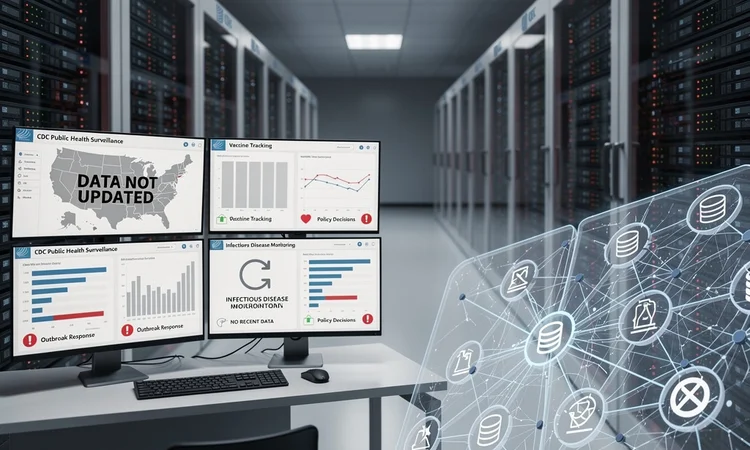
The Centers for Disease Control and Prevention, America’s premier public health agency, is facing a crisis that has largely escaped public attention: dozens of its critical databases have gone dark, leaving health officials, researchers, and policymakers flying blind on issues ranging from vaccination rates to disease outbreaks. According to a comprehensive analysis published by NBC News , nearly half of the databases the CDC previously maintained are no longer being updated, with the majority of dormant systems related to vaccine tracking and infectious disease surveillance.
The scope of the breakdown is staggering. The investigation revealed that out of approximately 100 databases the CDC historically maintained, roughly 48 have ceased regular updates. These aren’t peripheral systems tracking obscure metrics—they include fundamental surveillance tools that public health departments across the country have relied upon for decades to make critical decisions about resource allocation, outbreak response, and vaccination campaigns. The databases cover everything from COVID-19 vaccination rates and RSV hospitalizations to influenza surveillance and childhood immunization tracking.
What makes this situation particularly alarming is the timing. The deterioration of these surveillance systems comes at a moment when public health infrastructure faces unprecedented challenges, from emerging infectious diseases to declining vaccination rates and growing vaccine hesitancy. Without accurate, timely data, health officials are essentially making decisions in the dark, unable to identify outbreaks early, track disease trends, or measure the effectiveness of interventions. The implications extend far beyond government agencies—academic researchers, pharmaceutical companies, healthcare providers, and local health departments all depend on CDC data to inform their work.
The Roots of Systemic Failure
The database crisis didn’t emerge overnight. Multiple factors have converged to create what experts describe as a perfect storm of institutional dysfunction. Budget constraints have plagued the CDC for years, with the agency’s funding remaining essentially flat in inflation-adjusted terms even as its responsibilities have expanded dramatically. The COVID-19 pandemic exposed and exacerbated these underlying weaknesses, stretching the agency’s resources to the breaking point while simultaneously demonstrating the critical importance of robust disease surveillance.
Internal reorganizations have also played a significant role. The CDC has undergone multiple structural changes in recent years, with shifting priorities and leadership transitions creating confusion about which departments are responsible for maintaining specific databases. Sources familiar with the agency’s operations, speaking on condition of anonymity, describe a situation where institutional knowledge has been lost as experienced staff have departed, leaving behind systems that newer employees don’t fully understand or know how to maintain. The technical debt has accumulated to the point where some databases are running on outdated software platforms that few current staff members know how to operate.
Vaccine Surveillance Takes the Hardest Hit
The concentration of defunct databases in vaccine-related areas is particularly concerning given the current public health environment. Systems that once tracked vaccination rates in near real-time across different demographics and geographic regions have fallen silent, making it impossible to identify communities with dangerously low immunization coverage before outbreaks occur. This blind spot comes at a time when measles, whooping cough, and other vaccine-preventable diseases are experiencing resurgences in various parts of the country.
The COVID-19 vaccination tracking systems, which were hastily built during the pandemic and initially provided detailed information about vaccination progress, have also deteriorated significantly. What was once a comprehensive system providing daily updates on vaccination rates by age, race, and location has devolved into sporadic updates with incomplete data. Public health officials who previously relied on these systems to target vaccination campaigns and identify vulnerable populations now find themselves working with information that may be weeks or months out of date, if available at all.
The Ripple Effects Across Public Health
The consequences of these database failures extend far beyond the CDC itself. State and local health departments, which have historically looked to the CDC as the authoritative source for disease surveillance data, are now forced to develop their own tracking systems or operate without reliable national benchmarks. This fragmentation creates inefficiencies and makes it difficult to compare disease trends across different jurisdictions or coordinate regional responses to outbreaks.
Academic researchers who depend on CDC data for epidemiological studies are finding their work stymied by the lack of reliable information. Grant applications that would have routinely used CDC databases as primary data sources now face questions about data availability and quality. Long-term research projects tracking disease trends over time are being disrupted, potentially losing years of continuity. The pharmaceutical industry, which uses CDC surveillance data to inform vaccine development and distribution strategies, is similarly hampered by the information gap.
Technical Infrastructure and Modernization Challenges
Behind the database failures lies a deeper story of technological obsolescence. Many of the CDC’s data systems were built decades ago using programming languages and database architectures that are now considered legacy technology. Maintaining these systems requires specialized expertise that is increasingly difficult to find as programmers with knowledge of older systems retire or move to private sector jobs offering higher salaries. The agency has struggled to recruit and retain the technical talent needed to both maintain existing systems and build modern replacements.
Efforts to modernize the CDC’s data infrastructure have been announced repeatedly over the years, but progress has been slow and uneven. The Data Modernization Initiative, launched with considerable fanfare, has faced numerous setbacks including budget shortfalls, technical challenges, and bureaucratic obstacles. While some new systems have been successfully deployed, the pace of modernization has not kept up with the rate of deterioration in existing databases, resulting in a net loss of surveillance capacity.
Political and Organizational Pressures
The database crisis is unfolding against a backdrop of intense political scrutiny and organizational upheaval at the CDC. The agency has faced criticism from multiple directions—from those who believe it overstepped its authority during the pandemic and those who argue it didn’t do enough. This political pressure has created an environment where maintaining routine surveillance systems takes a back seat to responding to immediate crises and addressing congressional inquiries.
Recent leadership changes and proposed reorganizations have added to the uncertainty. Staff members report low morale and confusion about priorities, with some describing a sense that maintaining databases is seen as unglamorous work that doesn’t receive adequate recognition or resources. The institutional focus has shifted toward high-profile initiatives and crisis response, while the unglamorous but essential work of maintaining surveillance infrastructure has been neglected.
The Path Forward Remains Uncertain
Public health experts warn that restoring the CDC’s surveillance capabilities will require more than just additional funding—it will demand a fundamental rethinking of how the agency approaches data infrastructure. Some advocate for a complete overhaul of the CDC’s technical systems, arguing that piecemeal fixes to aging databases are no longer sufficient. Others emphasize the need for better coordination with state and local health departments to create a more distributed surveillance network that doesn’t rely solely on federal systems.
There are also calls for greater transparency about which databases are functional and which are not. Currently, there is no comprehensive public inventory of CDC databases and their operational status, making it difficult for data users to know what information is reliable and what isn’t. Creating such an inventory would be a first step toward accountability and could help prioritize restoration efforts based on public health impact.
Implications for Future Pandemic Preparedness
Perhaps the most sobering aspect of the database crisis is what it reveals about America’s readiness for the next major public health emergency. The COVID-19 pandemic demonstrated the critical importance of robust disease surveillance systems, yet the very systems that should have been strengthened in the pandemic’s wake are instead deteriorating. If another novel pathogen emerges, the country will be even less prepared to track its spread than it was in 2020.
The situation also raises questions about the broader state of America’s public health infrastructure. If the CDC, with its national prominence and relatively substantial budget, cannot maintain basic surveillance systems, what does that say about the state of health departments at the state and local level? Many of these agencies operate with even more severe resource constraints and face similar challenges with aging technology and staff retention. The database crisis at the CDC may be just the most visible symptom of a much larger problem affecting public health infrastructure across the country.
As the nation grapples with ongoing health challenges from infectious diseases to chronic conditions, the loss of reliable surveillance data represents more than a technical problem—it’s a fundamental threat to the country’s ability to protect public health. Without accurate information about disease trends, vaccination rates, and health outcomes, policymakers are making decisions based on incomplete or outdated information, potentially missing opportunities for early intervention and allowing preventable outbreaks to gain momentum. The restoration of these critical databases isn’t just an administrative priority; it’s an urgent public health necessity that will require sustained attention, adequate resources, and a renewed commitment to the unglamorous but essential work of disease surveillance.






Leave a Reply
Your email address will not be published.