







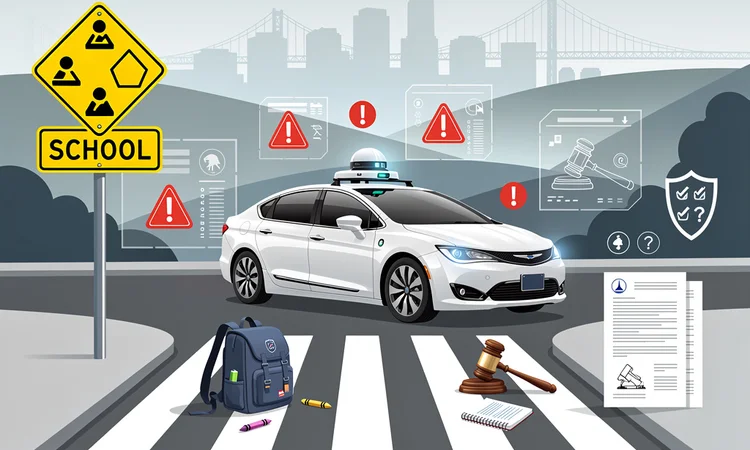
The collision between a Waymo autonomous vehicle and an elementary school student in San Francisco has reignited fundamental questions about the readiness of self-driving technology for widespread deployment, casting a shadow over an industry that has spent billions convincing regulators and the public that its systems are safer than human drivers. The incident, which occurred in a school zone, represents a critical test case for how autonomous vehicle companies handle accountability when their technology fails in scenarios involving the most vulnerable road users.
According to Futurism , the Waymo vehicle struck a child in what the company described as a low-speed incident. While the child’s injuries were reportedly minor, the event has amplified concerns among safety advocates, parents, and transportation officials about whether autonomous vehicles can reliably detect and respond to unpredictable pedestrian behavior, particularly that of children. The incident comes at a pivotal moment for Waymo, which has been expanding its robotaxi operations across multiple cities and positioning itself as the industry leader in safe autonomous transportation.
The timing of this collision is particularly significant given Waymo’s aggressive expansion strategy. The Alphabet-owned company has been scaling its driverless taxi service in San Francisco, Phoenix, and Los Angeles, completing hundreds of thousands of paid rides. Industry observers note that as autonomous vehicle companies increase their operational footprint, the statistical likelihood of incidents involving vulnerable road users inevitably rises, making robust safety protocols and transparent incident reporting more critical than ever.
The Engineering Challenge of Predicting Child Behavior
Autonomous vehicle systems face unique challenges when it comes to detecting and predicting the behavior of children. Unlike adult pedestrians who generally follow predictable patterns when crossing streets, children are more likely to dart into traffic unexpectedly, change direction suddenly, or fail to recognize hazardous situations. The machine learning algorithms that power self-driving cars are trained on vast datasets of road scenarios, but edge cases involving unpredictable child behavior remain among the most difficult to model effectively.
Transportation safety experts have long warned that school zones represent particularly complex environments for autonomous systems. These areas combine multiple risk factors: reduced speed limits that may not match the flow of surrounding traffic, increased pedestrian activity during specific time windows, the presence of crossing guards whose hand signals must be interpreted correctly, and the unpredictable movements of children who may be distracted or excited. The convergence of these factors creates scenarios that challenge even experienced human drivers, let alone artificial intelligence systems still learning to navigate the nuances of urban environments.
Regulatory Scrutiny Intensifies as Incidents Accumulate
The Waymo incident adds to a growing list of autonomous vehicle collisions that have drawn regulatory attention. California’s Department of Motor Vehicles and the National Highway Traffic Safety Administration both maintain reporting requirements for autonomous vehicle incidents, but critics argue that current regulations lack the teeth necessary to ensure comprehensive safety oversight. The patchwork of state and federal rules governing self-driving cars has created inconsistencies in how incidents are investigated, reported, and addressed.
Federal regulators have been walking a tightrope between fostering innovation in autonomous vehicle technology and ensuring public safety. The Biden administration has signaled support for the development of self-driving technology as part of its broader transportation and climate goals, but incidents involving pedestrians, particularly children, create political pressure for stricter oversight. Industry insiders suggest that a major incident resulting in serious injury or death could trigger a regulatory backlash that might significantly slow the deployment of autonomous vehicles nationwide.
The Liability Question That Keeps Insurers Awake
When an autonomous vehicle strikes a pedestrian, the question of liability becomes exponentially more complex than in traditional auto accidents. Is the vehicle manufacturer responsible? The software developer? The company operating the robotaxi service? The municipality that permitted autonomous vehicle testing on public roads? These questions have significant implications for insurance markets, legal precedents, and the future viability of autonomous vehicle business models.
Insurance industry analysts note that the liability framework for autonomous vehicles remains underdeveloped in most jurisdictions. Traditional auto insurance is predicated on human driver error, but when the driver is an AI system, the calculus changes fundamentally. Some legal experts argue that autonomous vehicle incidents should be treated as product liability cases, similar to defective consumer products, while others contend that a new category of insurance and liability is needed. The resolution of these questions will likely require years of litigation and legislative action, creating uncertainty for companies investing heavily in autonomous technology.
Waymo’s Response Strategy and Transparency Challenges
In the aftermath of the incident, Waymo’s public response has been closely scrutinized by industry observers, safety advocates, and competitors. The company has emphasized its commitment to safety and cooperation with authorities, but critics argue that autonomous vehicle companies have been selectively transparent about incidents, often releasing minimal information while touting their overall safety records. This approach, while perhaps understandable from a legal and public relations standpoint, undermines public trust at a time when autonomous vehicle companies need to build confidence in their technology.
The broader autonomous vehicle industry faces a collective action problem when it comes to incident reporting and transparency. While individual companies may benefit from downplaying negative incidents, the industry as a whole suffers when patterns of safety concerns emerge without adequate explanation or corrective action. Some industry veterans advocate for the creation of an independent safety board, similar to the National Transportation Safety Board, specifically focused on autonomous vehicle incidents and empowered to conduct thorough investigations and issue public recommendations.
The Technology’s Promise Versus Present-Day Limitations
Proponents of autonomous vehicle technology argue that isolated incidents should be evaluated in the context of overall safety performance compared to human drivers. They point to statistics showing that human error causes the vast majority of traffic accidents, resulting in tens of thousands of deaths annually in the United States alone. From this perspective, autonomous vehicles need not be perfect; they merely need to be safer than the alternative. However, this utilitarian calculus becomes more difficult to defend when incidents involve children in school zones, scenarios where the public expects maximum caution and where the consequences of failure are particularly tragic.
The technical challenges facing autonomous vehicle developers are formidable. Computer vision systems must reliably detect pedestrians in varying lighting conditions, weather, and visual clutter. Prediction algorithms must anticipate potential movements seconds in advance. Decision-making systems must balance multiple competing objectives: maintaining traffic flow, ensuring passenger comfort, and above all, preventing collisions. These systems must perform flawlessly across millions of miles of driving, because even a small failure rate becomes significant when scaled across an entire fleet operating in dense urban environments.
Market Implications and Investor Confidence
The financial stakes in autonomous vehicle development are staggering. Companies have invested tens of billions of dollars in the technology, betting that self-driving vehicles will revolutionize transportation, logistics, and urban planning. Waymo alone has received billions in funding from Alphabet and external investors. Incidents that raise questions about safety and readiness can impact investor confidence, potentially slowing the flow of capital to the sector and delaying the timeline for widespread commercialization.
Wall Street analysts who cover the autonomous vehicle sector note that the path to profitability remains uncertain for most companies in the space. The economics of robotaxi services depend on achieving scale while maintaining safety standards that satisfy regulators and the public. Each incident that generates negative publicity makes that balance more difficult to achieve, potentially extending the timeline to profitability and increasing the capital requirements for companies that are already burning through cash at prodigious rates. Some analysts suggest that a consolidation in the sector is inevitable, with only the best-capitalized and technologically advanced companies surviving to see widespread commercialization.
The Path Forward for Autonomous Vehicle Safety
Moving forward, the autonomous vehicle industry faces critical decisions about how to address safety concerns while continuing to advance the technology. Some experts advocate for a more gradual deployment approach, with autonomous vehicles initially restricted to specific routes, weather conditions, or times of day until they demonstrate consistent safety performance. Others argue that real-world testing is essential for improving the technology and that overly restrictive regulations will simply push development to jurisdictions with lighter oversight, potentially compromising safety in the long run.
The incident involving the Waymo vehicle and the elementary school student serves as a sobering reminder that autonomous vehicle technology, despite remarkable advances, still faces significant challenges in handling the full complexity of urban traffic environments. As the industry continues to grow and autonomous vehicles become more common on public roads, the imperative for rigorous safety standards, transparent incident reporting, and continuous technological improvement has never been greater. The question is no longer whether autonomous vehicles will become a significant part of the transportation system, but rather how quickly they can achieve the safety performance necessary to earn and maintain public trust while navigating the inevitable challenges that arise when cutting-edge technology meets the unpredictable reality of human behavior on city streets.






Leave a Reply
Your email address will not be published.