








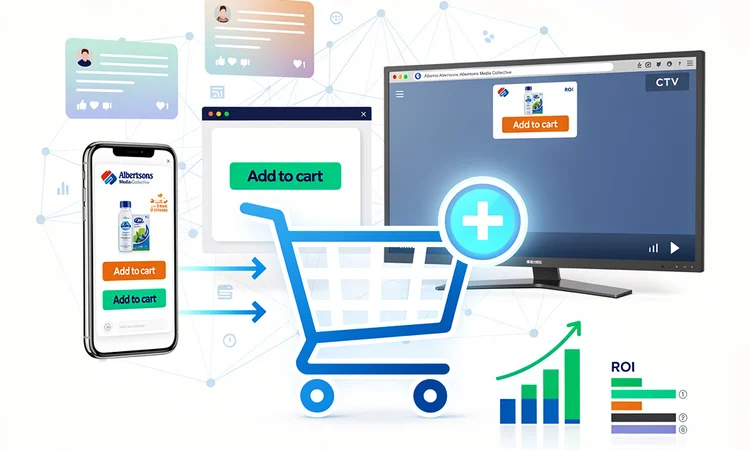
Albertsons Cos. is deploying a new advertising tool called Add-It, designed to bridge the gap between digital impressions and actual purchases in the offsite retail media arena. This beta program, launched by the grocer’s Albertsons Media Collective, allows consumers viewing display ads or shoppable content across the open web to instantly drop products, recipes, coupons, or offers directly into their Albertsons online shopping carts. The move addresses a persistent pain point in retail media networks: the high abandonment rate between ad exposure and checkout.
Retail media spending is exploding, with global projections reaching $184 billion this year and surpassing $300 billion by 2030, according to recent forecasts cited in industry reports. Yet, offsite ads—those running outside a retailer’s owned properties—often fail to convert because shoppers must navigate multiple steps to buy. Add-It aims to slash that friction, transforming passive browsing into immediate action. ‘This is about making media shoppable,’ an Albertsons executive told Adweek .
The technology integrates with Albertsons’ just-for-you personalization engine, which powers tailored shopping experiences across its 2,200-plus stores. Early tests with brands like General Mills have shown promising results, with the grocer reporting streamlined paths to purchase that boost return on ad spend.
Frictionless Path Reshapes Advertiser ROI
At its core, Add-It tackles the ‘cold start’ problem in offsite retail media, where consumers encounter ads on third-party sites without an established shopping session. A single click on the Add-It button authenticates the user via Albertsons’ login and populates their cart, eliminating manual searches and logins. This mirrors innovations like Amazon’s ‘Buy Now’ but extends them to a fragmented web environment.
Albertsons Media Collective positions this as part of a broader ‘frictionless commerce’ strategy. The network, which generated over $1 billion in revenue last year, now extends its closed-loop measurement capabilities to offsite channels. Advertisers gain visibility into how impressions drive incremental sales, a key differentiator as competition intensifies from players like Walmart Connect and Kroger Precision Marketing.
Expansion plans are aggressive: after display ads and shoppable content, Add-It rolls out to connected TV and social media in 2026. ‘We’re evolving retail media into retail services,’ said an Albertsons leader in a Beet.TV interview, hinting at deeper integrations with loyalty data and in-store fulfillment.
Tech Stack Powers Seamless Execution
Behind Add-It lies Albertsons’ proprietary tech, including its owned digital shelf and AI-driven recommendations. The system leverages first-party data from 35 million loyalty households to serve hyper-targeted ads. When a user clicks Add-It, it pulls product details, pricing, and availability in real-time, accounting for promotions and substitutions.
This isn’t Albertsons’ first foray into innovative formats. Earlier this year, the company launched an in-store digital display network with STRATACACHE, featuring screens for dynamic ads from brands like Mondelēz. Combined with video solutions from Criteo that delivered a 460% sales lift, per Retail Customer Experience , these efforts underscore a multi-channel push.
General Mills emerged as the launch partner, testing Add-It to drive trial of new products. ‘It closes the loop from awareness to basket,’ a brand spokesperson noted in Grocery Dive , highlighting how the tool feeds directly into Albertsons’ fulfillment network, including same-day delivery via partnerships with Instacart.
Competitive Pressures Mount in Grocery Ad Wars
Albertsons faces stiff rivalry in the $50 billion U.S. retail media market. Walmart’s offsite expansions and Kroger’s post-merger ambitions loom large, while Amazon dominates with 80% share. Yet Albertsons differentiates through its regional footprint and exclusive CPG partnerships. Add-It’s beta, currently live for select advertisers, promises measurable lift: early metrics show double-digit increases in add-to-cart rates compared to traditional display units.
Posts on X from industry watchers, including Adweek, amplified the launch, with one noting, ‘.@Albertsons is rolling out a beta program for a new offsite ad format called “Add-It” that lets consumers add the products promoted to a shopping cart.’ This buzz aligns with broader trends, as eMarketer reports Albertsons’ investments are attracting more CPG budgets amid slowing grocery traffic.
Challenges remain. Privacy regulations like state-level data laws could complicate cross-site authentication, and scaling to CTV requires robust attribution models. Still, Albertsons’ closed-loop data—tracking from ad view to in-store redemption—gives it an edge, as validated in pilots with Chobani via NBCUniversal, per Grocery Dive .
Implications for CPG Brands and Shoppers
For CPG marketers, Add-It means reallocating budgets from awareness to performance. Traditional offsite media often yields low conversion; this tool could shift 20-30% of spend, analysts predict. Brands gain granular insights, like which creatives drive highest basket velocity, fueling iterative campaigns.
Shoppers benefit from relevance: ads now lead to effortless addition of meal kits or pantry staples, synced with loyalty perks. Albertsons reports higher engagement among its forU members, who opt-in for personalized nudges. As one executive put it to eMarketer , ‘A speedier path to purchase is a major selling point for advertisers.’
The rollout coincides with holiday peaks, with Albertsons’ weekly ads promoting deals that Add-It can amplify offsite. Long-term, this positions the grocer as a commerce enabler, blurring lines between media and retail operations.
Broader Industry Ripples
Add-It’s debut signals a maturation of retail media, moving beyond onsite dominance to true omnichannel activation. Competitors like Target’s Roundel are watching closely, with whispers of similar buttons in development. For Albertsons, still navigating FTC scrutiny on its Kroger merger bid, tech wins like this bolster its standalone value proposition.
Success hinges on adoption. If betas convert at scale, expect a flurry of copycats. As Supermarket News detailed, ‘New “Add-It” technology transforms passive impressions into shoppable actions.’ This could redefine ROI benchmarks, pressuring networks without such capabilities.
Ultimately, Add-It exemplifies how grocers are weaponizing data and UX to capture media dollars, ensuring every impression inches closer to revenue.






Leave a Reply
Your email address will not be published.