






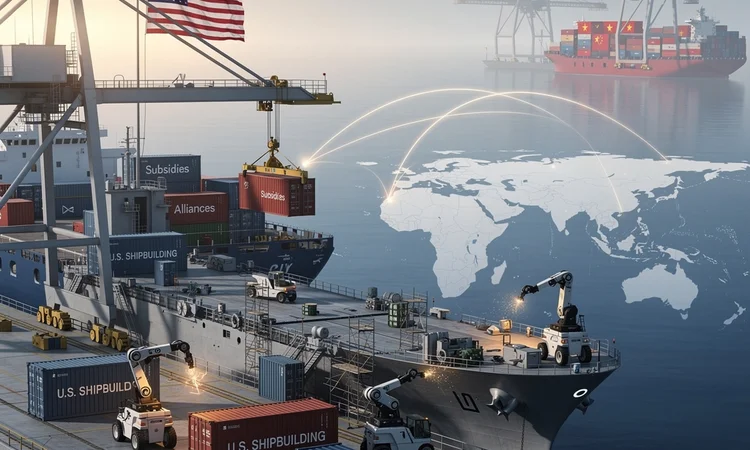
In the shadow of China’s shipbuilding juggernaut, President Donald Trump is unleashing a bold campaign to resurrect America’s dormant yards. Echoing his ‘Make America Great Again’ rallying cry, the initiative—dubbed ‘Make U.S. Shipbuilding Great Again’—aims to claw back maritime supremacy through tariffs, subsidies and international alliances. Recent moves signal a seismic shift, with the U.S. Navy eyeing massive contracts and private yards gearing up for a boom.
China commands over 50% of global shipbuilding capacity, churning out vessels at a pace that dwarfs the U.S., which holds less than 1%, according to data from [CNBC](https://www.cnbc.com/2025/12/14/trump-america-shipbuilding-china-competition.html). Trump’s strategy hinges on port fees targeting Chinese-built ships and incentives for domestic production, a plan detailed in executive orders and backed by bipartisan polls showing 72% American support, as reported by [Reuters](https://www.reuters.com/world/most-americans-back-trump-push-rebuild-us-shipbuilding-better-compete-with-china-2025-03-21/). Industry insiders see this as a generational pivot.
The push gained steam with a March 2025 executive order calling for a ‘wholesale overhaul’ of U.S. maritime sectors, per [USNI News](https://news.usni.org/2025/03/05/trumps-make-shipbuilding-great-again-order-calls-for-wholesale-overhaul-of-u-s-maritime-industry). This directive tasks federal agencies with crafting a six-month action plan to bolster commercial and military output, addressing decades of underinvestment that left U.S. yards idled while Beijing’s facilities hummed.
China’s Overwhelming Edge
Beijing’s shipyards delivered 1,700 vessels last year, compared to America’s handful, fueled by state subsidies and low labor costs. U.S. officials warn this gap threatens national security, as reliance on foreign hulls hampers naval expansion amid rising tensions in the Pacific. ‘China’s shipbuilding sector has established dominance,’ notes a White House draft cited by [USNI News](https://news.usni.org/2025/03/05/trumps-make-shipbuilding-great-again-order-calls-for-wholesale-overhaul-of-u-s-maritime-industry).
Tariffs on steel imports have already revived segments of the supply chain, with domestic production surging under prior Trump policies. Now, proposals for 15-25% port fees on Chinese ships aim to price them out of U.S. waters, per [Bloomberg](https://www.bloomberg.com/news/articles/2025-10-21/us-china-port-fees-can-trump-make-american-shipbuilding-great-again). Shippers decry the costs, but proponents argue it’s essential for sovereignty.
Experts like Johnathan Ward, a China analyst, highlight the urgency: ‘The U.S. is finally responding,’ as quoted in older Trump posts on X, underscoring a consistent theme from 2019 that resonates today.
Allies in the Arsenal
Trump is courting South Korea, the world’s second-largest builder, for joint ventures. ‘On an island off its southern coast, South Korea is doing the kind of shipbuilding that President Donald Trump envisions for the United States,’ reports [NBC News](https://www.nbcnews.com/world/asia/trump-wants-make-america-shipbuilding-great-turning-ally-help-rcna240413). Talks focus on technology transfers and co-production to fast-track U.S. capabilities.
Domestic yards like Huntington Ingalls and General Dynamics are ramping up, with Navy plans for 30 new warships by 2030. Yet challenges loom: skilled labor shortages and regulatory hurdles could delay progress. A new White House shipbuilding office, outlined in the executive order, aims to streamline approvals.
Polls reflect public buy-in, with most Americans favoring rebuilding to counter China, according to [Reuters](https://www.reuters.com/world/most-americans-back-trump-push-rebuild-us-shipbuilding-better-compete-with-china-2025-03-21/). Bipartisan backing in Congress could unlock billions in funding.
Funding the Fleet Revival
The maritime action plan targets $10 billion in initial investments, blending public funds with private capital. Tax credits for U.S.-built ships and penalties for foreign ones form the carrot-and-stick approach. ‘It will not happen overnight and will require allies,’ cautions [CNBC](https://www.cnbc.com/2025/12/14/trump-america-shipbuilding-china-competition.html).
Historical precedents abound: Reagan-era investments doubled naval tonnage. Today’s effort scales that ambition, with Trump vowing to end foreign dependency. Industry leaders at Newport News Shipbuilding report order backlogs growing 20% post-election.
China’s response has been muted, but analysts predict retaliatory subsidies. U.S. ports handled 40% Chinese-built containerships last year; fees could redirect $50 billion in trade flows.
Workforce and Tech Imperatives
America’s yards employ just 100,000, versus China’s millions. Trump’s plan includes vocational programs and immigration tweaks for welders and engineers. Automation and AI integration promise efficiency gains, drawing from Korean models.
Military needs drive urgency: The Navy’s fleet must hit 355 ships, but aging infrastructure lags. Recent contracts for Virginia-class submarines signal commitment, with spillovers to commercial sectors.
Private players like Philly Shipyard eye LNG carriers and offshore wind vessels, sectors ripe for growth amid energy transitions.
Global Ripples and Risks
Europe watches warily, as U.S. revival could disrupt alliances. Japan’s Mitsubishi Heavy Industries explores partnerships, per web reports. Beijing’s dominance stems from 1990s WTO entry, which flooded markets with cheap steel.
Risks include inflation from higher shipping costs and supply chain snarls. Yet proponents like Sen. Roger Wicker argue security trumps economics: ‘We cannot remain dependent on China.’
Progress metrics include yard utilization rates, projected to rise 50% by 2027 under optimistic forecasts from [Biztoc](https://biztoc.com/x/8fb02c0f85bc8256).
Path Forward
By mid-2026, the action plan’s milestones—new yards online, first ally-built hulls delivered—will test resolve. Trump’s December pledges, amid CNBC coverage, frame this as a MAGA cornerstone. For insiders, it’s a high-stakes bet on American ingenuity reclaiming the seas.






Leave a Reply
Your email address will not be published.