






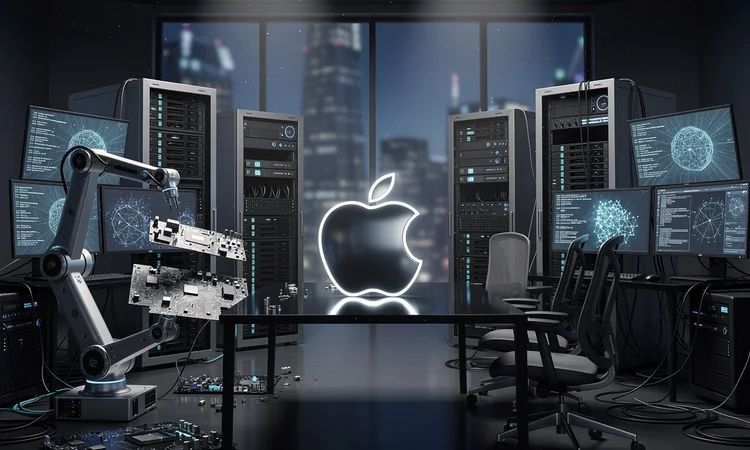
Apple Inc. is hemorrhaging artificial intelligence expertise at a critical juncture in its technological evolution, with another wave of departures threatening the company’s ambitions to compete with rivals in the rapidly evolving AI sector. The latest exodus includes key researchers and a senior Siri executive, marking a troubling pattern for a company that has historically prided itself on employee retention and technological innovation.
According to Bloomberg , the departures represent a continuation of talent losses that have plagued Apple’s AI divisions over the past several years. The company’s struggles to maintain its artificial intelligence workforce come at a time when competitors like Google, Microsoft, and OpenAI are aggressively recruiting top-tier talent and pushing the boundaries of what AI systems can accomplish. For Apple, which built its reputation on being first to market with revolutionary products, the talent drain raises questions about whether the iPhone maker can maintain its competitive edge in an industry increasingly defined by machine learning capabilities.
The timing of these departures is particularly significant as Apple attempts to integrate more sophisticated AI features across its product ecosystem. The company’s recent push into generative AI, branded as Apple Intelligence, has been met with mixed reviews from both consumers and industry analysts who note that Apple’s offerings lag behind those of its competitors in terms of capabilities and innovation.
The Siri Problem: Years of Stagnation Come Home to Roost
At the heart of Apple’s AI struggles lies Siri, the voice assistant that once represented the cutting edge of consumer-facing artificial intelligence but has since fallen dramatically behind competitors. The departure of a senior Siri executive, as reported by Bloomberg, underscores the challenges Apple faces in revitalizing a product that many users find frustratingly limited compared to alternatives like Amazon’s Alexa, Google Assistant, and newer AI chatbots.
Industry insiders have long criticized Apple’s approach to Siri development, citing organizational dysfunction and a lack of clear strategic direction. Former Apple employees have previously described a work environment where progress was hampered by bureaucratic obstacles and competing internal priorities. The voice assistant’s limitations have become increasingly apparent as competitors have leveraged large language models to create more conversational and capable AI assistants.
Compensation and Culture: Why Top Researchers Are Looking Elsewhere
The financial incentives offered by AI-focused companies and well-funded startups have created a competitive hiring environment that even Apple’s substantial resources struggle to match. While Apple remains one of the world’s most valuable companies, its compensation packages for AI researchers have reportedly fallen short of what specialists can command at firms like OpenAI, Anthropic, and Google DeepMind, where equity stakes in rapidly appreciating companies can translate to life-changing wealth.
Beyond compensation, cultural factors play a significant role in these departures. Apple’s famously secretive corporate culture, while effective for maintaining product surprise and competitive advantage in hardware, can be stifling for researchers accustomed to the open exchange of ideas common in academic and AI research communities. Many top AI researchers value the ability to publish their work and contribute to the broader scientific community—opportunities that Apple’s secrecy policies often preclude.
The Competitive Disadvantage of Playing Catch-Up
Apple’s current position in the AI race represents a stark departure from its historical pattern of entering markets with fully formed, superior products. When Apple introduced the iPhone, iPod, and iPad, the company redefined entire product categories. With AI, however, Apple finds itself in the unfamiliar position of playing catch-up, attempting to match capabilities that competitors established years ago while simultaneously trying to innovate beyond them.
The company’s cautious approach to AI deployment, while consistent with its privacy-focused brand identity, has allowed competitors to gain valuable real-world data and user feedback that continually improves their systems. Google’s AI benefits from search query data, Amazon’s from e-commerce interactions, and Microsoft’s from enterprise software usage—data advantages that Apple, with its emphasis on on-device processing and privacy, struggles to replicate.
Strategic Implications for Apple’s Product Ecosystem
The talent exodus has immediate implications for Apple’s product roadmap and its ability to deliver on promised AI features. Apple Intelligence, announced with considerable fanfare, was positioned as a privacy-preserving alternative to cloud-based AI systems. However, delivering on this promise requires exceptional engineering talent capable of optimizing large language models to run efficiently on mobile devices—precisely the kind of expertise that Apple is now losing.
The departures also raise questions about Apple’s ability to integrate AI meaningfully across its product ecosystem. From the iPhone and iPad to the Mac, Apple Watch, and Vision Pro headset, the company’s devices could all benefit from more sophisticated AI capabilities. However, without the research talent to develop these features, Apple risks falling further behind competitors who are rapidly integrating AI into every aspect of their products and services.
The Broader Industry Context: A War for Talent
Apple’s struggles reflect broader trends in the technology industry, where AI expertise has become the most sought-after skill set. The number of qualified AI researchers and engineers remains far smaller than demand, creating a seller’s market where top talent can command extraordinary compensation and choose work environments that best suit their preferences and career goals.
This talent shortage has led to increasingly aggressive recruiting tactics across the industry. Companies are offering not just higher salaries but also greater autonomy, access to more powerful computing resources, and the freedom to pursue research directions that interest them. For a company like Apple, which has traditionally maintained tight control over employee activities and research directions, adapting to this new reality presents significant challenges.
Privacy as Both Advantage and Constraint
Apple’s commitment to user privacy, while admirable and differentiating, creates technical constraints that make AI development more challenging. The company’s insistence on processing as much data as possible on-device rather than in the cloud limits the scale of models it can deploy and the amount of data available for training. While this approach aligns with Apple’s brand values and addresses legitimate consumer concerns about data privacy, it places Apple’s AI researchers at a disadvantage compared to peers who can leverage massive cloud computing resources and vast datasets.
This philosophical commitment to privacy also affects Apple’s ability to rapidly iterate and improve its AI systems. Competitors who collect and analyze user interaction data can quickly identify and fix problems, understand usage patterns, and refine their models accordingly. Apple’s privacy-preserving approach, while ethically sound, slows this feedback loop and makes it harder to achieve the same rate of improvement.
What Apple Must Do to Stem the Tide
Addressing the talent retention crisis will require Apple to make significant changes to how it approaches AI development and researcher relations. The company may need to relax some of its publication restrictions, allowing researchers to contribute to academic literature and maintain their standing in the scientific community. Creating clearer career paths and reducing organizational friction could also help retain talent that might otherwise seek opportunities elsewhere.
Apple must also reconsider its compensation structures for AI talent, potentially creating separate pay scales that reflect the premium that AI expertise commands in the current market. While this approach could create internal equity issues, the alternative—continuing to lose top researchers to competitors—poses an even greater long-term risk to the company’s competitive position.
The company’s substantial financial resources and installed base of over two billion active devices provide advantages that, if properly leveraged, could still position Apple as a significant player in AI. However, realizing this potential requires not just money and users, but the human expertise to build systems that can compete with the best in the industry. As the latest round of departures makes clear, securing and retaining that expertise remains Apple’s most pressing challenge in its quest to remain relevant in an AI-driven future.






Leave a Reply
Your email address will not be published.