







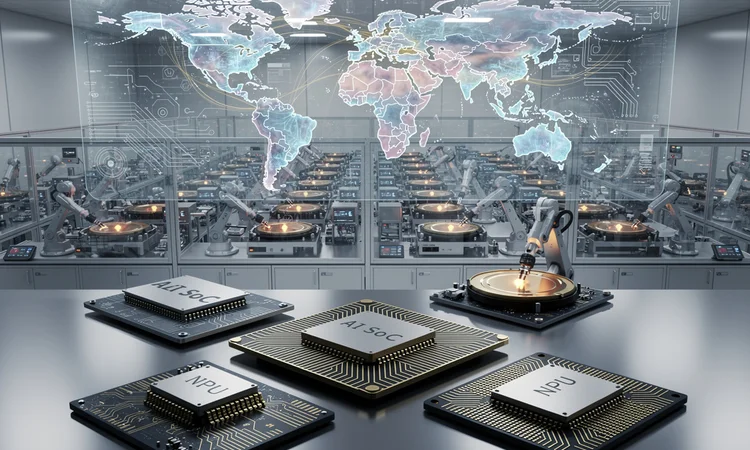
Apple Inc. finds itself at a critical juncture as surging artificial intelligence demands strain its decades-long relationship with Taiwan Semiconductor Manufacturing Company, forcing the iPhone maker to explore alternative chip production partners for the first time in years. The shift represents a fundamental change in Apple’s hardware strategy and highlights the broader semiconductor industry’s struggle to meet AI-driven computing requirements that are reshaping global technology infrastructure.
According to AppleInsider , the Cupertino-based technology giant has begun preliminary discussions with other foundries as TSMC’s production capacity becomes increasingly constrained by overwhelming demand from AI chip manufacturers. This marks a significant departure from Apple’s traditional supply chain management, where TSMC has served as the exclusive manufacturer for the company’s custom-designed processors since 2016, producing everything from the A-series chips in iPhones to the M-series processors powering Mac computers.
The capacity crunch at TSMC stems from multiple converging factors. Nvidia’s explosive growth in AI accelerator sales, coupled with aggressive expansion plans from AMD, Qualcomm, and other fabless semiconductor companies, has created unprecedented demand for advanced node manufacturing capacity. TSMC’s 3-nanometer and upcoming 2-nanometer production lines, which represent the cutting edge of semiconductor manufacturing technology, are now oversubscribed for the foreseeable future.
Manufacturing Constraints Force Strategic Recalibration
Industry analysts estimate that AI-related chip production now consumes approximately 40 percent of TSMC’s advanced node capacity, up from just 15 percent two years ago. This dramatic shift has created allocation challenges for traditional clients like Apple, which historically enjoyed preferential treatment and guaranteed capacity due to its massive order volumes and willingness to adopt new process nodes early. The situation has become acute enough that Apple’s supply chain executives have reportedly engaged with Samsung Foundry and Intel’s newly reorganized foundry services division about potential manufacturing partnerships.
Samsung represents the most logical alternative, given its position as the world’s second-largest contract chip manufacturer and its existing relationship with Apple as a supplier of OLED displays and NAND flash memory. However, the relationship between the two companies remains complicated by their ongoing competition in the smartphone market and historical tensions over intellectual property. Samsung previously manufactured Apple’s A-series chips from 2007 through 2015 before TSMC won exclusive rights to the business, partly due to yield issues and concerns about technology leakage to Samsung’s mobile division.
Intel’s foundry services division, rebranded as Intel Foundry under CEO Pat Gelsinger’s IDM 2.0 strategy, presents another option, albeit one with significant technical and logistical challenges. Intel has invested heavily in expanding its manufacturing footprint with new facilities in Arizona, Ohio, and Europe, positioning itself as a geographically diversified alternative to Asian foundries. However, Intel’s foundry business lacks the proven track record and advanced process technology maturity that Apple requires for its flagship products.
Artificial Intelligence Reshapes Semiconductor Economics
The fundamental economics of semiconductor manufacturing have shifted dramatically with the AI boom. Training large language models and running inference workloads require massive parallel processing capabilities, driving unprecedented demand for high-performance computing chips built on the most advanced manufacturing processes. Companies like OpenAI, Google, Meta, and Microsoft are ordering AI accelerators in quantities that rival or exceed traditional data center CPU volumes, fundamentally altering foundry capacity allocation.
TSMC’s capital expenditure plans reflect this new reality. The company announced plans to invest between $40 billion and $44 billion in 2025, with the majority directed toward expanding advanced node capacity. Despite this massive investment, lead times for new capacity remain extended, typically requiring 18 to 24 months from groundbreaking to production readiness. This timeline mismatch creates a critical gap for companies like Apple that need guaranteed capacity for product launches scheduled years in advance.
Apple’s chip design roadmap compounds the challenge. The company’s transition to Apple Intelligence, its branded AI platform integrated across iOS, iPadOS, and macOS, requires significant increases in on-device processing capability. Future iPhone and Mac processors will need substantially more transistors dedicated to neural engine components and memory bandwidth to handle AI workloads efficiently. These requirements push Apple toward TSMC’s most advanced nodes, precisely where capacity constraints are most severe.
Geopolitical Considerations Add Complexity
Beyond pure capacity concerns, geopolitical tensions surrounding Taiwan add urgency to Apple’s diversification efforts. The island’s precarious political status and ongoing tensions with mainland China create supply chain risks that Apple’s board and executive team can no longer ignore. A significant portion of the global economy’s most advanced semiconductors originates from TSMC facilities concentrated in Taiwan, creating what industry observers call a “silicon chokepoint” vulnerable to natural disasters, accidents, or geopolitical disruption.
The CHIPS and Science Act in the United States, along with similar initiatives in Europe and Japan, explicitly aims to reduce dependence on Asian semiconductor manufacturing by subsidizing domestic production. TSMC has responded by building advanced fabs in Arizona, with the first facility expected to begin volume production using 4-nanometer technology in 2025. However, these overseas facilities represent only a fraction of TSMC’s total capacity and face challenges related to workforce development, supply chain localization, and operational efficiency compared to the company’s Taiwan operations.
Apple has historically maintained a relatively concentrated supply chain, preferring deep partnerships with a small number of suppliers rather than distributing orders across multiple vendors. This strategy has enabled close technical collaboration and preferential treatment but creates vulnerability when those suppliers face capacity constraints or other disruptions. The company’s experience during the COVID-19 pandemic, when supply chain disruptions affected product availability and launch schedules, reinforced the need for greater resilience.
Technical Hurdles in Foundry Diversification
Qualifying a new foundry partner for advanced chip production involves substantial technical and financial investment. Apple’s chip designs are optimized for TSMC’s specific process technologies, including transistor architectures, metal stack configurations, and design rule specifications. Porting these designs to Samsung or Intel foundries would require significant engineering effort, potentially taking 12 to 18 months and costing hundreds of millions of dollars in non-recurring engineering expenses.
Yield rates represent another critical consideration. TSMC’s advanced processes typically achieve mature yields of 80 to 90 percent, meaning the vast majority of chips produced meet specifications. Alternative foundries may require extended ramp periods to achieve comparable yields, potentially resulting in higher costs and supply uncertainty during the transition period. For a company like Apple that ships hundreds of millions of devices annually, even small yield differences translate to significant financial and operational impacts.
The complexity of modern chip manufacturing also limits how quickly new capacity can come online. Advanced semiconductor fabs require thousands of precisely calibrated process steps, each with tight tolerances and complex interdependencies. Building institutional knowledge and process expertise takes years, giving established players like TSMC substantial advantages over competitors attempting to catch up. This reality suggests that even if Apple secures commitments from alternative foundries, TSMC will likely remain its primary manufacturing partner for the foreseeable future.
Industry-Wide Implications and Future Outlook
Apple’s foundry diversification efforts signal broader changes in the semiconductor industry’s structure. The concentration of advanced manufacturing capacity in a small number of facilities operated by even fewer companies creates systemic risks that customers, governments, and investors increasingly view as unacceptable. This recognition is driving investment in distributed manufacturing capacity, though the capital requirements and technical challenges mean this transition will unfold over years rather than months.
Other fabless semiconductor companies face similar challenges. Nvidia, AMD, and Qualcomm all depend heavily on TSMC for their most advanced products, creating competition for limited capacity. Unlike Apple, these companies generally lack the negotiating leverage and order volumes to secure guaranteed allocation, potentially placing them at a competitive disadvantage. The resulting capacity allocation decisions by TSMC will significantly influence competitive dynamics in AI accelerators, mobile processors, and other high-performance computing segments.
For TSMC, managing customer relationships amid capacity constraints represents a delicate balancing act. The company must maintain its reputation for reliability and customer service while allocating scarce capacity among competing demands. Favoring AI chip manufacturers could alienate traditional customers like Apple, but ignoring the AI market’s growth trajectory would represent a strategic miscalculation. TSMC’s response will likely involve continued aggressive capacity expansion while working with customers on long-term capacity agreements and technology roadmaps.
The situation also highlights fundamental questions about the semiconductor industry’s ability to meet AI-driven demand growth. If current trends continue, the industry may face a prolonged period of tight capacity and extended lead times, potentially constraining AI deployment and development. This dynamic could slow the pace of AI advancement or drive architectural innovations that reduce dependence on cutting-edge manufacturing processes. Either outcome would significantly impact technology companies’ strategies and the broader digital economy’s evolution.
As Apple navigates these challenges, its decisions will reverberate throughout the technology sector. The company’s scale and influence mean its foundry choices will affect capacity availability for other customers, competitive dynamics among foundry operators, and investment patterns in semiconductor manufacturing infrastructure. For an industry built on precision and predictability, the current period of uncertainty and rapid change represents both challenge and opportunity, with outcomes that will shape technology development for years to come.






Leave a Reply
Your email address will not be published.