









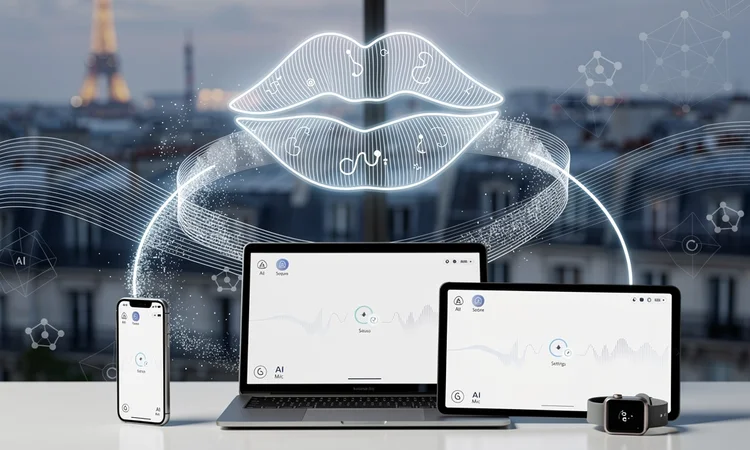
Apple’s recent acquisition of Quantum AI, a Paris-based startup specializing in advanced lip-reading technology, represents far more than a routine talent acquisition. The move signals a fundamental shift in how the world’s most valuable technology company envisions human-computer interaction, potentially reshaping the wearables market and establishing new paradigms for assistive technology that could affect billions of users worldwide.
According to CNET , the acquisition was completed in early 2025, though Apple characteristically declined to disclose financial terms or provide detailed commentary on its strategic intentions. Quantum AI’s core technology employs sophisticated machine learning algorithms capable of interpreting speech through visual cues alone, achieving accuracy rates that reportedly exceed 90% under optimal conditions—a threshold that industry experts consider commercially viable for consumer applications.
The timing of this acquisition coincides with mounting evidence that Apple is preparing a significant expansion of its wearables portfolio. Industry analysts have long speculated about Apple’s development of augmented reality glasses, and lip-reading capabilities would address one of the most persistent challenges facing such devices: capturing user input in environments where voice commands prove impractical or socially inappropriate. The technology could enable silent communication with devices, transforming how users interact with everything from AirPods to future head-mounted displays.
The Technical Foundation Behind Silent Speech Recognition
Quantum AI’s approach to lip-reading technology distinguishes itself through its use of transformer-based neural networks, similar to those powering large language models, but specifically trained on vast datasets of visual speech patterns. Unlike earlier systems that relied on simpler computer vision techniques, Quantum AI’s solution can account for variations in lighting conditions, facial hair, speaking accents, and even partially obscured faces—factors that previously rendered lip-reading technology unreliable outside controlled laboratory settings.
The startup’s research, published in several peer-reviewed journals before the acquisition, demonstrated that their system could recognize complete sentences rather than isolated words, understanding context and correcting for ambiguities inherent in visual speech recognition. This contextual understanding proves critical because many English phonemes—such as ‘p’ and ‘b’—appear nearly identical when observed visually, requiring sophisticated language models to disambiguate based on surrounding words and probable meaning.
Strategic Implications for Apple’s Accessibility Initiatives
Beyond consumer convenience, lip-reading technology holds transformative potential for accessibility applications, an area where Apple has consistently invested resources and earned industry recognition. For individuals with speech impairments or hearing loss, visual speech recognition could enable more natural communication with devices and, potentially, with other people through real-time translation and augmentation services.
Apple’s existing accessibility features, including VoiceOver, AssistiveTouch, and Sound Recognition, have established the company as a leader in inclusive design. Integrating advanced lip-reading capabilities would extend this commitment, potentially enabling new forms of assistive technology that bridge communication gaps. The technology could power features that translate silent speech into audible voice output, assist in language learning by providing real-time pronunciation feedback, or enable communication in situations where producing sound is impossible or dangerous.
Competitive Pressures in the Wearables Market
Apple’s move comes as competition intensifies in the wearables sector, with Meta, Google, and emerging players all vying for position in what analysts project will become a $100 billion market by 2028. Meta’s Ray-Ban smart glasses, which integrate cameras and AI assistants, have gained unexpected traction among consumers, demonstrating appetite for wearable devices that extend beyond fitness tracking into ambient computing.
The acquisition also positions Apple to compete more effectively with specialized hearing aid manufacturers, a market the company entered with AirPods Pro’s hearing aid features. By combining audio processing with visual speech recognition, Apple could create devices that assist users in understanding speech even in challenging acoustic environments—crowded restaurants, noisy streets, or situations where multiple conversations occur simultaneously. Such capabilities would differentiate Apple’s products in an increasingly commoditized earbuds market.
Privacy Considerations and Technical Challenges
Implementing lip-reading technology at scale raises significant privacy questions that Apple will need to address to maintain consumer trust. Cameras capable of capturing sufficient facial detail for accurate speech recognition could theoretically record conversations without participants’ knowledge or consent. Apple’s historical emphasis on on-device processing and privacy-preserving technologies suggests the company will likely process lip-reading data locally rather than transmitting video to cloud servers, but the technical requirements for real-time processing may challenge even Apple’s most advanced silicon.
The computational demands of continuous lip-reading present another hurdle. Quantum AI’s published research indicates their models require substantial processing power, raising questions about battery life and thermal management in compact wearable devices. Apple’s recent advances in neural engine capabilities, particularly in the A17 Pro and M-series chips, may provide the necessary computational foundation, but miniaturizing this technology for glasses or earbuds will require significant engineering innovation.
Integration With Apple’s Existing Ecosystem
The strategic value of lip-reading technology multiplies when considered within Apple’s broader ecosystem. Siri, Apple’s voice assistant, has long trailed competitors in accuracy and functionality. Visual speech recognition could enhance Siri’s performance by providing additional input channels, improving recognition accuracy in noisy environments, and enabling truly silent operation—a feature that would address one of the most common user complaints about voice assistants.
Furthermore, the technology could integrate with Apple’s spatial computing platform, Vision Pro, enabling more natural interaction methods for the mixed-reality headset. Current Vision Pro users control the device primarily through eye tracking and hand gestures, but adding silent speech recognition would provide a more comprehensive input system, particularly for text entry and complex commands where gesture-based interfaces prove cumbersome.
Market Timing and Product Development Cycles
While Apple typically integrates acquired technologies into products within two to three years, the complexity of bringing lip-reading capabilities to market suggests a longer timeline. The company must not only refine the core technology but also design user interfaces, establish privacy frameworks, and potentially navigate regulatory requirements, particularly in markets with strict data protection laws like the European Union.
Industry observers note that Apple’s pattern of strategic acquisitions often precedes product category expansions by several years. The company acquired AuthenTec in 2012, introducing Touch ID in 2013. It purchased PrimeSense in 2013, with spatial computing technologies emerging years later in products like Face ID and eventually Vision Pro. If this pattern holds, consumers might expect to see lip-reading features in Apple products between 2026 and 2027, likely debuting in a new product category rather than as updates to existing devices.
Broader Industry Implications
Apple’s investment in visual speech recognition may catalyze broader industry adoption of multimodal input systems that combine voice, gesture, eye tracking, and facial analysis. As computing devices become more ambient and less obtrusive, the need for input methods that work seamlessly across contexts becomes paramount. A user might speak aloud to their device at home, switch to silent lip-reading commands in a meeting, and use gestures while exercising—all without consciously changing interaction modes.
This vision of context-aware, multimodal interaction represents the next frontier in human-computer interface design. By acquiring Quantum AI, Apple has positioned itself to lead this transition, potentially establishing standards and interaction paradigms that could influence the industry for decades. The acquisition underscores a fundamental truth about technology evolution: the most profound innovations often involve not just what devices can do, but how naturally and invisibly they integrate into human life.
For competitors, Apple’s move serves as a clear signal that the battle for wearables dominance will be won not through incremental hardware improvements but through fundamental reimagining of how humans and machines communicate. The companies that master this transition—creating devices that understand users through multiple channels simultaneously—will define the next era of personal computing. Apple’s acquisition of Quantum AI suggests the company intends to be among those defining that future, building on its legacy of making complex technology accessible through elegant, intuitive design.






Leave a Reply
Your email address will not be published.