







New data from NASA’s ongoing analysis of Jupiter’s moon Europa has forced scientists to reconsider fundamental assumptions about one of the solar system’s most promising candidates for extraterrestrial life. The space agency’s latest research suggests that Europa’s ice shell may be significantly thicker than previously estimated, a finding that carries profound implications for future exploration missions and the search for life beyond Earth.
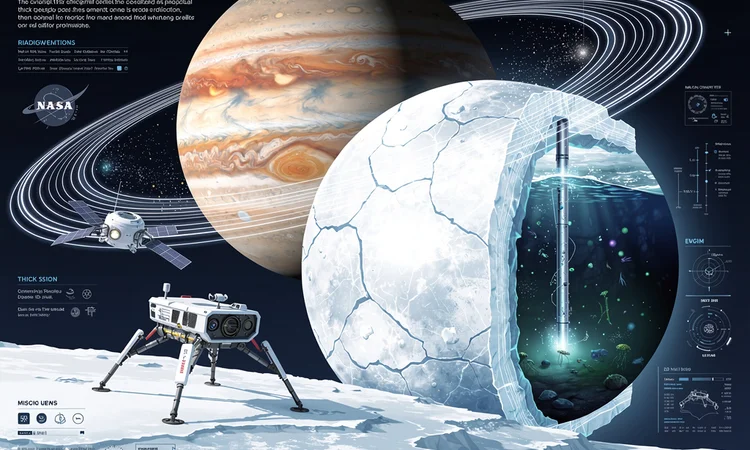
According to Futurism , the revised thickness estimates could fundamentally alter mission planning for NASA’s Europa Clipper spacecraft, currently en route to the Jovian system. The mission, which launched in October 2024, represents a $5 billion investment in understanding whether Europa’s subsurface ocean could harbor life. Scientists had long operated under the assumption that Europa’s ice shell ranged between 10 to 15 miles thick, but new modeling suggests it could extend 20 miles or more in certain regions.
The implications extend far beyond academic curiosity. A thicker ice shell presents substantial engineering challenges for any future lander mission designed to penetrate the surface and reach the ocean below. Dr. Samuel Howell, a planetary scientist involved in Europa research, noted that understanding ice shell thickness remains “one of the most critical unknowns” for planning future missions to the moon. The discovery forces mission planners to reconsider drilling capabilities, power requirements, and the feasibility of direct ocean sampling within realistic budget constraints.
The Physics Behind Europa’s Frozen Fortress
Europa’s ice shell thickness has long been a subject of intense scientific debate, with estimates varying wildly based on different modeling approaches. The moon’s surface shows extensive evidence of geological activity, including vast networks of linear fractures, chaotic terrain regions, and what appear to be recent resurfacing events. These features have traditionally been interpreted as signs of a relatively thin, dynamic ice shell that allows interaction between the surface and the ocean below.
However, new thermal modeling and analysis of Europa’s gravitational field suggest a more complex picture. The research incorporates data from NASA’s Galileo mission, which orbited Jupiter from 1995 to 2003, combined with advanced computer simulations of heat transfer through ice under Europa’s extreme conditions. The moon experiences intense tidal flexing due to Jupiter’s massive gravitational pull, generating heat through friction within the ice and potentially in the rocky mantle below.
Tidal Forces and Heat Distribution Patterns
The tidal heating mechanism on Europa operates differently than scientists initially understood. As Europa orbits Jupiter in an elliptical path, the moon experiences varying gravitational forces that literally squeeze and stretch its interior. This process, called tidal flexing, generates heat through friction—the same principle that causes a paperclip to warm up when bent repeatedly. However, the distribution of this heat throughout Europa’s interior remains poorly constrained.
Recent models suggest that tidal heating may be concentrated more heavily in Europa’s rocky mantle rather than its ice shell, which would reduce the amount of heat available to thin the ice from below. This redistribution of heat sources could explain why the ice shell might be thicker than earlier estimates suggested. The research also indicates that Europa’s ice shell thickness likely varies significantly across different regions of the moon, with some areas potentially much thinner than others.
Impact on the Search for Extraterrestrial Life
The thickness of Europa’s ice shell directly affects the probability of finding biosignatures—chemical or physical signs of life—on the moon’s surface. A thinner ice shell would allow more efficient exchange of materials between the ocean and surface, potentially bringing evidence of oceanic life to areas accessible by spacecraft. Conversely, a thicker barrier would limit this exchange, making surface detection of life more challenging.
Europa’s subsurface ocean, estimated to contain twice as much water as all of Earth’s oceans combined, remains one of the solar system’s most intriguing targets for astrobiology. The ocean likely contacts Europa’s rocky mantle, creating conditions where water interacts with minerals—a process that on Earth provides energy and nutrients for microbial ecosystems in deep ocean hydrothermal vents. However, if the ice shell proves substantially thicker than anticipated, it may isolate the ocean more effectively from surface radiation and chemical inputs from space.
Engineering Challenges for Future Missions
NASA’s Europa Clipper mission, equipped with ice-penetrating radar and other sophisticated instruments, should provide definitive measurements of ice shell thickness when it begins its detailed survey of Europa in 2030. The spacecraft will conduct nearly 50 close flybys of the moon, mapping its surface composition, ice shell thickness, and subsurface ocean characteristics. These measurements will prove critical for designing any follow-on lander mission.
The European Space Agency’s JUICE (Jupiter Icy Moons Explorer) mission, launched in April 2023, will also study Europa during two close flybys, though its primary focus remains on Ganymede, another of Jupiter’s large moons. The complementary data from both missions will help scientists construct a comprehensive picture of Europa’s internal structure and evolution.
Technological Requirements for Ocean Access
If Europa’s ice shell indeed extends 20 miles or more in thickness, accessing the subsurface ocean directly would require technology far beyond current capabilities. For comparison, the deepest ice core ever drilled on Earth reached approximately 2.2 miles into Antarctica’s ice sheet. Drilling through 20 miles of ice in Europa’s low-temperature, high-radiation environment—while operating autonomously millions of miles from Earth—represents an engineering challenge of unprecedented scale.
Alternative approaches under consideration include targeting regions where the ice may be thinner, such as areas of recent geological activity or locations where subsurface water may have recently reached the surface. Some researchers have proposed searching for active water plumes, similar to those observed on Saturn’s moon Enceladus, which could provide direct samples of subsurface material without requiring drilling. However, despite extensive searching, confirmed plume activity on Europa remains elusive and controversial.
Comparative Analysis with Other Ocean Worlds
Europa is not the only moon in our solar system believed to harbor a subsurface ocean. Saturn’s moon Enceladus actively vents water vapor and organic compounds into space through fractures near its south pole, providing researchers with direct samples of its subsurface ocean. However, Enceladus is much smaller than Europa, and its ocean may be less voluminous and potentially less stable over geological time.
Saturn’s largest moon, Titan, also likely contains a subsurface water ocean beneath its thick ice shell and unique hydrocarbon seas on its surface. However, Titan’s ocean may be sandwiched between layers of high-pressure ice, making it less accessible and potentially less hospitable to life as we understand it. Europa’s combination of ocean volume, potential ocean-rock interaction, and relative accessibility has maintained its status as a priority target despite the new thickness estimates.
Economic and Political Considerations
The revised ice shell thickness estimates arrive at a critical juncture for planetary science funding. NASA’s planetary science division faces competing priorities, including Mars sample return, lunar exploration under the Artemis program, and missions to other targets throughout the solar system. A Europa lander mission, already estimated to cost several billion dollars under optimistic scenarios, could become prohibitively expensive if it requires significantly more sophisticated drilling or melting technology.
Congressional support for Europa exploration has historically been strong, with legislative language in multiple years directing NASA to accelerate Europa mission development. However, the agency’s overall budget constraints and the increasing costs of flagship missions create tension between scientific ambition and fiscal reality. The Europa Clipper mission itself experienced significant cost overruns during development, requiring careful management to avoid cancellation.
Next Steps in Europa Research
As the scientific community awaits Europa Clipper’s arrival at Jupiter, researchers continue refining models of Europa’s interior structure using available data. Advanced computer simulations now incorporate more sophisticated physics, including non-linear ice rheology, three-dimensional heat transfer, and coupled models of tidal heating and orbital evolution. These models will be tested against Europa Clipper’s observations, potentially revolutionizing our understanding of icy moon dynamics throughout the solar system.
The ice thickness question also drives technology development for future missions. NASA’s Scientific Exploration Subsurface Access Mechanism for Europa (SESAME) program has funded research into autonomous drilling systems, ice-melting probes, and other technologies that could eventually enable direct ocean access. While a Europa lander mission remains years or decades away, the engineering challenges identified by current research help focus technology development efforts on the most critical capabilities.
The discovery that Europa’s ice shell may be thicker than previously estimated serves as a reminder that our understanding of even well-studied celestial bodies continues to evolve. Rather than diminishing Europa’s appeal as a target for astrobiology, the finding emphasizes the importance of the Europa Clipper mission and the need for continued investment in planetary science. Whether Europa’s ocean harbors life remains unknown, but answering that question has become more complex—and perhaps more expensive—than scientists hoped just a few years ago.






Leave a Reply
Your email address will not be published.