





Nvidia Corp. has surged to become the world’s most valuable company on the strength of its artificial-intelligence chips, but its ascent hinges on a single Dutch firm: ASML Holding NV. The Veldhoven-based equipment maker holds a near-total grip on the market for extreme ultraviolet lithography machines, the intricate devices essential for etching the tiniest circuits onto silicon wafers used in advanced AI processors. Without ASML’s technology, Nvidia’s Blackwell chips and the data centers fueling generative AI models simply could not exist at scale.
ASML’s extreme ultraviolet, or EUV, systems fire powerful lasers at droplets of molten tin in a vacuum chamber to generate plasma that emits light at a wavelength of just 13.5 nanometers—far shorter than previous deep ultraviolet tools. This light bounces off ultra-precise mirrors crafted by Germany’s Carl Zeiss and projects shrunken chip patterns onto wafers. Foundry giants like Taiwan Semiconductor Manufacturing Co., or TSMC, purchase these behemoths, which weigh as much as several elephants and cost up to 400 million euros ($478 million) apiece, to fabricate Nvidia’s designs. CNBC reports that ASML commands 90% of the broader lithography market and a complete monopoly on EUV, the only viable path to sub-3-nanometer nodes powering today’s AI revolution.
“Lithography was ‘the building block of any chip,’ adding that ASML machines have played a role in the production of 99% of semiconductors,” said Javier Correonero, equity analyst at Morningstar, as quoted in the CNBC piece. Bank of America analyst Didier Scemama added: “ASML has industrialised next gen EUV (Extreme Ultraviolet) lithography technology, which we believe will underpin many of the disruptive trends of this decade.”
Record Orders Signal AI Buildout Acceleration
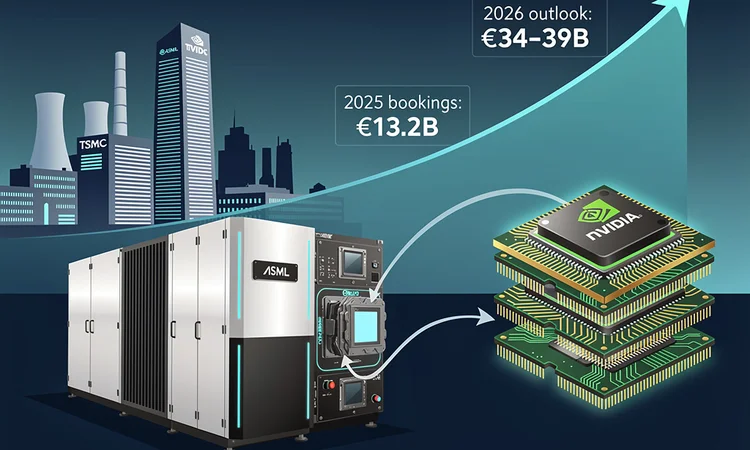
ASML’s latest earnings underscored its pivotal role. In the fourth quarter of 2025, net bookings rocketed to 13.2 billion euros, more than double analyst expectations of 6.3 billion euros, with EUV systems accounting for 7.4 billion euros. For the full year, the company shipped 48 EUV machines, generating 11.6 billion euros in revenue from them alone. Net sales hit 32.7 billion euros, up 15.5%, while net profit climbed 26.3% to 9.6 billion euros. Reuters noted the surge reflects chipmakers ramping capacity for AI logic and memory chips demanded by Microsoft Corp., Amazon.com Inc., and Alphabet Inc.’s Google.
Looking ahead, ASML raised its 2026 sales forecast to 34 billion to 39 billion euros, topping consensus estimates of 35 billion euros. EUV revenue is set to “significantly go up” as foundries expand advanced production, the company stated. Shares jumped 36% in 2025 and another 32% year-to-date in 2026, pushing ASML’s market value past 450 billion euros, making it Europe’s third-most-valuable firm. Yet, the stock dipped 1.9% post-earnings amid concerns over capacity to meet demand. CNBC highlighted a planned 12-billion-euro share buyback through 2028 and cuts to 1,700 management jobs to prioritize engineering amid the boom.
TSMC, ASML’s top customer and Nvidia’s primary foundry, plans 37% higher capital spending at $56 billion in 2026. Samsung Electronics Co. aims for $40 billion, up 24%; SK Hynix Inc. $22 billion, up 25%; and Micron Technology Inc. $20 billion, up 45%. Analysts estimate a quarter of such spending flows to lithography, much of it ASML’s domain, with AI chips demanding even more. Reuters quoted John West of Yole Group: “ASML is ‘the only game in town,'” referring to EUV’s 13.5-nanometer light beams.
EUV’s Engineering Marvel and Monopoly Barriers
Each EUV machine comprises over 100,000 parts from 5,000 suppliers, assembles in the Netherlands, then ships in 40 containers via Boeing 747 freighters to fabs worldwide. Last year, ASML delivered 44 systems to TSMC, Samsung, SK Hynix, Intel, Micron, and Japan’s Rapidus. Analysts forecast sharp increases in 2026-2027 as AI data centers proliferate. Luc Van den Hove, CEO of Belgium’s Interuniversity Microelectronics Centre, which aided EUV development, praised the machines’ “patterning precision, scalability and energy efficiency” vital for AI chips. Reuters .
Competitors like Japan’s Nikon Corp. and Canon Inc. linger far behind in older nodes, having invested fractions of ASML’s three-decade, multibillion-euro R&D outlay. “They are large conglomerates which have invested only a tiny fraction of what ASML has invested over three decades. At this point, catching up is virtually impossible,” Correonero told CNBC. Dan Hutcheson of TechInsights likened switching tools to “swapping a Formula One engine mid-race,” with supply chains locked into ASML for years ahead.
ASML offers low-numerical-aperture EUV for current AI chips like Nvidia’s Blackwell and high-NA versions—priced 320-400 million euros—for R&D at TSMC, Intel, and Samsung. High-NA promises features nearly twice as dense, targeting high-volume manufacturing by 2027-2028, with Intel first. “Once customers are accustomed to the tool, it is gradually introduced into high volume manufacturing. High NA is expected to reach high volume manufacturing by 2027-2028, with Intel as the first adopter,” Correonero said.
Geopolitical Pressures and China Exposure
China, once 41% of sales, fell to 33% in 2025 and is projected at 20% in 2026 due to U.S.-led export curbs blocking EUV sales there. No EUV has ever reached Chinese customers, though older deep-UV tools face tightening rules. CFO Roger Dassen affirmed the drop, but AI demand elsewhere compensates. The Globe and Mail . Chinese efforts to reverse-engineer EUV lag, recruiting ex-ASML talent but trailing years behind, per reports.
ASML’s edge endures through software integration, metrology, and decades of customer data. Nvidia CEO Jensen Huang recently called data-center expansion “the largest infrastructure build-out in human history,” requiring trillions in investment—much flowing to ASML. Collaborations like Nvidia’s cuLitho software with ASML, TSMC, and Synopsys accelerate computational lithography for 2nm and beyond. Peter Wennink, ASML CEO, stated: “We are planning to integrate support for GPUs into all of our computational lithography software products.” NVIDIA Newsroom .
Mizuho analyst Kevin Wang noted: “Overall there is good fourth-quarter orders and 2026 outlook, driven by AI demand for EUV in both logic and DRAM.” Big Tech’s projected $400 billion AI infrastructure spend in 2026 ensures ASML’s low-NA EUV fleet stays fully utilized, with TSMC’s 2nm node booked solid. Forbes . ASML executives dismissed capacity bottleneck fears: “I sense some concern that we may be the bottleneck for the customer. This is not the case, certainly not this year and again for next year,” said a company spokesman.
High-NA Horizon and Sustained Demand Drivers
High-NA EUV, the industry’s next leap, shipped its first units in 2025 at around $380 million each. Only five exist so far, with Intel, TSMC, and Samsung as pioneers. This tool enables sub-2nm nodes critical for denser, more efficient AI accelerators. ASML’s 52% gross margins and €36 billion-plus backlog provide multi-year visibility, insulating it from cycles even as China wanes.
Memory shortages from AI workloads boost DRAM capex, further padding orders. Barclays expects SK Hynix to take 12 EUV machines in 2026 alone. Nvidia’s supply chain—TSMC fabricating with ASML tools—forms an unbreakable triad, with no viable alternatives. X posts from analysts like @rohanpaul_ai emphasize: “Without ASML: No NVIDIA H100, No AI supercomputers, No GPT-4, Gemini, or Claude.”
The firm’s path from a 1984 Philips spinout to Europe’s top company reflects relentless innovation amid physics’ limits. As AI scales, ASML’s monopoly ensures it captures value across the semiconductor stack, from Nvidia’s GPUs to hyperscalers’ fleets. Analysts project continued stock upside, with targets above $1,500, betting on the unrelenting AI infrastructure surge.






Leave a Reply
Your email address will not be published.