



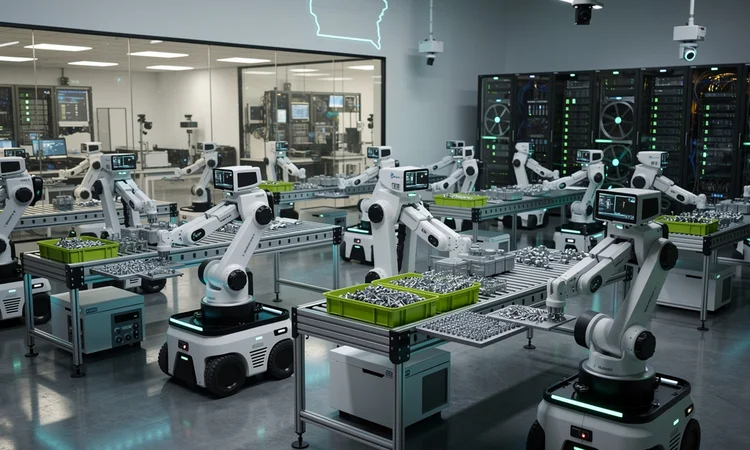
In a quiet corner of Hyundai Motor Group’s sprawling Metaplant America near Savannah, Georgia, Boston Dynamics’ Atlas humanoid robots have begun their real-world apprenticeship. Segregated from human workers, these bipedal machines sort roof racks and sequence automotive parts, marking the first industrial deployment of advanced humanoids beyond laboratory confines. This $7.6 billion facility, already employing nearly 1,500 people and over 1,000 traditional industrial robots, now serves as a live proving ground for Atlas’s transition from viral videos to value-creating labor.
Hyundai’s push stems from its 2021 acquisition of an 80% stake in Boston Dynamics for $880 million, a bet now yielding tangible results. At CES 2026 in Las Vegas, the company unveiled the production-ready electric Atlas, capable of lifting 50 kilograms, rotating its torso fluidly, and manipulating objects with human-scale hands equipped with tactile sensors. “This is the first time Atlas has been out of the lab doing real work,” said Zack Jackowski , general manager for humanoid robots at Boston Dynamics, as reported across multiple outlets including NBC News .
The all-electric model ditches hydraulics for precise actuators supplied by Hyundai Mobis, enabling finer manipulation and energy efficiency suited for 24/7 operations. Powered by Nvidia hardware and infused with Google DeepMind’s Gemini AI, Atlas learns from experience rather than rigid scripts, generalizing to novel situations like a misplaced parts bin.
From CES Spotlight to Georgia Proving Ground
“Rather than having a set of predefined, loaded tasks onto the robot, we think robots should understand the physical world the same way we do,” Caroline Parada , senior director of robotics at Google DeepMind, told CES attendees, as detailed in BGR . This philosophy drives Atlas’s training at the Hyundai facility, where robots practice in isolation for years to amass data before main-line integration. A new Robot Metaplant Application Center (RMAC), opening in 2026, will use digital twins for virtual simulations, feeding behavioral datasets back into AI models for iterative improvement.
Hyundai envisions a phased rollout: parts sequencing by 2028, component assembly by 2030, and eventually heavy-load tasks across global sites. The company plans a U.S. factory producing 30,000 Atlas units annually by 2028, with deployments starting at the Georgia plant—a site that made headlines in 2025 for an immigration raid at a related battery joint venture with LG, per BBC News .
This aligns with Hyundai’s $26 billion U.S. investment, including expanded EV production. Affiliates like Kia, Hyundai Mobis, and Glovis form an end-to-end chain: manufacturing infrastructure from carmakers, actuators from Mobis, and logistics from Glovis. “Actuators play a critical role in enabling humanoid robots to perform physical movements,” Jackowski noted in Supply Chain 24/7 .
AI Brain Meets Industrial Muscle
Atlas’s intelligence draws from partnerships with Nvidia for compute and DeepMind for Large Behavior Models (LBMs), allowing adaptation in unstructured environments. A 60 Minutes segment showcased Atlas sorting roof racks autonomously, with workers observing from afar. “The Chinese government has a mission to win the robotics race,” warned Robert Playter, Boston Dynamics CEO, highlighting competition from state-backed Chinese startups.
Unlike Tesla’s Optimus, aimed at lower-cost consumer markets, Atlas positions as a premium industrial solution for rugged conditions and heavy payloads. Figure AI’s BMW deployments and Agility Robotics’ efforts underscore the intensifying race, but Hyundai’s scale—backed by $125 trillion won in Korean AI investments—gives it an edge in mass production and data loops from real factories.
Early pilots build on Spot robots already inspecting Hyundai plants worldwide, including Singapore and U.S. sites. A 2025 Korea JoongAng Daily report flagged October field trials at the Georgia EV plant, accelerating toward full commercialization despite Atlas’s speculated $150,000+ price tag.
Phased Deployment and Economic Stakes
By 2026, Atlas will handle robot-only shifts in hazardous zones like high-heat areas, per FinancialContent . Safety validation ensures 99.9% reliability before scaling. Hyundai CEO José Muñoz affirmed hiring commitments despite automation, framing robots as relievers of physical strain on humans.
The model shifts to Robotics-as-a-Service (RaaS), offering subscriptions with maintenance and updates, extending beyond autos to logistics and aerospace. Reuters reports initial sequencing tasks from 2028, expanding as benefits prove out, with Atlas lifting up to 110 pounds using tactile hands.
X posts from insiders like Sawyer Merritt and Disclose.tv amplified CES demos, showing Atlas’s three-fingered hand and autonomous warehouse sorting, fueling buzz about manufacturing’s “ChatGPT moment.”
Rivals Circle as Humanoids Scale
Tesla’s Optimus lags in factory proofs, while Chinese firms leverage subsidies. Boston Dynamics’ edge: decades of R&D since 2013’s hydraulic Atlas, retired in 2024 for this electric iteration. TechCrunch chronicled partnerships like Toyota Research Institute for AI smarts, blending automotive rivals’ expertise.
Hyundai’s “software-defined factory” vision integrates Atlas data for cyclical learning: real-world ops refine RMAC simulations, boosting speed and safety. Axios detailed mass production at Savannah, tying into $21 billion U.S. logistics investments.
For workers, implications loom large. Robots target repetitive, risky jobs, but unions voice concerns over unnerving flexibility, as noted in X discussions. Yet, as Reuters observes, embodied AI overlaps autonomous driving tech, positioning humanoids as physical AI’s biggest market segment.
Path to Global Factory Domination
By 2030, tens of thousands of Atlases could populate Hyundai’s network, generating demand via proven ROI. Bloomberg and CNBC confirmed Georgia as the launchpad, with Axios projecting worldwide integration. This isn’t replacement but augmentation, easing strains while humans oversee complexity.
The Georgia Metaplant, producing 500,000 EVs yearly, validates in a high-stakes live lab, bypassing sim-to-reality gaps plaguing rivals. Automotive Logistics highlighted cyclical data synergy: RMAC training plus factory feedback evolves robots continuously.






Leave a Reply
Your email address will not be published.