









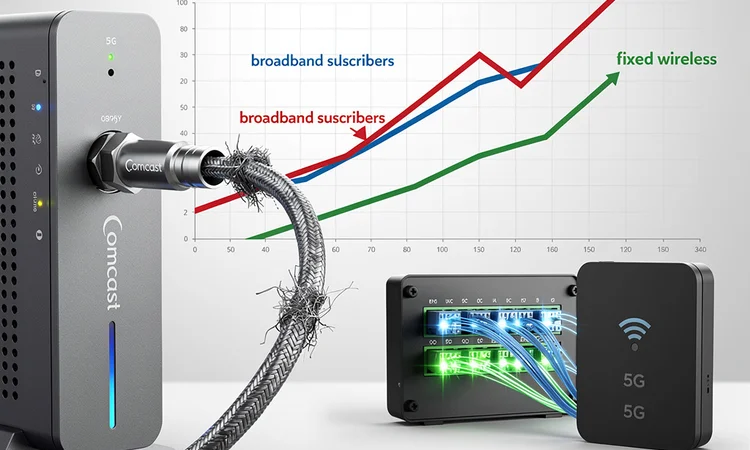
The nation’s largest cable provider finds itself in an increasingly precarious position as subscriber losses continue to mount, revealing deeper structural challenges in the broadband industry that promotional tactics alone cannot solve. Comcast’s latest quarterly results paint a sobering picture of a company struggling to retain customers even as it deploys what should be its most compelling competitive weapons: price stability guarantees and unlimited data access.
According to Ars Technica , Comcast lost approximately 139,000 broadband subscribers in the most recent quarter, a continuation of a troubling trend that has persisted despite the company’s introduction of a NOW Internet plan featuring a three-year price lock and elimination of data caps. The losses represent more than just numbers on a balance sheet; they signal a fundamental shift in how consumers perceive value in telecommunications services and suggest that traditional cable operators face challenges far more complex than simple pricing concerns.
The company’s response to these losses has been multifaceted, including the introduction of promotional offers that would have seemed unthinkable just a few years ago. The NOW Internet plan, which guarantees pricing stability for 36 months and removes the controversial 1.2TB monthly data cap, represents a significant departure from the industry’s historical approach of regular price increases and usage-based billing. Yet even these consumer-friendly changes have failed to stem the tide of departures, raising questions about whether price and data limits were ever the primary drivers of customer dissatisfaction.
The Competitive Pressure from Fiber and Fixed Wireless
The broadband market has undergone a dramatic transformation in recent years, with fiber-optic providers and fixed wireless services emerging as formidable competitors to traditional cable infrastructure. Companies like AT&T and Verizon have invested billions in fiber-to-the-home deployments, offering symmetrical speeds that cable’s hybrid fiber-coaxial networks struggle to match. Meanwhile, T-Mobile and Verizon have leveraged their 5G networks to offer home internet services that require no installation and often come with simplified pricing structures.
This competitive pressure has fundamentally altered the market dynamics that once allowed cable companies to operate with limited concern for customer retention. Where Comcast previously enjoyed near-monopoly status in many markets, subscribers now frequently have three or more viable options for high-speed internet access. The shift has empowered consumers to vote with their wallets, and the data suggests they are increasingly willing to do so regardless of promotional incentives from incumbent providers.
Beyond Price: The Trust Deficit Problem
Industry analysts increasingly point to a less tangible but perhaps more significant factor in Comcast’s struggles: a fundamental trust deficit with consumers. Years of customer service complaints, unexpected fee increases, and controversial data cap policies have created a reservoir of ill will that cannot be easily overcome with promotional offers. The American Customer Satisfaction Index has consistently ranked cable and internet service providers among the lowest-scoring industries, with Comcast frequently appearing near the bottom of even that troubled sector.
This trust problem manifests in multiple ways. When Comcast announces a price guarantee, many consumers remain skeptical, remembering past experiences with promotional rates that expired or fees that appeared on bills without clear explanation. The company’s decision to eliminate data caps, while welcomed, came only after years of consumer advocacy and regulatory pressure, leading many to view the change as forced rather than voluntary. Such perceptions create a psychological barrier that pricing strategies alone cannot overcome.
The Cord-Cutting Spillover Effect
While Comcast’s broadband losses are concerning for the company, they occur against the backdrop of even more dramatic declines in its traditional cable television business. The phenomenon of cord-cutting—consumers abandoning traditional pay-TV packages in favor of streaming services—has accelerated beyond even pessimistic industry projections. This creates a compound problem for Comcast: not only are customers leaving the video service, but many are also reassessing their entire relationship with the company, including their broadband subscription.
The psychological connection between these services should not be underestimated. For many households, the decision to cancel cable television serves as a catalyst for broader evaluation of all telecommunications expenses. Once customers begin researching alternatives to Comcast’s video service, they inevitably encounter information about alternative broadband providers as well. This creates a vulnerability point that competitors have learned to exploit, often offering bundle deals that position themselves as complete replacements for the Comcast relationship.
Infrastructure Investment and the DOCSIS 4.0 Gambit
Comcast has not been idle in the face of these challenges. The company has committed billions to upgrading its network infrastructure, including deployment of DOCSIS 4.0 technology that promises to deliver multi-gigabit speeds over existing cable lines. These technical improvements aim to neutralize the speed advantage that fiber providers currently enjoy, potentially offering downstream speeds up to 10 Gbps and upstream speeds up to 6 Gbps.
However, the effectiveness of this infrastructure investment remains uncertain. By the time DOCSIS 4.0 reaches widespread deployment, fiber competitors will have continued their own expansion, and the technological arms race may have shifted to new battlegrounds entirely. Moreover, the investment required for these upgrades creates financial pressure that may limit Comcast’s ability to compete aggressively on price, creating a strategic tension between technological competitiveness and pricing flexibility.
Regulatory Headwinds and Policy Uncertainty
The regulatory environment for broadband providers continues to evolve in ways that may further complicate Comcast’s position. Discussions around net neutrality, data privacy, and infrastructure investment requirements create uncertainty that affects long-term strategic planning. Additionally, various states and municipalities have explored or implemented their own broadband regulations, creating a patchwork of compliance requirements that add operational complexity and cost.
The Biden administration’s infrastructure investments, including significant funding for broadband expansion in underserved areas, have also altered competitive dynamics. While these programs aim to address the digital divide, they often fund fiber deployments by smaller providers or municipalities, creating new competitors in markets where Comcast previously faced limited competition. The long-term impact of these publicly-funded networks on incumbent providers remains a subject of intense industry debate.
The Mobile Integration Strategy
One area where Comcast has shown innovation is in its Xfinity Mobile service, which leverages Verizon’s network infrastructure to offer cellular service to its broadband customers. This strategy aims to increase customer stickiness by creating a multi-service relationship that becomes more difficult to unwind. The approach mirrors successful strategies employed by T-Mobile and Verizon, which have used their own home internet services to reduce churn in their core mobile businesses.
Early results from this strategy show promise, with Xfinity Mobile adding subscribers even as broadband customers depart. However, the mobile service requires customers to maintain Comcast broadband, creating a dependency that may become problematic if broadband losses continue. The economics of this approach also remain somewhat unclear, as Comcast must pay Verizon for network access while competing on price with that same company’s direct mobile offerings.
Market Saturation and Growth Limitations
A fundamental challenge facing Comcast and other established broadband providers is simple market saturation. In most of their service areas, the vast majority of households that want internet service already have it. This means growth must come primarily from taking customers from competitors rather than from expanding the overall market. Such zero-sum competition typically leads to margin pressure and increased customer acquisition costs, both of which are evident in Comcast’s recent financial results.
The company’s traditional growth strategy of expanding into new geographic markets has also become more difficult. Most attractive markets already have established competitors, and the capital requirements for building new infrastructure make expansion into unserved areas economically challenging. This creates a strategic box where Comcast must defend existing market share while finding limited opportunities for expansion, a position that rarely leads to strong growth trajectories.
The Path Forward: Adaptation or Decline
As Comcast navigates these challenges, the company faces fundamental questions about its future identity and strategy. Some industry observers suggest the company should embrace its role as a utility-like infrastructure provider, focusing on reliability and customer service rather than growth. Others argue for more aggressive transformation, potentially including structural separation of content and distribution businesses or dramatic shifts in pricing models.
What seems clear is that incremental adjustments—even significant ones like price guarantees and unlimited data—are insufficient to reverse current trends. The combination of increased competition, technological change, regulatory evolution, and accumulated consumer skepticism creates a challenge that requires more fundamental strategic rethinking. Whether Comcast’s leadership can execute such a transformation while managing the expectations of investors accustomed to the cable industry’s historically high margins remains one of the most important questions facing the telecommunications sector.
The company’s struggles serve as a cautionary tale for all established technology and telecommunications companies: market dominance built on infrastructure advantages and limited competition can erode with surprising speed when those conditions change. For Comcast, the coming quarters will reveal whether its current strategies represent the beginning of successful adaptation or merely the rearrangement of deck chairs on a slowly sinking ship. The answer will have implications not just for the company’s shareholders, but for millions of American households whose internet access depends on the decisions made in Comcast’s Philadelphia headquarters.






Leave a Reply
Your email address will not be published.