



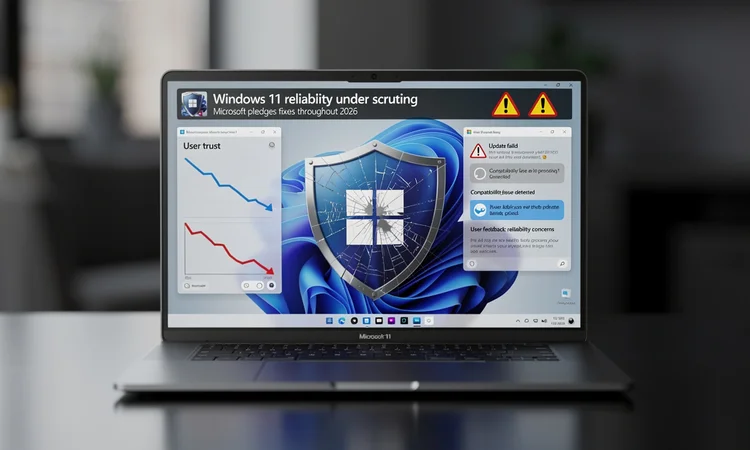
Microsoft has publicly acknowledged what millions of users have been expressing through forums, social media, and IT departments worldwide: Windows 11 has a serious trust problem. In an unprecedented admission that signals both corporate transparency and the depth of user frustration, the Redmond-based tech giant has committed to making reliability and user confidence its primary focus throughout 2026, marking a potential turning point in the operating system’s troubled trajectory since its October 2021 launch.
The confession comes at a critical juncture for Microsoft, as enterprise clients and individual users alike have voiced mounting concerns about forced updates, compatibility issues, hardware requirements that alienated millions of older PCs, and a perceived prioritization of advertising and data collection over core functionality. According to Slashdot , Microsoft’s acknowledgment represents a rare moment of corporate vulnerability in an industry where admitting fault can carry significant financial and reputational consequences.
The trust deficit didn’t emerge overnight. Since Windows 11’s introduction, users have contended with a litany of issues ranging from the controversial TPM 2.0 requirement that rendered countless functional computers obsolete, to the removal of beloved features like the ability to move the taskbar, to persistent bugs that have disrupted workflows across industries. IT administrators have particularly struggled with the operating system’s unpredictable update cycles, which have occasionally introduced more problems than they solved, creating a crisis of confidence in mission-critical environments.
The Breaking Point: When User Patience Runs Dry
Microsoft’s decision to publicly address these concerns didn’t occur in a vacuum. Industry observers point to several catalytic moments that forced the company’s hand. Throughout 2024 and into early 2025, Windows 11 adoption rates lagged significantly behind Microsoft’s internal projections, with many organizations choosing to extend their Windows 10 deployments despite the approaching end-of-support deadline. This resistance from the enterprise sector—traditionally Microsoft’s most loyal customer base—sent unmistakable signals that business as usual was no longer viable.
The company’s approach to Windows 11 had increasingly resembled a platform for experimentation with AI features, advertising integrations, and cloud services, often at the expense of stability and user autonomy. Features like Copilot, while innovative, were perceived by many as intrusive additions that consumed system resources without delivering proportional value. The Start menu’s evolution into what critics described as an advertisement delivery system particularly rankled long-time Windows users who remembered when the operating system prioritized productivity over monetization.
Technical Debt and the Cost of Innovation
Behind the scenes, sources familiar with Microsoft’s Windows development process describe an organization struggling to balance competing priorities. The push to integrate artificial intelligence capabilities, maintain backward compatibility with decades of legacy applications, and simultaneously modernize the user interface created technical debt that manifested as the reliability issues users experienced daily. Engineering teams reportedly faced pressure to ship features on aggressive timelines, sometimes at the expense of thorough testing and quality assurance.
The hardware requirements controversy exemplifies this tension. Microsoft’s insistence on TPM 2.0 and specific CPU generations was justified on security grounds, yet the implementation alienated users with perfectly functional hardware who saw the requirements as arbitrary obsolescence. This decision, more than perhaps any other, damaged Microsoft’s relationship with its user base and fueled perceptions that the company prioritized its strategic objectives over customer needs.
The 2026 Roadmap: Promises and Skepticism
Microsoft’s commitment to focus on “fixes” throughout 2026 represents a significant strategic pivot, though details remain deliberately vague. The company has indicated that stability, performance optimization, and addressing long-standing user complaints will take precedence over flashy new features. This approach mirrors strategies employed during previous Windows crises, most notably the Windows Vista debacle that led to the more refined Windows 7.
However, industry analysts express cautious skepticism about whether Microsoft can truly deliver on these promises while maintaining its aggressive cloud and AI integration agenda. The company faces a fundamental tension: its corporate strategy increasingly revolves around subscription services, cloud computing, and AI-powered features, yet users are demanding a return to basics—a stable, predictable operating system that simply works without constant intervention or surprises.
Enterprise Implications and Migration Challenges
For enterprise IT departments, Microsoft’s admission validates years of frustration but offers little immediate relief. Organizations have invested substantial resources in managing Windows 11’s quirks, developing workarounds for its limitations, and fielding user complaints. The promise of future improvements doesn’t address the immediate challenges of maintaining productivity in environments where operating system reliability cannot be taken for granted.
The extended support timeline for Windows 10, while providing a temporary reprieve, has created its own complications. IT departments must now weigh the risks of remaining on an aging platform against the uncertainties of migrating to an operating system that its own creator admits has fundamental trust issues. This calculus becomes particularly complex in regulated industries where stability and predictability are not merely preferences but compliance requirements.
User Autonomy and the Control Paradox
Central to Windows 11’s trust problem is the erosion of user control. Decisions that were once left to users—when to update, which features to enable, how to configure the interface—have increasingly been made by Microsoft. This paternalistic approach, justified by the company as necessary for security and optimal performance, has backfired spectacularly among power users and IT professionals who built their expertise on Windows’ historical flexibility.
The telemetry and data collection practices embedded in Windows 11 have further eroded confidence. While Microsoft maintains that data collection improves the user experience and enables better support, many users perceive it as surveillance that serves Microsoft’s business interests rather than their own. The difficulty in completely disabling these features, even through registry modifications and group policies, reinforces the perception that users are no longer in control of their own computers.
Competitive Pressures and Alternative Platforms
Microsoft’s acknowledgment comes as alternative platforms gain traction in markets traditionally dominated by Windows. Linux distributions have made significant strides in user-friendliness, with options like Ubuntu and Linux Mint offering viable alternatives for users frustrated with Windows 11’s direction. Apple’s macOS continues to attract Windows refugees, particularly in creative industries, while ChromeOS has carved out substantial market share in education and light computing scenarios.
Perhaps most significantly, the rise of cloud-based computing and web applications has reduced the importance of the underlying operating system for many use cases. Users who once felt locked into Windows due to application dependencies now find themselves with genuine alternatives, fundamentally altering the power dynamic between Microsoft and its customer base. This shift means Microsoft can no longer take user loyalty for granted—a reality that likely influenced the decision to publicly address trust issues.
The Path Forward: Rebuilding Credibility One Update at a Time
Microsoft’s challenge extends beyond technical fixes to cultural transformation within the organization. Rebuilding trust requires not just addressing specific bugs and performance issues but fundamentally rethinking the relationship between the company and its users. This means greater transparency about update contents and timelines, more user control over system behavior, and a genuine commitment to prioritizing stability over feature proliferation.
The success of this initiative will ultimately be measured not in press releases or corporate commitments but in user experience. IT administrators will need to see consistent, predictable update cycles that don’t disrupt operations. Individual users will need to feel that their computers serve their needs rather than Microsoft’s business objectives. Power users will need restored control over system configuration and behavior. Only when these constituencies report improved experiences will Microsoft’s trust problem truly begin to resolve.
Industry-Wide Implications for Software Development
Microsoft’s predicament offers broader lessons for the software industry. The company’s experience demonstrates that even dominant market players cannot indefinitely prioritize business model innovation over core product reliability. Users have limits to their tolerance for disruption, even when locked into ecosystems through years of investment and habit. The social contract between software vendors and users, while unwritten, proves remarkably durable—violate it sufficiently, and even the most entrenched monopolies face consequences.
The Windows 11 situation also highlights the dangers of treating operating systems as platforms for advertising, data collection, and service promotion rather than as foundational tools that enable user productivity. While Microsoft’s desire to monetize its user base beyond initial licensing fees is understandable from a business perspective, the execution has demonstrated that users distinguish between value-added services and exploitative monetization. The challenge for Microsoft and the broader industry is finding sustainable business models that don’t compromise the core value proposition that attracted users in the first place.
As Microsoft embarks on its 2026 focus on fixes and reliability, the entire technology sector will be watching closely. The outcome will influence not just Windows’ future but broader industry practices around update policies, user autonomy, and the balance between innovation and stability. For now, Microsoft has taken the crucial first step of acknowledging the problem—whether the company can successfully execute the solutions remains the defining question for Windows 11’s legacy and Microsoft’s relationship with the users who have sustained its dominance for decades.






Leave a Reply
Your email address will not be published.