




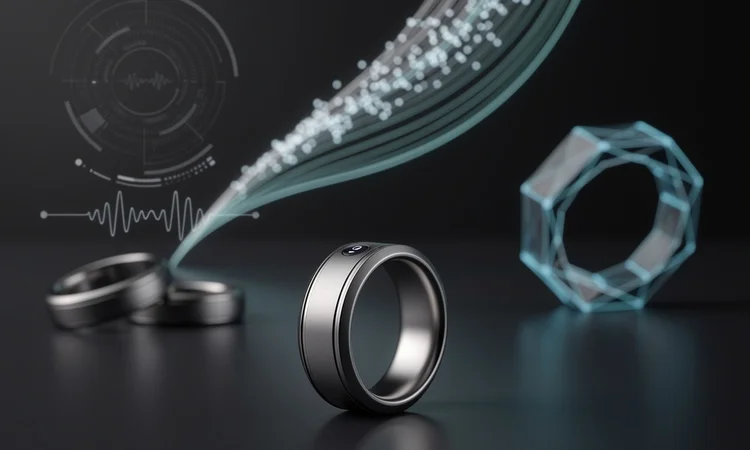
James Park and Eric Friedman, the visionaries who built Fitbit into a household name before its $2.1 billion acquisition by Google, are making an audible return to the wearable technology sector. Their new venture, Luffu, represents a calculated departure from the wrist-based devices that defined their previous company, instead betting on the nascent smart ring market with a device that promises to deliver comprehensive health tracking in a form factor that consumers have historically approached with skepticism.
According to Android Authority , the Luffu smart ring is priced at $199 and offers a subscription-free experience, a strategic positioning that directly challenges market leader Oura, whose rings start at $299 and require an ongoing monthly subscription. The device tracks sleep patterns, heart rate, blood oxygen levels, and activity metrics while promising up to seven days of battery life—specifications that place it squarely in competition with established players in an increasingly crowded market segment.
The timing of Park and Friedman’s re-emergence is particularly noteworthy. The smart ring category has experienced significant momentum over the past two years, with Samsung’s entry through the Galaxy Ring and continued growth from Oura signaling that consumers may finally be ready to embrace finger-based wearables. Yet the market remains a fraction of the size of the smartwatch segment, and previous attempts by credible companies to establish smart ring products have met with mixed results.
The Strategic Calculus Behind Form Factor Selection
The decision to pursue a ring rather than return to wrist-based devices reflects both market opportunity and practical considerations. Smart rings offer distinct advantages for sleep tracking, as many users find watches uncomfortable to wear during rest periods. The form factor also appeals to consumers who prefer traditional watches or find wrist-worn fitness trackers aesthetically incompatible with professional or formal attire.
Park and Friedman’s experience scaling Fitbit from a startup to a company that shipped over 100 million devices provides crucial institutional knowledge for navigating the challenges ahead. However, the wearable technology market they’re re-entering bears little resemblance to the one they left. Apple Watch has established dominant market share in smartwatches, while the broader fitness tracker category has contracted as smartphone capabilities have expanded and consumer preferences have shifted toward more feature-rich devices.
Differentiation in a Crowded Market
Luffu’s subscription-free model represents its most significant point of differentiation. While Oura’s $5.99 monthly membership fee generates recurring revenue that investors favor, it has also created consumer resistance. The decision to forgo subscription income places greater pressure on hardware margins and limits ongoing customer engagement opportunities, but it may prove strategically sound if it accelerates user acquisition in a market where consumers are still evaluating whether smart rings deliver sufficient value to justify their cost.
The device’s seven-day battery life positions it favorably against the Galaxy Ring’s reported seven-day capacity and well ahead of most smartwatches, which typically require daily or every-other-day charging. Extended battery life addresses one of the primary friction points in wearable adoption, though it comes with the trade-off of a larger form factor that may not appeal to all users, particularly those with smaller fingers.
Technical Specifications and Health Tracking Capabilities
Luffu incorporates sensors for continuous heart rate monitoring, blood oxygen saturation measurement, and skin temperature tracking—the core metrics that have become table stakes in the health wearable category. The ring’s ability to track sleep stages, including REM, light, and deep sleep, leverages the same algorithmic approaches that Park and Friedman refined during their Fitbit tenure, though the company has not disclosed whether they’ve developed proprietary algorithms or licensed existing technology.
The device’s activity tracking capabilities include step counting, calorie estimation, and workout detection, though the absence of GPS means that distance and pace measurements for outdoor activities will depend on paired smartphone connectivity. This limitation is inherent to the ring form factor and represents a compromise that all smart ring manufacturers face when competing against wrist-worn devices with more physical space for components.
Market Dynamics and Competitive Positioning
The smart ring market’s growth trajectory remains uncertain despite recent positive indicators. While Oura has reported strong sales and Samsung’s entry has validated the category, total unit volumes remain modest compared to the tens of millions of smartwatches sold annually. Consumer research suggests that many potential buyers remain unconvinced that rings can deliver the functionality they’ve come to expect from wrist-based devices, creating a challenging environment for new entrants.
Luffu’s $199 price point positions it in the middle of the market, below Oura’s premium offering but above emerging competitors from lesser-known brands that have flooded e-commerce platforms with rings priced under $100. This positioning suggests Park and Friedman are targeting consumers who value brand credibility and proven leadership but are unwilling to pay the premium that Oura commands or commit to ongoing subscription fees.
The Founders’ Track Record and Investor Considerations
Park and Friedman’s history with Fitbit cuts both ways when evaluating Luffu’s prospects. On one hand, they successfully built a category-defining brand and navigated the transition from startup to public company to acquisition target. Their understanding of supply chain management, regulatory compliance for health devices, and consumer marketing provides advantages that most hardware startups lack.
Conversely, Fitbit’s trajectory in its later years revealed the challenges of competing against Apple and the difficulties of maintaining growth as market dynamics shifted. The company’s ultimate sale to Google at a valuation below its previous highs, followed by Google’s subsequent struggles to revitalize the brand, demonstrates that even experienced leadership cannot always overcome structural market forces. Whether Park and Friedman have learned lessons that will enable Luffu to avoid similar pitfalls remains to be seen.
Distribution Strategy and Go-to-Market Approach
Details about Luffu’s distribution strategy remain limited, though the company has launched a website where consumers can pre-order the device. The decision to pursue direct-to-consumer sales initially is consistent with how most hardware startups approach market entry, allowing for higher margins and direct customer relationships while avoiding the complexity and cost of retail partnerships.
However, Fitbit’s success was significantly amplified by its presence in major retail chains, where impulse purchases and the ability to see products in person drove substantial sales volume. Whether Luffu will pursue similar retail distribution or remain primarily direct-to-consumer will significantly impact its growth potential and market penetration.
Regulatory Environment and Data Privacy Considerations
The regulatory environment for health wearables has evolved considerably since Park and Friedman’s Fitbit days. Increased scrutiny of data privacy practices, particularly regarding health information, has raised compliance costs and created reputational risks for companies that fail to adequately protect user data. Luffu will need to demonstrate robust data security practices and transparent privacy policies to earn consumer trust, particularly given the sensitivity of sleep and biometric data.
The device’s classification as a wellness product rather than a medical device allows Luffu to avoid the more stringent FDA approval processes that would be required for diagnostic or therapeutic claims. However, this classification also limits the types of health insights the company can provide and the language it can use in marketing materials, creating constraints on how it positions the product’s value proposition.
The Path Forward for Luffu and Smart Ring Adoption
Luffu’s success will ultimately depend on whether Park and Friedman can execute on multiple fronts simultaneously: manufacturing a reliable product at scale, creating software experiences that deliver genuine value, building brand awareness in a crowded market, and convincing skeptical consumers that smart rings deserve a place in their daily routines. Each of these challenges is formidable individually; collectively, they represent the kind of execution gauntlet that has defeated countless well-funded hardware startups.
The broader question is whether the smart ring category will achieve mainstream adoption or remain a niche product for early adopters and health enthusiasts. Park and Friedman’s involvement lends credibility to the former possibility, but credibility alone has never been sufficient to drive category creation. If Luffu succeeds, it will be because the founders have correctly identified an inflection point in consumer readiness for finger-based wearables and executed flawlessly on product development, marketing, and distribution. If it struggles, it will join the long list of hardware ventures launched by accomplished entrepreneurs who discovered that past success provides no guarantee of future results in the unforgiving world of consumer electronics.






Leave a Reply
Your email address will not be published.