








A sophisticated supply chain attack targeting the Open VSX Registry has exposed critical vulnerabilities in the developer extension ecosystem, demonstrating how threat actors are increasingly exploiting trust relationships within open-source infrastructure. The campaign, which involved typosquatted malicious extensions designed to mimic legitimate developer tools, represents a concerning evolution in software supply chain threats that could affect thousands of development teams worldwide.
According to The Hacker News , the attack leveraged carefully crafted extension names that closely resembled popular development tools, exploiting the natural tendency of developers to quickly install extensions without thoroughly verifying their authenticity. The malicious packages were uploaded to Open VSX, an open-source registry that serves as an alternative to Microsoft’s Visual Studio Code Marketplace, particularly for users of VSCodium and other open-source code editors that cannot legally access Microsoft’s proprietary marketplace.
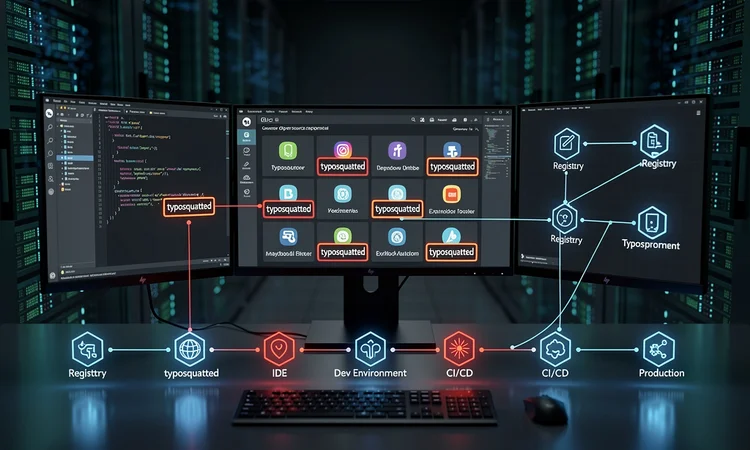
The attack methodology reveals a deep understanding of developer workflows and the extension installation process. Threat actors created extensions with names that differed by only one or two characters from legitimate, widely-used tools, banking on the likelihood that busy developers would overlook subtle naming discrepancies during installation. This typosquatting technique has proven effective in previous supply chain attacks but represents a new frontier when applied to developer tool registries that lack the same level of scrutiny as more established platforms.
The Architecture of Deception: How Malicious Extensions Infiltrated Development Pipelines
The malicious extensions contained obfuscated code designed to execute upon installation, establishing persistence within affected development environments. Once activated, the payloads were capable of exfiltrating sensitive information including authentication tokens, environment variables, and potentially source code from projects under development. The sophistication of the obfuscation techniques employed suggests that the threat actors possess significant technical expertise and understanding of how security tools scan for malicious code.
Security researchers who analyzed the malicious packages discovered that the extensions employed multi-stage payload delivery mechanisms, with initial infection vectors downloading additional components from command-and-control servers. This approach allowed attackers to evade initial detection while maintaining the flexibility to update their malicious capabilities post-installation. The modular nature of the attack infrastructure indicates a well-resourced operation with long-term objectives beyond simple credential theft.
Open VSX Registry: An Unintended Vulnerability in the Open Source Ecosystem
The Open VSX Registry was created by the Eclipse Foundation to provide an open-source alternative to proprietary extension marketplaces, filling a critical gap for developers using open-source code editors. However, this noble mission has inadvertently created a security challenge, as the registry operates with fewer resources and less stringent vetting processes than commercial alternatives. The platform relies heavily on community reporting and automated scanning tools that can be circumvented by sufficiently sophisticated threat actors.
Unlike Microsoft’s Visual Studio Code Marketplace, which benefits from substantial corporate investment in security infrastructure and manual review processes, Open VSX operates as a community-driven project with limited funding for comprehensive security measures. This disparity in resources creates an asymmetric risk profile, where attackers can exploit the trust developers place in open-source platforms while facing lower barriers to entry than they would encounter with commercial alternatives.
The Broader Implications for Software Supply Chain Security
This incident represents part of a disturbing trend in which threat actors increasingly target developer tools and infrastructure as a means of compromising downstream software products. By infiltrating development environments, attackers can potentially inject malicious code into applications before they reach end users, effectively weaponizing the software development lifecycle itself. The implications extend far beyond individual developers to encompass entire organizations and their customers.
The attack on Open VSX follows a pattern established by previous supply chain compromises, including the SolarWinds breach and numerous npm package attacks, where trusted infrastructure becomes the vector for widespread compromise. However, targeting developer extension registries represents a particularly insidious approach, as these tools often operate with elevated privileges and access to sensitive development resources including source code repositories, cloud credentials, and production deployment pipelines.
Detection Challenges and the Race Against Time
Security teams face significant challenges in detecting compromised extensions after installation, as the malicious code often mimics legitimate extension behavior while conducting unauthorized activities in the background. Traditional endpoint detection tools may not flag extension-based threats, particularly when the malicious code employs sophisticated evasion techniques and operates within the expected parameters of extension functionality. This creates a detection gap that threat actors can exploit for extended periods.
The time between initial compromise and detection represents a critical window during which attackers can establish persistence, exfiltrate sensitive data, and potentially pivot to other systems within the development environment. Organizations that rely on open-source development tools must now grapple with the reality that their extension ecosystems may harbor threats that evade conventional security controls, necessitating new approaches to monitoring and validation.
Industry Response and Mitigation Strategies
The Eclipse Foundation, which oversees the Open VSX Registry, faces pressure to enhance security measures without compromising the open and accessible nature that makes the platform valuable to the developer community. Potential improvements include implementing more rigorous automated scanning, establishing community-driven verification systems, and creating clearer indicators of extension trustworthiness. However, these measures must be balanced against the need to maintain low barriers to entry for legitimate extension developers.
Organizations can protect themselves by implementing stricter policies around extension installation, including mandatory review processes for new extensions and maintaining allowlists of approved tools. Development teams should be trained to verify extension authenticity by checking publisher information, download statistics, and community reviews before installation. Additionally, implementing network monitoring to detect unusual outbound traffic from development environments can help identify compromised systems before significant damage occurs.
The Evolution of Typosquatting as an Attack Vector
Typosquatting has evolved from a relatively unsophisticated domain-based attack into a multi-faceted threat that targets package managers, extension registries, and other software distribution platforms. The technique’s effectiveness stems from exploiting human error and the cognitive shortcuts developers take when working under time pressure. As development workflows become increasingly dependent on third-party extensions and packages, the attack surface for typosquatting campaigns continues to expand.
The success of typosquatting attacks in developer ecosystems reflects broader challenges in maintaining security within fast-paced development environments. Developers often prioritize speed and functionality over security verification, creating opportunities for threat actors to exploit trust relationships and established workflows. This cultural dimension of the problem suggests that technical solutions alone may be insufficient without accompanying changes to development practices and security awareness.
Long-Term Security Implications for Open Source Infrastructure
The attack on Open VSX raises fundamental questions about the sustainability of security in open-source infrastructure projects. As these platforms become critical components of global software development, they increasingly attract attention from sophisticated threat actors while often lacking the resources to implement enterprise-grade security measures. This creates a systemic vulnerability that could undermine confidence in open-source alternatives to commercial platforms.
The incident may accelerate discussions about funding models for open-source security, including potential corporate sponsorship programs, government grants, or community-funded security initiatives. Without sustainable funding for security infrastructure, open-source projects risk becoming the weakest link in software supply chains, potentially driving developers back toward proprietary alternatives that can invest more heavily in security measures. This would represent a significant setback for the open-source movement and could concentrate power further in the hands of large technology companies.
Moving Forward: Building Resilience in Developer Tool Ecosystems
The path forward requires a multi-stakeholder approach involving platform operators, security researchers, extension developers, and the broader developer community. Open VSX and similar registries must invest in enhanced security capabilities while maintaining their commitment to openness and accessibility. This may include implementing reputation systems, establishing trusted publisher programs, and developing more sophisticated automated scanning capabilities that can detect obfuscated malicious code.
Developers and organizations must also adapt their practices to account for the evolving threat environment. This includes treating extension installation as a security-critical decision requiring verification and approval, implementing monitoring systems to detect unusual behavior from installed extensions, and maintaining incident response capabilities specifically tailored to supply chain compromises. As the software development ecosystem continues to evolve, security must become an integral consideration at every layer of the toolchain, from individual extensions to the registries that distribute them.






Leave a Reply
Your email address will not be published.