




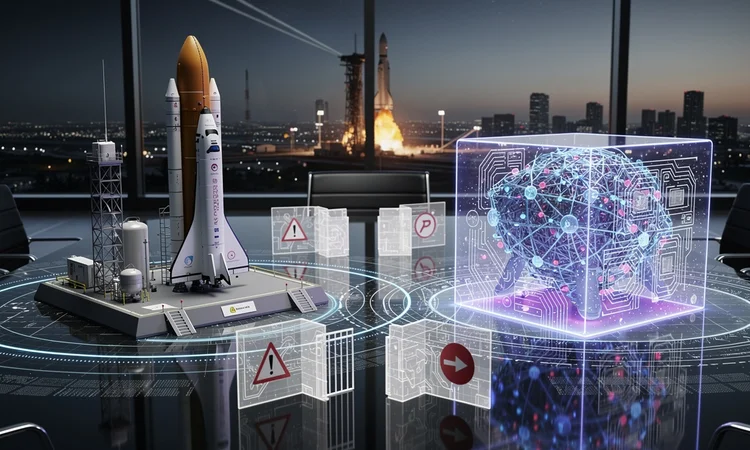
Elon Musk’s empire-building ambitions have taken a dramatic turn as internal discussions reveal serious consideration of merging his rocket company SpaceX with his artificial intelligence startup xAI. The potential combination, first reported by The Information , would create an unprecedented conglomerate combining space exploration, satellite internet, and cutting-edge AI development under one corporate umbrella. This merger discussion represents more than just corporate restructuring—it signals Musk’s vision of creating a vertically integrated technology powerhouse that could dominate multiple industries simultaneously.
The proposed merger comes at a pivotal moment for both companies. SpaceX, valued at approximately $210 billion in its most recent funding round, has established itself as the world’s dominant commercial space company, launching more rockets than any other entity and operating the Starlink satellite constellation. Meanwhile, xAI, founded in July 2023, has rapidly emerged as a formidable competitor in the artificial intelligence race, recently securing a $6 billion funding round that valued the company at $40 billion. According to The Information , Musk has personally advocated for combining the companies, arguing that xAI’s advanced AI systems could enhance SpaceX’s rocket technology, autonomous spacecraft operations, and the performance of its Starlink satellite network.
The Strategic Rationale Behind an Unprecedented Corporate Marriage
The synergies between SpaceX and xAI extend far beyond simple cost-sharing arrangements. Industry analysts suggest that integrating xAI’s large language models and machine learning capabilities into SpaceX’s operations could revolutionize everything from launch trajectory optimization to autonomous spacecraft docking procedures. The Starlink constellation, which currently comprises over 5,000 satellites providing internet service to customers worldwide, could particularly benefit from AI-driven network management, predictive maintenance algorithms, and enhanced signal processing capabilities. This technological fusion could create competitive advantages that would be nearly impossible for rivals to replicate.
However, the merger faces significant obstacles that extend beyond typical corporate integration challenges. SpaceX’s existing investors, who have poured billions into what they understood to be primarily a space transportation and satellite internet business, may resist the fundamental transformation of their investment thesis. The company’s valuation assumes specific growth trajectories in launch services and Starlink subscriptions—not speculative AI development that could divert resources and management attention. According to sources familiar with the discussions cited by The Information , some SpaceX investors have expressed concerns about dilution and strategic focus, questioning whether combining the companies truly serves their interests or primarily benefits Musk’s broader vision.
Regulatory Hurdles and National Security Implications
The regulatory complexity of merging SpaceX and xAI cannot be overstated. SpaceX operates under extensive oversight from multiple federal agencies, including NASA, the Federal Aviation Administration, the Federal Communications Commission, and the Department of Defense. The company holds numerous classified contracts and maintains security clearances that give it access to sensitive national security information. Introducing an AI company into this tightly controlled environment would trigger intensive scrutiny from regulators concerned about data security, foreign investment restrictions, and the potential for AI systems to access classified information.
The Committee on Foreign Investment in the United States (CFIUS) would likely conduct a thorough review of any merger, particularly given xAI’s recent funding rounds that may have included international investors. The Pentagon’s increasing reliance on SpaceX for critical national security launches—including spy satellites and military communications infrastructure—means that any corporate restructuring affecting SpaceX requires careful evaluation of potential security risks. Defense Department officials have privately expressed concerns about the concentration of critical space infrastructure under entities that might prioritize commercial AI development over national security considerations, though no formal opposition has been announced.
Financial Engineering and Valuation Challenges
Determining the appropriate merger terms presents extraordinary valuation challenges. SpaceX’s $210 billion valuation reflects its dominant market position, proven revenue streams from launch services and Starlink subscriptions, and long-term contracts with government and commercial customers. In contrast, xAI’s $40 billion valuation, achieved less than two years after its founding, is based largely on potential rather than realized revenue. The company’s flagship product, the Grok chatbot, competes in an increasingly crowded market against OpenAI’s ChatGPT, Google’s Gemini, and Anthropic’s Claude. Reconciling these divergent valuation methodologies in a merger structure that satisfies both companies’ investors requires financial creativity that may prove elusive.
The proposed transaction would also need to address the dramatically different capital requirements of the two businesses. SpaceX’s operations demand enormous ongoing capital expenditures for rocket development, launch infrastructure, and Starlink satellite manufacturing and deployment. The company reportedly generates several billion dollars in annual revenue, providing some self-funding capability, but continues to raise external capital for expansion. xAI, meanwhile, requires massive investments in computing infrastructure, with the company recently completing construction of a supercomputer facility in Memphis featuring tens of thousands of Nvidia GPUs. Merging these capital-intensive operations could strain even the combined entity’s fundraising capabilities, particularly if investors grow skeptical about the strategic rationale.
The Precedent of Musk’s Cross-Company Resource Sharing
This potential merger represents the formalization of resource-sharing practices that Musk has employed across his corporate empire for years. Tesla engineers have reportedly worked on projects for SpaceX, Neuralink, and The Boring Company, while executives frequently move between Musk’s various ventures. This cross-pollination has enabled rapid innovation but has also raised questions about conflicts of interest and whether public company resources—particularly Tesla’s—are being appropriated for private ventures. The proposed SpaceX-xAI merger would bring some of these arrangements into a more transparent corporate structure, though questions about governance and resource allocation would persist.
Critics have pointed to Musk’s management of X (formerly Twitter) as a cautionary tale about the risks of divided attention and strategic drift. Since acquiring the social media platform for $44 billion in 2022, Musk has simultaneously run Tesla, SpaceX, xAI, Neuralink, and The Boring Company, leading to concerns about whether any single executive can effectively manage such diverse operations. The potential merger would theoretically reduce the number of separate entities requiring Musk’s attention, but would create an organization of such scope and complexity that management challenges could actually intensify.
Competitive Dynamics and Industry Reactions
The potential creation of a SpaceX-xAI combination has sent ripples through both the aerospace and artificial intelligence industries. Competitors in the commercial space sector, including Blue Origin, Rocket Lab, and United Launch Alliance, are closely monitoring developments, recognizing that a merged entity with advanced AI capabilities could accelerate SpaceX’s already formidable competitive advantages. In the AI sector, companies like OpenAI, Anthropic, and Google DeepMind face the prospect of competing against an organization with unique access to vast amounts of satellite data, space-based computing potential, and essentially unlimited capital from SpaceX’s profitable operations.
Some industry observers suggest that the merger discussions may be part of a broader negotiating strategy rather than a definitive plan. By floating the possibility of a merger, Musk may be seeking to encourage greater cooperation between the companies, facilitate investor acceptance of resource sharing, or establish valuation benchmarks for future fundraising. The complexity of actually consummating such a transaction—navigating regulatory approvals, satisfying diverse investor constituencies, and integrating vastly different corporate cultures—may prove insurmountable, rendering the merger more valuable as a concept than as a reality.
The Long-Term Vision: Mars, AI, and Technological Convergence
Understanding Musk’s merger ambitions requires examining his frequently stated long-term objectives, particularly the establishment of a self-sustaining human civilization on Mars. This goal, which Musk has described as essential for ensuring humanity’s survival as a multi-planetary species, demands technological capabilities that span multiple disciplines. Advanced AI systems would be crucial for managing the complex logistics of interplanetary travel, operating autonomous systems in hostile environments, and making real-time decisions during missions where communication delays with Earth render human control impractical. From this perspective, merging SpaceX and xAI represents not corporate opportunism but a logical step toward achieving an ambitious civilizational objective.
The integration of AI into space operations aligns with broader industry trends. NASA has increasingly incorporated machine learning into mission planning and spacecraft operations, while commercial satellite operators use AI for everything from image analysis to orbital debris avoidance. A merged SpaceX-xAI entity could accelerate these developments, potentially creating AI systems specifically optimized for space applications—a niche that current general-purpose AI models do not adequately address. Such specialized capabilities could open new revenue streams while advancing Musk’s Mars colonization timeline, creating a rare alignment of commercial and ideological objectives.
Investor Perspectives and the Path Forward
The ultimate fate of the proposed merger will likely be determined by investor reactions rather than regulatory barriers or technical considerations. SpaceX’s investor base includes some of the world’s most sophisticated institutional investors, venture capital firms, and strategic partners who have committed capital based on detailed financial projections and risk assessments. Fundamentally altering the company’s mission and capital allocation priorities requires convincing these stakeholders that the merger creates value rather than destroys it. Given the disparate nature of the businesses and the unproven synergies, securing investor approval may prove challenging even if Musk’s controlling position gives him significant leverage.
As discussions continue, the proposed merger serves as a reminder of the unprecedented concentration of technological capability and ambition in Musk’s corporate empire. Whether the SpaceX-xAI combination ultimately proceeds or remains an unrealized vision, the mere consideration of such a transaction illustrates how the boundaries between industries—space, AI, telecommunications, and transportation—are dissolving in ways that challenge traditional corporate structures and regulatory frameworks. The coming months will reveal whether this audacious proposal represents the future of technology conglomerates or an overreach that even Musk’s considerable persuasive abilities cannot overcome.






Leave a Reply
Your email address will not be published.