









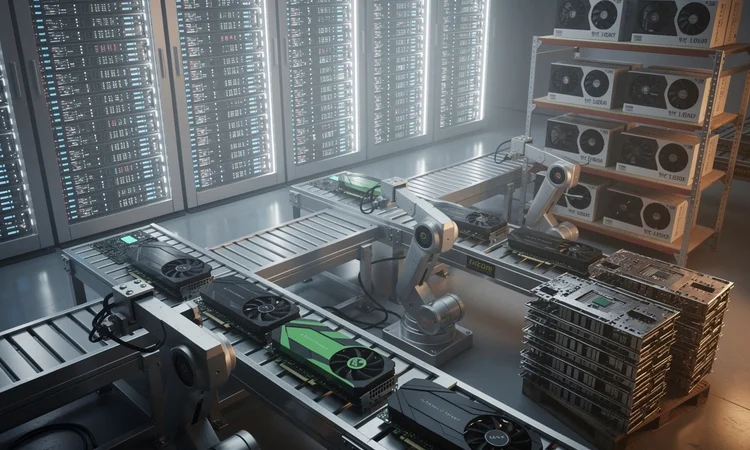
Nvidia’s Memory Squeeze: Why RTX 50-Series GPUs Might Become Scarce in 2026
In the high-stakes world of semiconductor manufacturing, Nvidia Corp. is reportedly preparing to throttle back production of its latest GeForce RTX 50-series graphics processing units (GPUs) by as much as 40% in the first half of 2026. This move, driven by persistent shortages in high-speed memory components, could ripple through the gaming and consumer electronics markets, affecting everything from PC builds to pricing dynamics. Industry sources indicate that the cuts are a strategic response to supply chain bottlenecks, particularly in GDDR7 video random access memory (VRAM), which is essential for the performance of these cutting-edge cards.
The decision comes at a time when Nvidia is juggling booming demand for artificial intelligence (AI) hardware with its traditional stronghold in gaming graphics. According to reports from supply chain insiders in Asia, the production reduction is not a sign of faltering interest in gaming but rather a calculated adjustment to avoid overstocking amid constrained resources. Nvidia’s RTX 50-series, including models like the RTX 5090 and RTX 5080, launched earlier this year with promises of superior ray tracing and AI-enhanced upscaling, but the company now faces external pressures that could limit availability.
Analysts suggest that this isn’t Nvidia’s first brush with supply issues. The company has navigated similar challenges in the past, such as during the cryptocurrency mining boom and the global chip shortage exacerbated by the pandemic. However, this time, the focus is squarely on memory suppliers like Samsung Electronics Co. and SK Hynix Inc., who are prioritizing allocations for AI data centers over consumer GPUs. As a result, Nvidia may need to redirect its own resources, potentially favoring its lucrative AI business lines.
The Roots of the Shortage
Details emerging from various tech publications paint a picture of a multifaceted crisis. For instance, TechRadar reports that Nvidia is rumored to slash RTX 5000 supply by 30% to 40% in early 2026, with the cuts hitting mid-range models like the RTX 5070 and RTX 5060 Ti hardest. This aligns with insights from Asian board partners, who anticipate a significant drop in shipments compared to 2025 levels.
The core issue revolves around GDDR7 memory, a next-generation standard that offers faster data transfer rates crucial for handling modern games’ demanding textures and resolutions. Production of GDDR7 is ramping up slowly, hampered by manufacturing complexities and competition from other sectors. Windows Central highlights how the AI boom is exacerbating the problem, as data center operators snap up memory modules for training large language models, leaving less for gaming applications.
Nvidia’s response appears pragmatic: by reducing output, the company aims to prevent inventory buildup that could lead to price erosion or unsold stock. This strategy echoes past maneuvers, such as during the RTX 30-series era when Nvidia adjusted production amid fluctuating cryptocurrency demands. Yet, insiders note that the current cuts could be more pronounced, potentially affecting up to 40% of planned volumes in the first six months of 2026.
Impacts on Gamers and the Market
For consumers, this development could mean higher prices and longer wait times for RTX 50-series cards, especially as holiday seasons approach in late 2026. Enthusiasts who delayed upgrades in anticipation of better availability might find themselves competing in a tighter market. PC Gamer suggests that while there’s currently an excess of RTX 50-series stock from earlier overproduction, the long-term outlook points to scarcity if memory supplies don’t rebound.
Broader market implications extend to PC manufacturers and retailers. Companies like Dell Technologies Inc. and HP Inc., which integrate Nvidia GPUs into their gaming laptops and desktops, may face component shortages, delaying product launches or forcing price hikes. Retailers such as Best Buy Co. and Amazon.com Inc. could see reduced stock levels, potentially boosting secondary market prices on platforms like eBay.
Social media chatter on platforms like X (formerly Twitter) reflects growing concern among gamers. Posts from tech influencers and enthusiasts express frustration over potential artificial scarcity, with some speculating that Nvidia is engineering hype to maintain premium pricing. One prominent thread noted Nvidia’s history of supply manipulations, drawing parallels to earlier series where limited availability drove up demand and resale values.
Supply Chain Dynamics at Play
Diving deeper into the supply chain, reports from TechPowerUp cite sources from Board Channels, an Asian forum for hardware partners, indicating that Nvidia informed add-in-board (AIB) manufacturers of the cuts weeks ago. These partners, including AsusTek Computer Inc. and MSI, rely on steady GPU die supplies from Nvidia to assemble and brand their cards. A 30-40% reduction could force them to scale back operations or pivot to alternative products.
The memory shortage isn’t isolated to Nvidia. Competitors like Advanced Micro Devices Inc. (AMD) are also grappling with similar constraints for their RDNA 4 architecture, though AMD’s smaller market share in high-end gaming might buffer some impacts. VideoCardz points out that mid-tier RTX 5070 Ti and 5060 Ti models will likely feel the pinch first, as they depend heavily on cost-effective GDDR7 configurations.
Geopolitical factors add another layer of complexity. Trade tensions between the U.S. and China, coupled with export restrictions on advanced semiconductors, have disrupted global supply lines. Memory production, concentrated in South Korea and Taiwan, faces risks from natural disasters or political instability, further straining availability.
Nvidia’s Strategic Pivot
Nvidia’s leadership, under CEO Jensen Huang, has increasingly emphasized AI and data center revenues, which now dwarf its gaming segment. Financial filings show that in the most recent quarter, data center sales accounted for over 80% of revenue, compared to gaming’s 10-15%. This shift might explain why the company is willing to deprioritize consumer GPUs when memory is scarce, reallocating resources to higher-margin AI chips like the Blackwell series.
However, this doesn’t mean Nvidia is abandoning gaming. OC3D reports that the production cuts are tied directly to rising memory costs, which could make continued high-volume manufacturing unprofitable. By trimming output, Nvidia aims to stabilize prices and maintain profit margins, potentially introducing efficiency improvements in future batches.
Industry watchers speculate on workarounds, such as Nvidia negotiating exclusive deals with memory suppliers or investing in alternative technologies like on-die memory integration. Partnerships with firms like Micron Technology Inc. could help mitigate shortages, though ramp-up times remain a hurdle.
Broader Industry Ramifications
The ripple effects extend beyond Nvidia’s ecosystem. Game developers, who optimize titles for RTX features like DLSS (Deep Learning Super Sampling), might see slower adoption if hardware becomes harder to obtain. This could slow innovation in graphics-intensive games, affecting studios like Epic Games Inc. and Unity Technologies.
On the investment front, Nvidia’s stock has shown resilience despite the news, with shares dipping only modestly in after-hours trading. Analysts from firms like Goldman Sachs Group Inc. view the cuts as a short-term adjustment rather than a fundamental weakness, given Nvidia’s dominant position in AI.
Consumer sentiment, as gleaned from X posts, mixes alarm with skepticism. Some users accuse Nvidia of creating false scarcity to inflate prices, referencing past instances where limited supply led to scalping. Others point to overstock issues earlier in 2025, suggesting the cuts are a corrective measure.
Potential Paths Forward
Looking ahead, Nvidia could accelerate diversification of its supply chain, perhaps by fostering more U.S.-based memory production through incentives from the CHIPS Act. Collaborations with Intel Corp.’s foundry services might also provide alternatives, though timelines for such shifts are lengthy.
For gamers, the advice from experts is to act sooner rather than later. With current stock levels healthy, as noted in PCMag , 2025 might be the optimal window for upgrades before 2026 constraints tighten.
Ultimately, this episode underscores the fragility of global tech supply chains. As demand for advanced computing surges across sectors, companies like Nvidia must balance competing priorities, ensuring that innovations in one area don’t starve another. While the RTX 50-series production cuts may cause short-term disruptions, they could pave the way for more sustainable manufacturing practices in the years ahead.
Wccftech echoes this sentiment, warning of long-term memory shortages that could make RTX 50 GPUs “vanish” from shelves if unresolved. As the industry adapts, stakeholders from chipmakers to end-users will watch closely for signs of recovery.






Leave a Reply
Your email address will not be published.