







Procurement executives, long battered by digital transformation promises that fizzled into stalled pilots, are now demanding hard proof that artificial intelligence delivers bottom-line impact. Leagh Turner, CEO of Coupa, captured the sentiment in a Forbes Technology Council article : “How do we make this pay off? After decades of transformation promises and stalled pilots, procurement leaders today want proof that AI can deliver real ROI where it matters—the bottom line.”
The shift comes as AI moves from experimental hype to operational reality in spend management, finance and supply chains. Companies succeeding with AI treat it as a tool for specific outcomes rather than an end in itself, according to Turner’s analysis of Coupa’s Clarity Survey of hundreds of customers. This practical mindset prompts three critical questions: What business outcome are we targeting? What data do we have? How must workflows change to make AI measurable?
Yet progress remains uneven. A 2025 Wharton GBK AI adoption report found procurement leading in generative AI use and confidence, with 72% measuring ROI and 74% reporting positive returns. McKinsey pegs potential efficiency gains at 25-40% in procurement operations. Still, four in five organizations see no bottom-line impact from AI rollouts, per McKinsey, as generic tools clash with legacy systems.
Three Barriers Blocking Scale
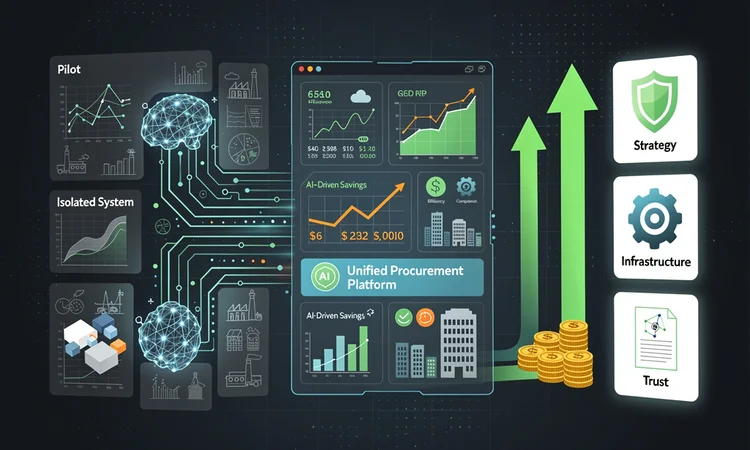
Coupa’s survey identifies three gaps stalling AI: strategy shortfalls where funding precedes problem definition; infrastructure deficits in data quality, integration and skills; and trust issues demanding verifiable results plus human oversight for complex calls. About 80% of organizations now favor AI-native platforms with governed data over scattered point solutions, favoring unified systems like Coupa’s, which draws on a network processing over $8 trillion in spend.
“Technology by itself does not deliver ROI. People do,” Turner writes. AI excels at removing manual drudgery—reconciliation, invoicing, approvals—freeing undersized teams for strategic supplier engagement and risk mitigation. But this requires upskilling procurement staff into AI enablers with digital fluency.
No pristine dataset is needed to start, Turner argues: “A common misconception is that you need perfect data before AI can drive value. My view is different. Data already exists—often buried in legacy systems, disconnected spreadsheets or even paper archives.” Agentic AI iteratively learns from transactional history for domain-specific wins like category savings or cycle-time cuts.
Real-World Gains Emerge
Coupa customers managed $425 billion in spend from August to October 2025, netting nearly $15 billion in savings and pushing lifetime totals to $288 billion, per a Yahoo Finance report . “Coupa’s ‘network effect’ is clear—quarter after quarter, we see many new customers come to Coupa to transform how they manage business spend using AI,” Turner said.
Specific applications shine: AI unifies spend views, accelerates contract analysis, provides negotiation intelligence, enables natural-language reporting and flags fraud autonomously. Efficio Consulting notes clients expanding category and supplier coverage exponentially, tying AI to KPIs like cycle time and savings, though data fragmentation remains the top scaling bottleneck.
In SupplyChainBrain, analysts warn 2026 separates ROI achievers from laggards: “For procurement and supply-chain leaders, 2026 will be the decisive year that separates those who can demonstrate ROI from those who cannot.” Deloitte’s 2025 survey shows 85% of leaders boosted AI spend, but paybacks stretched to 2-4 years amid pilot purgatory—90% of vertical use cases stuck there.
Skills and Platforms Take Center Stage
Wayne Clark, vice president of procurement transformation at GEP, told Procurement Magazine : “AI is not hype. It’s already a US$200bn industry and projected to grow to US$1.2tn by 2030.” Success hinges on culture—literacy, curiosity, judgment—over tech stacks alone, per GEP’s 2026 Outlook.
Efficio’s Jose Oliveira and Geoffrey Boutin urge three priorities: connected data foundations; AI embedded in workflows via copilots; people investments in prompt engineering and scenario design. Agentic systems for multi-step tasks like RFP drafting loom large, alongside ERP convergence and knowledge graphs for supply intelligence.
CIO.com reports mounting pressure: Kyndryl’s 2025 Readiness Report shows 61% of 3,700 leaders facing greater ROI scrutiny. MIT pegs GenAI project failure at 95% without six-month financial returns. Matt Marze, CIO at New York Life Group Benefit Solutions, insists: “All along the value question, the ROI was very top of mind,” funding AI from earnings plans.
Navigating Risks and Building Trust
Trust gaps persist; AI demands transparency in two forms, per cfotech: model traceability and decision auditability. SupplyChainBrain notes back-office automation like procurement offers superior ROI to sales tools, yet grabs fewer budgets. Leaders must kill non-performers within 18 months, focusing quick wins like intake routing alongside long-term process redesigns.
Coupa’s Navi AI agents exemplify progress, delivering real-time insights and automation across source-to-pay. As Turner puts it: “The next frontier for business will be measured by how rapidly you can turn real data, real platforms and real people into better outcomes.” Procurement’s evolution from cost center to strategic force accelerates, but only for those grounding AI in disciplined execution.
By 2026, Gartner predicts 90% of B2B buying AI-agent intermediated, channeling $15 trillion through exchanges. Federal agencies eye AI for contract evaluation, per iQuasar. Oracle claims up to 80% task-time cuts in procurement via embedded AI. The message is clear: Data readiness, workflow redesign and human-AI synergy define winners.






Leave a Reply
Your email address will not be published.