







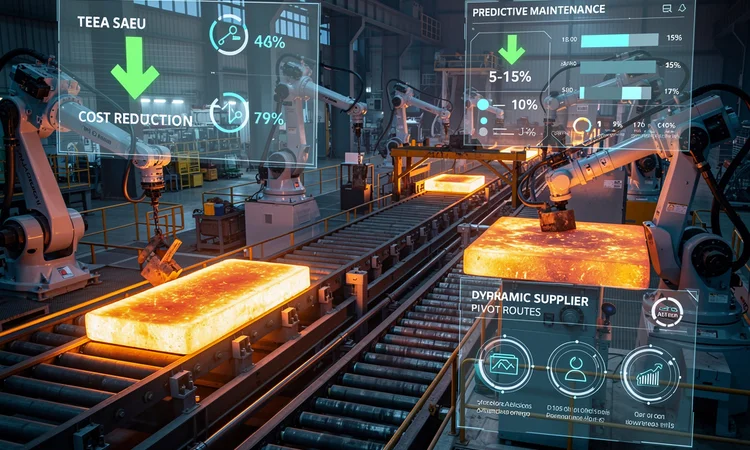
In the high-stakes arena of steel production, where raw materials devour 60-80% of costs, agentic AI is emerging as a relentless force, autonomously handling procurement to slash expenses and upend traditional roles. Tata Consultancy Services outlines in its white paper how these systems ingest context from supplier databases, spend histories, and market intelligence to reason, negotiate via rules, issue purchase orders, and learn from feedback loops, positioning them as “intelligent buyers” in an industry squeezed by thin margins of 45-55%.
For a large Indian steel producer, low-cost consumables alone tally $3.5 billion annually; a mere 1% savings via AI yields $35 million, with implementation costs dwarfed by the gains, according to the TCS white paper . Agentic AI targets tactical procurement—RFPs, tender evaluations, contract enforcement—reducing manual tasks by 50-80% and freeing full-time equivalents for strategic pursuits amid geopolitical risks affecting over 60% of raw material sources.
Yet steel’s unique demands, from massive volumes to regulatory scrutiny, test AI’s mettle. “Raw material and fuel costs typically make up 60-80% of production costs,” the TCS report notes, underscoring procurement’s leverage in a sector plagued by low profitability.
Procurement’s AI Overhaul
Agentic AI dismantles steel’s cumbersome procurement chain: sourcing strategies, RFx processes, negotiations, PO issuance, and risk monitoring. It automates low-value, high-volume buys like consumables, refractories, and scrap, piloting in low-complexity categories before scaling to iron ore and fuels. A phased rollout—data cleanup of supplier masters and spend cubes, process standardization, dashboards for metrics—promises spend under management rising from 70% to 80-90%, per TCS metrics.
Purchase price variance improves from +2% to zero or negative; PO cycle time drops from five days to 2-3; automation rates surge past 80%; maverick spend falls below 5%. Procurement costs as a percentage of spend halve to 0.4-0.5%, with FTEs per $1 billion spend declining from 45 to 25-30, alongside 5-15% overall spend reductions.
Real-world echoes abound. Ampcome reports a major steel facility deploying agentic AI for predictive maintenance, where agents detect vibrations at 3 a.m., predict bearing failures, order parts, and adjust schedules, extending to autonomous procurement during disruptions by scouting alternatives and negotiating terms ( Ampcome ).
Workforce Reinvention Underway
Steel procurement roles evolve dramatically. Gone are routine PO issuances, invoice matching, and risk triage; in their place, strategic supplier partnerships, green sourcing innovations like scrap circularity, AI oversight via dashboards, and ESG planning. TCS envisions smaller, high-value teams, reskilling specialists or streamlining headcounts as digitization boosts revenue per employee.
Challenges loom: data fragmentation in legacy firms, change resistance, governance for audits and ESG compliance. Human-in-the-loop safeguards persist for judgment calls, yet AI’s edge in real-time monitoring outpaces humans. Ripik.ai highlights steel-specific applications, like agents adjusting blast furnace oxygen flows from visual data for combustion efficiency, while managing procurement disruptions by rerouting deliveries ( Ripik.ai ).
Ocunapse details a metalworking factory’s “Forge” agent spotting European steel delays from strikes, pivoting to local suppliers, renegotiating rates, and generating reports—keeping production seamless without manager intervention ( Ocunapse ).
Steel-Specific Gains and Metrics
In automotive steel coil monitoring, Gleecus notes agentic AI predicts shortages, automates reorders, averting assembly halts costing thousands hourly, with implementations cutting unplanned downtime 15% and lifting productivity 5-20% ( Gleecus ). ET Edge Insights covers metals procurement, where AI analyzes global markets for price, sustainability, and certifications, sourcing options in minutes and drawing from adjacent industries.
The agents source quotes, monitor performance, reroute amid disruptions, and negotiate within policy bounds, shortening cycles, curbing price exposure, and automating routines to free humans for R&D and risk strategy ( ET Edge Insights ). Deloitte emphasizes orchestrating agents across plants for efficiency, agility, and quality, transcending reactive systems.
McKinsey reports manufacturers achieving defect-detection gains and over 20% inventory/logistics cuts via autonomous routing, with transactional times shrinking from days to minutes ( McKinsey ).
Implementation Roadmaps and Hurdles
TCS advocates starting with pilots in consumables for 20% FTE reductions and 5% spend cuts, scaling strategically. EY describes agents analyzing IoT data for predictive maintenance, automating repairs and parts procurement to minimize downtime, while simulating supplier scenarios for resilience ( EY ).
JAGGAER flags manufacturing’s procurement complexities—high-speed cycles, custom BOMs, multi-tier risks—met by process-specific agents like BOM-based supplier selectors. XMPRO projects agentic AI markets hitting $156 billion by 2034, with manufacturing saving 10,000+ man-hours yearly via multi-agent setups, ROI exceeding 250% in 24 months ( XMPRO ).
Governance remains key: aligning with regulations, embedding human oversight, addressing overestimation of impacts. As AVEVA’s Ted Combs notes, agents deliver transformation without operational overhauls, knitting digital systems for workflow automation.
Broader Ripples in Heavy Industry
Beyond steel, agentic AI infiltrates supply chains globally. Intellectyx envisions procurement agents renegotiating contracts on commodity shifts; Akira.ai agents manage price variance by timing buys. On X, John Galt Solutions touts its Atlas platform’s context-aware supply chain decisions, while Lyzr AI claims vendor discovery in three minutes versus days, with 99.2% OCR accuracy and 40-60% TCO cuts.
These threads converge on steel’s future: resilient, cost-lean operations where AI agents shoulder procurement’s grind, elevating humans to innovation. TCS warns of limits—domain tailoring, cultural shifts—but metrics signal a pivot point, with steel mills poised to forge ahead smarter and stronger.






Leave a Reply
Your email address will not be published.