







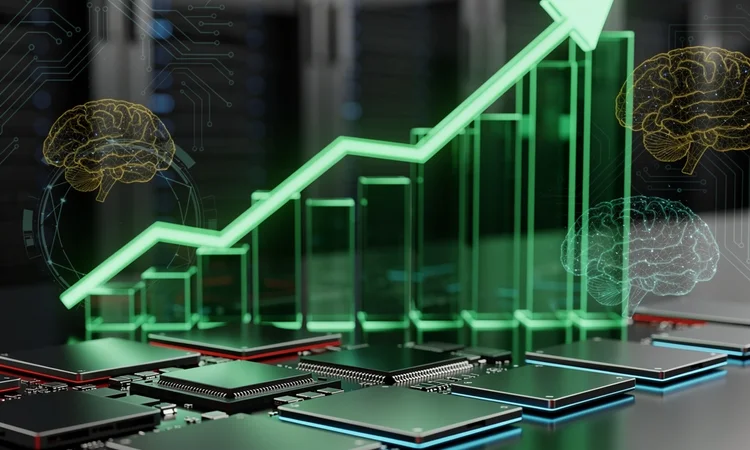
The data storage industry, long considered a commoditized corner of the technology sector, is experiencing an unexpected transformation as artificial intelligence workloads reshape demand patterns and profit margins. SanDisk’s remarkable surge on Friday—following its projection of third-quarter profit and revenue substantially exceeding Wall Street expectations—signals a fundamental shift in how the market values memory and storage infrastructure. According to Reuters , the company’s stock rally reflects growing investor recognition that AI’s insatiable appetite for data storage represents a structural growth opportunity rather than a cyclical uptick.
The semiconductor memory sector has historically been characterized by boom-and-bust cycles driven by oversupply and pricing pressure. However, the emergence of large language models, generative AI applications, and enterprise AI deployments has created sustained demand for high-performance storage solutions that can handle massive datasets and rapid read-write operations. SanDisk’s blowout forecast suggests that companies positioned at the intersection of storage technology and AI infrastructure are capturing premium valuations as enterprises race to build out their artificial intelligence capabilities.
The Memory Market’s AI-Driven Transformation
Traditional data storage demand has been relatively predictable, driven by incremental increases in consumer device capacity and enterprise data center expansion. The AI revolution has upended these assumptions. Training a single large language model can require processing petabytes of data, while inference operations—the actual deployment of AI models—demand storage systems capable of delivering data with minimal latency. This has created a bifurcated market where commodity storage products face continued pricing pressure, while specialized AI-optimized storage solutions command significant premiums.
SanDisk’s strategic positioning within this evolving market reflects broader industry dynamics. The company has invested heavily in high-bandwidth memory technologies and enterprise-grade solid-state drives optimized for AI workloads. These products feature enhanced endurance ratings, superior thermal management, and advanced controller architectures designed to handle the unique access patterns generated by machine learning applications. The premium pricing power these specialized products enjoy has fundamentally altered SanDisk’s margin profile, enabling the company to project earnings that significantly exceed historical norms.
Supply Chain Dynamics and Manufacturing Capacity
The memory and storage industry operates with long lead times for capacity expansion, creating supply-demand imbalances that can persist for extended periods. Current industry dynamics suggest that demand for AI-optimized storage is outpacing manufacturing capacity additions, particularly for advanced node NAND flash memory. This supply constraint has enabled pricing discipline across the sector, with leading manufacturers exercising restraint in capacity additions to preserve profitability rather than engaging in the destructive price wars that characterized previous cycles.
SanDisk’s manufacturing footprint and technology partnerships position the company to capitalize on these favorable supply dynamics. The firm has maintained close relationships with foundry partners and invested in advanced packaging technologies that enhance storage density and performance. These capabilities are increasingly critical as AI applications demand not just more storage capacity, but storage systems that can deliver data at unprecedented speeds while managing power consumption—a crucial consideration for data centers operating at scale.
Enterprise AI Adoption Accelerates Storage Investment
The enterprise technology spending landscape is undergoing a significant reallocation, with AI infrastructure capturing an increasing share of capital budgets. Chief information officers are prioritizing investments in the foundational technologies required to deploy AI applications, including high-performance computing systems, networking infrastructure, and storage arrays. This spending shift represents a multi-year tailwind for companies like SanDisk that provide essential components of the AI technology stack.
Fortune 500 companies are moving beyond experimental AI pilots to production deployments that require robust, scalable storage infrastructure. Financial services firms are implementing AI-powered fraud detection systems that analyze transaction data in real-time. Healthcare organizations are deploying medical imaging AI that requires rapid access to vast libraries of diagnostic images. Retail companies are using AI-driven recommendation engines that process customer behavior data across multiple channels. Each of these applications generates substantial storage requirements, with performance characteristics that exceed what traditional storage systems can deliver.
The Economics of AI Storage: Premium Pricing and Margin Expansion
SanDisk’s forecast-beating projections reflect the economic transformation occurring within the storage sector. The company’s product mix has shifted toward higher-value offerings designed specifically for AI workloads, enabling margin expansion that would have seemed implausible during the commoditization era. Enterprise customers are demonstrating willingness to pay premium prices for storage solutions that deliver measurable performance advantages in AI applications, recognizing that storage bottlenecks can significantly impact the return on investment from expensive AI infrastructure.
This pricing power extends across multiple product categories. High-capacity solid-state drives optimized for AI training workloads command prices per terabyte that substantially exceed commodity SATA drives. Enterprise-grade memory cards designed for edge AI applications in autonomous vehicles and industrial automation systems sell at premiums reflecting their reliability and performance specifications. Even consumer-oriented products targeting content creators working with AI-enhanced video editing tools benefit from the halo effect of AI-associated branding and capabilities.
Competitive Positioning in a Concentrated Market
The memory and storage industry has consolidated significantly over the past decade, with a handful of major players controlling the majority of global production capacity. This market structure has enabled more rational pricing behavior and reduced the risk of the catastrophic oversupply situations that periodically devastated industry profitability. SanDisk’s position within this oligopolistic market structure, combined with its technology differentiation in AI-optimized products, provides competitive advantages that are difficult for smaller players to replicate.
The company faces competition from established semiconductor manufacturers and emerging specialized storage vendors, but its scale advantages in manufacturing and established relationships with hyperscale cloud providers create meaningful barriers to entry. Major cloud computing platforms are among the largest consumers of storage infrastructure, and their AI service offerings generate massive internal demand for high-performance storage. SanDisk’s ability to meet the volume, performance, and reliability requirements of these demanding customers provides revenue visibility that supports aggressive growth projections.
Technology Roadmap and Innovation Imperatives
Sustaining premium valuations in the technology sector requires continuous innovation and technology leadership. SanDisk’s research and development investments focus on next-generation memory technologies that promise to deliver the performance characteristics required by future AI applications. The company is exploring computational storage architectures that move processing closer to data, reducing the energy and latency costs of moving information between storage and compute resources—a critical consideration as AI models continue to scale in size and complexity.
Emerging memory technologies such as persistent memory and storage-class memory blur the traditional boundaries between volatile RAM and non-volatile storage, offering performance characteristics that could unlock new AI application architectures. SanDisk’s participation in industry standards bodies and collaborative research initiatives positions the company to influence the evolution of storage technologies and ensure its products remain aligned with the requirements of AI system designers. The company’s patent portfolio in advanced memory controller designs and error correction algorithms provides additional competitive moats.
Market Valuation and Investor Sentiment
SanDisk’s stock surge reflects a broader reassessment by investors of how to value companies participating in the AI infrastructure buildout. Traditional valuation metrics based on historical earnings multiples may understate the growth potential of firms positioned to capture sustained demand from AI adoption. The market is increasingly willing to assign premium valuations to companies with credible claims to being essential enablers of AI deployment, even in sectors like data storage that were previously viewed as mature and commoditized.
The company’s blowout forecast provides concrete validation of the AI storage thesis, moving the investment narrative from speculative potential to demonstrated financial results. Analysts are revising their models to incorporate higher long-term growth rates and expanded margin assumptions, reflecting the structural nature of AI-driven demand rather than treating it as a temporary cyclical upturn. This reassessment has implications beyond SanDisk, potentially triggering valuation multiple expansion across the storage sector as investors recognize the strategic importance of memory infrastructure to AI deployment.
Risks and Challenges Ahead
Despite the optimistic near-term outlook, SanDisk faces several challenges that could impact its ability to sustain current growth trajectories. The memory industry’s cyclical history suggests that current favorable supply-demand dynamics could deteriorate if competitors aggressively add capacity or if AI adoption rates disappoint inflated expectations. Technological disruption remains a constant threat, with emerging memory technologies potentially displacing incumbent solutions more rapidly than anticipated. Geopolitical tensions affecting semiconductor supply chains introduce additional uncertainty, particularly given the concentration of manufacturing capacity in specific geographic regions.
The company must also navigate the transition from AI experimentation to production deployment, which may reveal different storage requirements than current products address. If AI applications evolve toward architectures that reduce storage intensity or if alternative storage technologies prove superior for specific AI workloads, SanDisk’s current product portfolio may require significant adaptation. Maintaining technology leadership while managing the capital intensity of semiconductor manufacturing requires sustained investment levels that could pressure profitability if revenue growth moderates. These challenges underscore the importance of execution and strategic agility as the AI storage market continues to evolve at a rapid pace.






Leave a Reply
Your email address will not be published.