




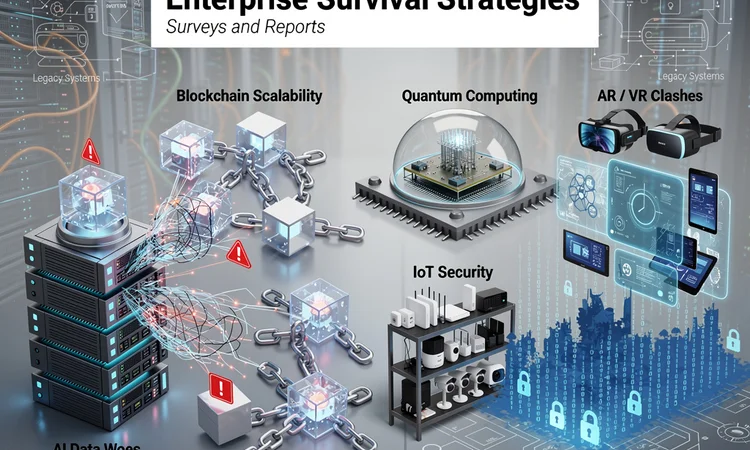
Chief technology officers at major corporations are grappling with profound hurdles in weaving emerging technologies into their operations, a struggle that threatens to widen the chasm between digital frontrunners and laggards. Artificial intelligence and machine learning top the list of integration headaches, followed closely by blockchain, quantum computing, Internet of Things devices, and augmented or virtual reality systems. Compatibility clashes with aging infrastructure, escalating security demands, and acute talent shortages amplify these pains, as highlighted in recent industry analyses.
Over 90% of organizations report difficulties fusing AI with entrenched systems, according to a study cited by Aura . Legacy platforms, engineered for structured transactions decades ago, falter under AI’s appetite for unstructured data and real-time inference. Data fragmentation across silos compounds the issue, demanding intricate pipelines to feed models with clean, unified inputs.
Algorithmic reliability adds another layer of torment. “Ensuring consistent and reliable AI outputs in environments with variable data is difficult for traditional business frameworks,” notes the provided industry overview. Ethical pitfalls like bias and opacity further complicate deployment, forcing CTOs to balance innovation with accountability.
AI’s Legacy Lock-In
Infrastructure overhauls loom large for AI adopters. Specialized hardware like GPUs and data pipelines strain budgets and timelines, especially when retrofitting into rigid enterprise resource planning setups. A Optimum report underscores platform incompatibility and governance voids as prime barriers, urging modular strategies to sidestep full rewrites.
Financial services exemplify the bind: legacy banking cores resist AI overlays for fraud detection, per SymphonyAI . Engineers lack domain knowledge in regulations, while compliance teams grapple with model opacity, inflating deployment costs.
CTO surveys paint a grim picture. Softtek’s “CTO: Challenges for 2025” white paper flags AI as a top priority amid fragmented data and skills gaps, echoing McKinsey’s call for centers of excellence to steer strategy and mitigate risks.
Blockchain’s Speed and Scrutiny Trap
Blockchain’s enterprise allure—immutable ledgers for supply chains—stumbles on scalability. Platforms like Ethereum choke on high-volume transactions, creating bottlenecks in real-time operations, as detailed in Phoenix Strategy Group . Integrating decentralized ledgers with centralized ERP demands sweeping architectural shifts.
Regulatory fog exacerbates woes. “The lack of clear, consistent regulations around blockchain and decentralized finance creates compliance risks,” the core assessment observes. U.S. firms navigate SEC flux and state variances, per the same source, deterring bold moves.
Gartner’s findings reveal over 60% of firms cite talent shortages as adoption blockers, per London Blockchain . Yet progress stirs: COTI’s garbled circuits offer 10x efficiency over zero-knowledge proofs, joining the Enterprise Ethereum Alliance for quantum-resistant privacy, as tweeted by @RaAres .
Quantum’s Exotic Barriers
Quantum computing lingers in experimental realms, demanding cryogenic setups and rare expertise. “Quantum computing still faces technical challenges such as error rates, the need for ultra-low temperatures, and the difficulty of building stable qubits,” states Ekascloud . Businesses eye it for optimization but balk at infrastructure voids.
Encryption Armageddon looms: quantum could shatter RSA via Shor’s algorithm, mandating post-quantum cryptography shifts. Bain’s 2025 report warns of talent gaps and lead times, advising early planning lest competitors surge ahead. IBM’s Quantum Readiness Index notes operational maturity drives preparedness, yet strategy lags.
Deloitte’s scenarios forecast talent crunches, with quantum jobs up just 4.4% yearly despite 250,000 needed by 2030. “The challenge today is navigating between moving too quickly… and moving too slowly,” Bain cautions.
IoT’s Data Deluge and Danger
IoT floods enterprises with sensor data, overwhelming legacy databases. “IoT deployments generate an enormous volume of data… which can overwhelm older databases,” the assessment notes. Interoperability falters sans standards, necessitating middleware.
Security surfaces explode: fragmented devices invite attacks. “The vast number of interconnected devices creates a fragmented and expanding attack surface,” per core insights. NIST flags IT-OT convergence risks via IoT, per Industrial Cyber .
WebbyLab identifies volume, security, GDPR compliance, and quality as thorns, advocating edge computing. “The sheer volume of data generated by IoT devices can overwhelm security systems,” adds Digital Matter .
AR/VR’s Immersion Impasse
AR/VR demands bespoke hardware clashing with enterprise tools. “Integrating immersive technologies requires specific hardware and software, and ensuring compatibility… can be challenging,” the overview states. User training stalls productivity.
Costs and UX deter: AIDAR Solutions pins budget, experience, and integration as top barriers. Avasant notes initial slowdowns from high expenses and weak apps, revived by AI-spatial fusion.
CTO Magazine echoes: hybrid work curbed office VR, leaving training and support as niches. Yet Ford slashed training time 70% via VR, per StartUs Insights .
CTO Strategies Amid the Storm
McKinsey urges eight imperatives for consumer CTOs, including AI centers of excellence. PwC’s survey reveals regulation and sustainability as AI value blockers. Deloitte’s Tech Trends spotlight quantum-cyber duality.
Global CTO Survey 2025 benchmarks AI strategies, per STX Next. Quant Network’s enterprise middleware bridges silos, tweeted by @gverdian , underscoring standards’ role.
Success hinges on targeted pilots, talent builds, and hybrid architectures. As Bain posits, quantum-ready firms blend attitudes with tech, positioning for advantage.






Leave a Reply
Your email address will not be published.