

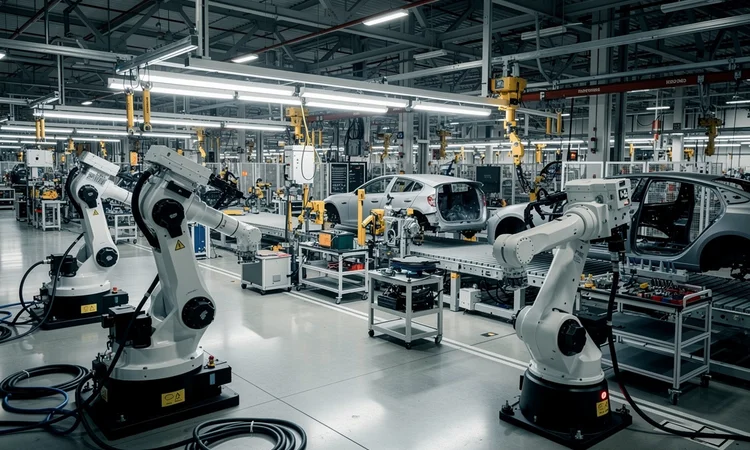
In a move that has sent shockwaves through the automotive manufacturing sector, Elon Musk appears to be reversing course on one of Tesla’s most ambitious technological bets: the extensive use of robotics in vehicle production. According to reports from Futurism , the electric vehicle manufacturer is scaling back its reliance on automated systems in favor of more traditional manufacturing approaches, marking a dramatic shift in strategy for a company that has long positioned itself at the vanguard of industrial automation.
The decision represents a significant departure from Musk’s previous proclamations about the future of manufacturing. For years, Tesla has invested heavily in what it called “the machine that builds the machine”—a vision of nearly fully automated factories where robots would handle the vast majority of assembly tasks. This approach was intended to give Tesla a decisive competitive advantage over traditional automakers, allowing for faster production ramps and lower labor costs. However, the reality of implementing such advanced automation has proven far more challenging than anticipated, leading to production bottlenecks, quality control issues, and delays that have plagued Tesla’s manufacturing operations.
The automotive industry has watched Tesla’s automation experiments with a mixture of fascination and skepticism. While some saw Musk’s approach as the inevitable future of car manufacturing, others questioned whether the technology was ready for such aggressive implementation. Now, as Tesla retreats from its most ambitious robotics deployments, the implications extend far beyond a single company’s production strategy—they touch on fundamental questions about the pace of automation, the role of human workers in modern manufacturing, and the realistic timeline for achieving truly lights-out factories.
The Automation Dream Meets Manufacturing Reality
Tesla’s journey into hyper-automation began with grand ambitions. Musk envisioned factories where vehicles would be assembled at speeds that would make traditional automotive manufacturing look positively antiquated. The company invested hundreds of millions of dollars in custom robotics systems, many designed specifically for Tesla’s unique production processes. These systems were supposed to work in perfect harmony, moving with precision and speed that human workers could never match. The promise was tantalizing: lower costs, higher quality, and production volumes that could scale rapidly to meet surging demand for electric vehicles.
However, the reality proved far more complex. Multiple sources within the automotive manufacturing industry have noted that Tesla’s production lines experienced significant challenges with their automated systems. Robots that looked impressive in demonstrations struggled with the variability and complexity of real-world manufacturing. Tasks that human workers could adapt to on the fly—dealing with slightly misaligned parts, making judgment calls about quality issues, or quickly adjusting to supply chain variations—proved extraordinarily difficult to program into robotic systems. The result was frequent production stoppages, quality issues that required expensive rework, and a production ramp that fell far short of Musk’s aggressive targets.
The Human Element Returns to the Factory Floor
The decision to scale back automation represents more than just a tactical retreat—it’s an acknowledgment of the enduring value of human workers in complex manufacturing environments. While robots excel at repetitive, precisely defined tasks in controlled environments, the assembly of automobiles involves countless variables that require human judgment, dexterity, and problem-solving abilities. Experienced factory workers can identify potential quality issues before they become problems, adapt their techniques to accommodate variations in parts, and collaborate with colleagues to solve unexpected challenges that arise during production.
This shift also has significant implications for Tesla’s workforce strategy. The company has experienced considerable turnover and labor relations challenges at its factories, partly due to the intense pressure to meet production targets with systems that weren’t performing as expected. By reintroducing more human workers into critical production processes, Tesla may be able to achieve more stable and predictable output, even if it means sacrificing some of the cost advantages that full automation was supposed to deliver. The move could also help address some of the quality concerns that have plagued Tesla vehicles, as human workers are often better at catching subtle defects that automated inspection systems might miss.
Industry-Wide Implications for Manufacturing Strategy
Tesla’s experience offers valuable lessons for the broader automotive industry and manufacturing sector. Traditional automakers, who have been under pressure to match Tesla’s innovation in both product and process, may now feel vindicated in their more measured approach to factory automation. Companies like Toyota, which has long emphasized the importance of human workers in its production system, have maintained that there’s an optimal balance between automation and human involvement—a philosophy that now appears prescient given Tesla’s challenges.
The robotics industry itself must also grapple with the implications of Tesla’s pullback. For years, automation companies have pointed to Tesla as a showcase for the potential of advanced manufacturing robotics. If even a company with Tesla’s resources, technical expertise, and willingness to take risks has found current automation technology insufficient for highly complex assembly tasks, it raises questions about the realistic timeline for achieving the fully automated factories that have been promised for decades. This doesn’t mean automation has no future in manufacturing—far from it—but it suggests that the path forward may involve more hybrid approaches that leverage the strengths of both human workers and robotic systems.
The Economics of Automation Reconsidered
The financial implications of Tesla’s automation retreat are substantial and multifaceted. The company’s significant investments in custom robotics systems may now represent stranded assets that failed to deliver their promised returns. While some of these systems can likely be repurposed or sold, the opportunity cost of the capital tied up in these experiments is considerable. Moreover, the production delays and quality issues associated with problematic automation have had their own financial consequences, from warranty costs to customer dissatisfaction that could impact long-term brand value.
However, the decision to scale back automation also carries its own costs. Human workers require wages, benefits, training, and management—expenses that don’t disappear simply because robots proved inadequate. Tesla will need to rebuild its workforce in areas where it had planned to rely on automation, potentially at a time when skilled manufacturing workers are in high demand across the industry. The company will also need to redesign production processes that were optimized for robotic assembly, a time-consuming and expensive undertaking that could temporarily impact production efficiency.
Lessons in Technological Hubris and Pragmatism
Musk’s willingness to reverse course on factory automation, while potentially embarrassing, demonstrates a pragmatic approach to problem-solving that has characterized Tesla’s operations in other areas. The company has shown a pattern of making bold technological bets, learning from failures, and rapidly adapting when those bets don’t pay off. This agility has been a key factor in Tesla’s ability to survive and thrive in the brutally competitive automotive industry, where many well-funded startups have failed. The automation retreat may ultimately be remembered not as a failure, but as an example of Tesla’s ability to recognize when a strategy isn’t working and make necessary corrections before the consequences become catastrophic.
The broader lesson for the technology industry is about the dangers of assuming that current trends will continue indefinitely and that technological solutions are always superior to human-centered approaches. The past decade has seen wave after wave of automation predictions, with consultants and futurists forecasting the imminent replacement of human workers across vast swaths of the economy. Tesla’s experience suggests that these predictions may be premature, at least for complex tasks that require judgment, adaptability, and problem-solving skills. Rather than wholesale replacement of human workers, the future of manufacturing may involve more sophisticated collaboration between humans and machines, each handling the tasks they do best.
The Road Ahead for Tesla and Automotive Manufacturing
As Tesla recalibrates its manufacturing strategy, the company faces the challenge of maintaining its reputation as an industry innovator while adopting more conventional production approaches. The shift away from extreme automation doesn’t mean Tesla is abandoning technology—the company continues to lead in areas like battery production, electric powertrains, and software integration. However, it does suggest a more mature understanding of where technological advantages can be achieved and where traditional methods remain superior.
For the automotive industry as a whole, Tesla’s experience provides a valuable case study in the limits of current automation technology and the importance of balancing innovation with practical manufacturing realities. As electric vehicles become mainstream and new competitors enter the market, the lessons learned from Tesla’s automation experiments will inform manufacturing strategies across the industry. The companies that succeed will likely be those that can find the right balance between human expertise and robotic precision, leveraging the strengths of both to achieve efficient, high-quality production at scale. Tesla’s retreat from extreme automation may ultimately prove to be not a step backward, but a necessary recalibration that enables the company to achieve the sustainable, profitable production that has long eluded it.






Leave a Reply
Your email address will not be published.