






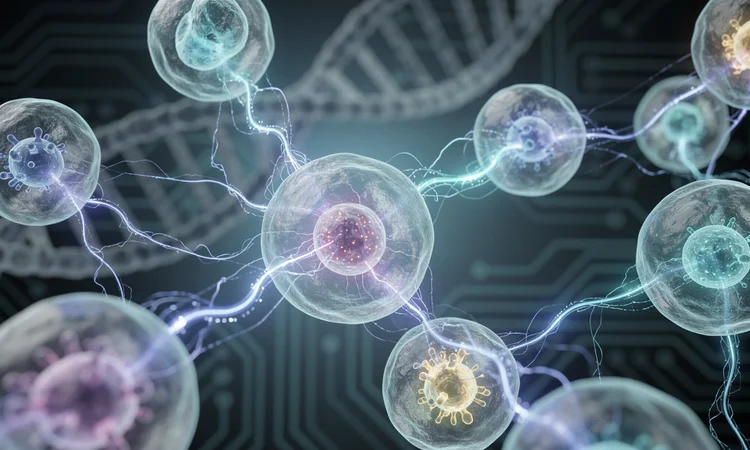
In laboratories across the globe, scientists are uncovering a hidden dimension of cellular communication that challenges our fundamental understanding of how living organisms coordinate their behavior. Far from being mere chemical factories, cells are now revealed as sophisticated electrical networks, using bioelectric signals to make group decisions, coordinate development, and even determine their fate within tissues. This discovery is reshaping fields from developmental biology to regenerative medicine, offering insights that could revolutionize how we approach cancer treatment, wound healing, and tissue engineering.
The revelation that cells communicate through electrical signals isn’t entirely new, but recent research has demonstrated that this bioelectric communication operates at a level of complexity previously unimaginable. According to Quanta Magazine , cells don’t just respond to electrical signals—they actively generate and manipulate voltage patterns to coordinate group behavior, making decisions that affect everything from embryonic development to cancer progression. These voltage patterns create what researchers describe as a “bioelectric code” that operates alongside the genetic code, providing an additional layer of information processing that cells use to organize themselves into functional tissues and organs.
Michael Levin, director of the Allen Discovery Center at Tufts University, has emerged as a leading figure in this field, demonstrating through groundbreaking experiments that manipulating bioelectric signals can fundamentally alter cellular behavior and tissue structure. His work has shown that cells use voltage gradients much like a computational network, processing information about their environment and their neighbors to determine appropriate actions. This discovery suggests that biological systems operate with a level of distributed intelligence that rivals artificial neural networks, with each cell acting as both a sensor and a decision-maker within the larger collective.
The Mechanics of Cellular Electrical Communication
At the heart of bioelectric communication lies the cell membrane, a structure that acts as both a barrier and a sophisticated electrical device. Cells maintain voltage differences across their membranes through the careful regulation of ion channels—protein structures that control the flow of charged particles like sodium, potassium, and calcium ions. These voltage differences, known as membrane potentials, typically range from -90 to +50 millivolts, creating electrical fields that can influence neighboring cells and coordinate tissue-level behavior. Unlike the rapid electrical signals of neurons, which last milliseconds, these bioelectric signals can persist for hours or days, providing a stable communication channel for long-term coordination.
The sophistication of this system becomes apparent when examining how cells use these electrical signals to make collective decisions. Research highlighted by Quanta Magazine demonstrates that groups of cells can synchronize their electrical activity, creating wave-like patterns that propagate through tissues. These bioelectric waves carry information about the tissue’s overall state, allowing individual cells to adjust their behavior based on the needs of the collective. In embryonic development, for instance, these electrical patterns help coordinate the formation of organs and body structures, ensuring that cells differentiate into the right types at the right locations.
From Development to Disease: The Broad Implications of Bioelectric Control
The implications of bioelectric communication extend far beyond basic developmental biology. Cancer researchers have discovered that tumor cells often exhibit aberrant electrical properties, with voltage patterns that differ significantly from healthy tissue. This electrical disruption may not merely be a consequence of cancer but could actually drive tumor formation and metastasis. Studies have shown that artificially normalizing the bioelectric state of cancer cells can sometimes cause them to behave more like healthy cells, suggesting that electrical interventions could complement or even replace traditional chemotherapy approaches.
In regenerative medicine, the potential applications are equally profound. Salamanders and other animals capable of regenerating limbs maintain specific bioelectric patterns at wound sites, and researchers have found that recreating these patterns in non-regenerative species can sometimes trigger regenerative responses. Levin’s laboratory has demonstrated that manipulating bioelectric signals in flatworms can cause them to regenerate heads with different shapes—essentially rewriting the bioelectric “blueprint” that guides tissue formation. These experiments suggest that bioelectric intervention could one day enable humans to regenerate damaged organs or limbs, a capability that currently seems confined to science fiction.
The Computational Nature of Biological Systems
Perhaps the most revolutionary aspect of bioelectric research is what it reveals about the computational capabilities of living systems. Traditional molecular biology has focused on understanding life through the lens of genetic information—the sequences of DNA that encode proteins and regulate gene expression. However, bioelectric patterns represent a parallel information processing system that operates at a higher level of organization. While genes provide the basic toolkit of proteins, bioelectric signals determine how those tools are deployed across space and time to build and maintain complex structures.
This realization has led some researchers to propose that biological systems should be understood as “cognitive” entities at multiple scales. Just as neurons process information to generate thought and behavior, non-neural cells appear to process bioelectric information to generate tissue structure and function. This perspective challenges the traditional boundary between brain and body, suggesting that intelligence and information processing are fundamental properties of life that exist at every organizational level, from individual cells to entire organisms.
Technical Challenges and Methodological Advances
Studying bioelectric phenomena requires sophisticated tools capable of measuring and manipulating voltage patterns in living tissues without disrupting normal cellular function. Recent technological advances have made this increasingly feasible. Voltage-sensitive fluorescent dyes now allow researchers to visualize electrical activity across entire tissues in real-time, revealing patterns that were previously invisible. Optogenetic tools, borrowed from neuroscience, enable precise control of ion channels using light, allowing researchers to test hypotheses about how specific electrical patterns influence cellular behavior.
These methodological advances have accelerated the pace of discovery in the field. Researchers can now create detailed maps of bioelectric patterns during development, identifying critical periods when electrical signals guide tissue formation. They can also conduct experiments that would have been impossible just a decade ago, such as creating artificial bioelectric patterns to direct stem cell differentiation or prevent tumor formation. As reported by Quanta Magazine , these tools are revealing that bioelectric communication is far more prevalent and important than previously recognized, operating in contexts ranging from bacterial biofilms to plant development.
Evolutionary Perspectives on Bioelectric Communication
The ubiquity of bioelectric signaling across diverse life forms suggests an ancient evolutionary origin. Even bacteria, the simplest cellular organisms, use electrical signals to coordinate behavior within biofilms—the slimy communities that coat surfaces from rocks to teeth. This suggests that bioelectric communication may have emerged early in life’s history, possibly even before the evolution of dedicated nervous systems. The nervous system, in this view, represents a specialized elaboration of a more fundamental biological principle rather than an entirely novel invention.
This evolutionary perspective has profound implications for understanding the origin of complex life. The ability of cells to communicate electrically may have been a prerequisite for the evolution of multicellularity, providing the coordination mechanism necessary for cells to work together as integrated organisms. The fact that this communication system operates through physics—the movement of charged particles—rather than through specific molecular recognition suggests a certain inevitability to its evolution. Any system of cells separated by membranes will generate voltage differences, and natural selection would inevitably favor organisms that could exploit these electrical signals for coordination and control.
Clinical Applications on the Horizon
The translation of bioelectric research into clinical applications is already underway, though significant challenges remain. Several companies are developing devices and drugs that target ion channels to treat conditions ranging from chronic wounds to birth defects. The advantage of bioelectric interventions is their potential to work with the body’s natural coordination systems rather than against them, potentially reducing side effects and improving outcomes. However, the complexity of bioelectric patterns means that interventions must be carefully designed to avoid unintended consequences.
One promising area is the treatment of chronic wounds, which affect millions of people and cost healthcare systems billions of dollars annually. Research has shown that chronic wounds often exhibit disrupted bioelectric patterns, and restoring normal electrical activity can sometimes restart the healing process. Clinical trials are currently testing devices that apply weak electrical fields to wounds, with some showing promising results. Similarly, researchers are exploring whether bioelectric interventions could help treat birth defects by correcting the electrical signals that guide embryonic development, potentially offering alternatives to risky surgical procedures.
Philosophical and Theoretical Implications
Beyond its practical applications, bioelectric research raises profound questions about the nature of biological organization and the definition of cognition. If cells can process information and make decisions using electrical signals, where do we draw the line between simple responsiveness and genuine intelligence? Some researchers argue that we need to expand our definition of cognition to include the information processing that occurs at all biological scales, from molecules to minds. This perspective could transform not only biology but also fields like artificial intelligence, which might benefit from understanding how biological systems achieve robust, adaptive behavior through distributed electrical communication.
The bioelectric code also challenges the gene-centric view that has dominated biology for the past century. While genes remain crucial, they appear to operate within a broader context of bioelectric information that helps determine when, where, and how genetic programs are executed. This suggests that understanding life requires studying multiple levels of organization simultaneously, from molecular interactions to tissue-level electrical patterns. The integration of these different levels remains one of the major challenges facing modern biology, requiring new theoretical frameworks that can bridge scales from nanometers to centimeters.
Future Directions and Unanswered Questions
Despite rapid progress, many fundamental questions about bioelectric communication remain unanswered. How exactly do cells interpret bioelectric signals and translate them into specific behaviors? What determines the patterns of electrical activity that guide development, and how are these patterns encoded and transmitted across generations? Can we develop a comprehensive “dictionary” that translates between bioelectric patterns and biological outcomes, enabling precise control of tissue formation and regeneration?
Answering these questions will require continued technological innovation and interdisciplinary collaboration. Physicists, engineers, computer scientists, and biologists must work together to develop new tools for measuring and manipulating bioelectric signals, new computational models for understanding how these signals generate complex patterns, and new experimental systems for testing hypotheses about bioelectric control. The field is still young, but the pace of discovery suggests that the next decade will bring transformative insights into how electrical signals coordinate life, potentially opening new frontiers in medicine, biotechnology, and our fundamental understanding of what it means to be alive. As cells continue to reveal their electrical secrets, we are glimpsing a hidden dimension of biology that has been operating beneath our notice since life began, orchestrating the dance of development, regeneration, and adaptation that makes complex life possible.






Leave a Reply
Your email address will not be published.