



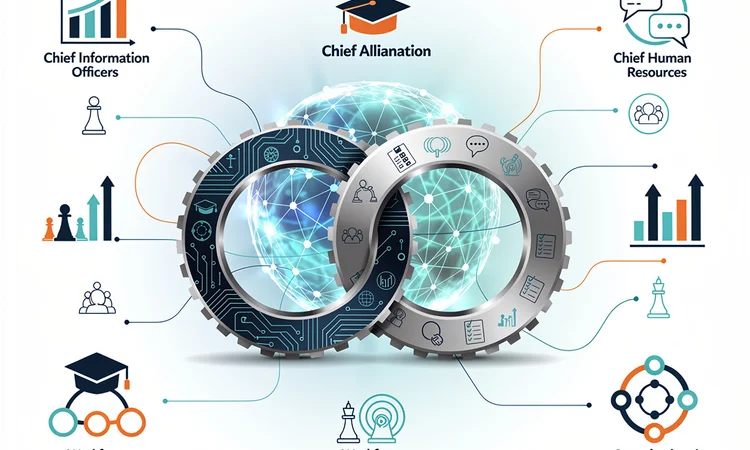
In corporate boardrooms across America, an unprecedented partnership is taking shape. Chief Information Officers and Chief Human Resources Officers—traditionally operating in separate spheres—are now joining forces to navigate one of the most transformative technological shifts in business history. As artificial intelligence tools proliferate throughout enterprises, these two executive roles are discovering that their collaboration isn’t just beneficial—it’s essential for organizational survival.
The convergence represents a fundamental reimagining of how companies approach technology deployment. Where CIOs once focused primarily on infrastructure and CHROs on talent management, the AI revolution has blurred these boundaries. According to Yahoo Finance , this collaboration is becoming increasingly critical as organizations race to implement AI solutions that fundamentally alter how work gets done. The stakes are high: companies that fail to thoughtfully integrate AI risk both technological obsolescence and workforce disruption.
This alliance addresses a crucial reality: AI implementation isn’t merely a technical challenge but a deeply human one. Technology leaders bring expertise in evaluating, deploying, and securing AI systems, while HR executives understand workforce dynamics, skill development, and organizational culture. Together, they’re crafting strategies that balance innovation with employee wellbeing, efficiency with ethics, and automation with augmentation.
The Imperative Behind Cross-Functional Leadership
The urgency driving CIO-CHRO collaboration stems from AI’s unprecedented pace of adoption. Unlike previous technological waves that unfolded over decades, generative AI tools have achieved mainstream business adoption in mere months. This acceleration has caught many organizations flat-footed, lacking frameworks for responsible deployment. Without coordinated leadership, companies risk implementing AI in ways that create compliance nightmares, erode employee trust, or fail to deliver promised productivity gains.
Recent research indicates that organizations with strong CIO-CHRO partnerships are significantly more successful in their AI initiatives. These collaborations enable companies to address multiple dimensions simultaneously: technical feasibility, workforce readiness, ethical considerations, and change management. When technology leaders work in isolation, they may deploy powerful tools that employees don’t understand, don’t trust, or actively resist. Conversely, HR-led initiatives without technical guidance often fail to leverage AI’s full capabilities or inadvertently introduce security vulnerabilities.
Reskilling at Scale: The Workforce Transformation Challenge
One of the most critical areas where CIO-CHRO collaboration proves essential is workforce reskilling. As AI automates routine tasks and augments complex decision-making, job roles across industries are evolving rapidly. The challenge isn’t simply teaching employees to use new tools—it’s fundamentally reimagining roles, career paths, and organizational structures. This transformation requires both technological infrastructure for learning and sophisticated change management strategies.
Progressive organizations are establishing joint CIO-CHRO task forces specifically focused on skills transformation. These teams identify which roles will be most affected by AI, determine what new capabilities employees need, and design learning pathways that combine technical training with soft skills development. The most successful programs don’t just teach employees about AI—they involve workers in identifying use cases, testing tools, and shaping implementation strategies. This participatory approach, championed by HR leaders and enabled by IT infrastructure, increases adoption rates while reducing anxiety about job displacement.
The scale of this reskilling challenge cannot be overstated. Industry analysts estimate that AI will impact over 80% of jobs in some capacity within the next five years. Some roles will be eliminated, others created, and most will be significantly transformed. Companies that fail to proactively reskill their workforces face a dual threat: losing institutional knowledge as displaced workers leave while simultaneously struggling to attract talent with emerging AI-related skills. The CIO-CHRO partnership provides the organizational structure necessary to navigate this transition systematically rather than reactively.
Governance Frameworks: Balancing Innovation and Responsibility
As AI tools become embedded in daily operations, establishing robust governance frameworks has emerged as a top priority for the CIO-CHRO alliance. These frameworks must address technical concerns like data security and model accuracy while also tackling human-centric issues including bias mitigation, transparency, and employee privacy. The complexity requires expertise from both domains: CIOs understand the technical guardrails necessary to prevent AI systems from producing harmful outputs, while CHROs recognize how governance policies affect employee morale, trust, and legal compliance.
Leading organizations are creating cross-functional AI governance committees co-chaired by technology and human resources executives. These bodies establish policies governing AI use cases, approval processes for new tools, and protocols for monitoring AI system performance. Critically, they also define escalation procedures when AI systems produce unexpected results or when employees raise concerns about AI-driven decisions. This governance structure ensures that AI deployment proceeds thoughtfully rather than haphazardly, with clear accountability when issues arise.
The governance challenge extends beyond internal operations to external stakeholders. Customers increasingly demand transparency about how companies use AI, regulators are implementing new compliance requirements, and investors scrutinize AI-related risks in corporate disclosures. The CIO-CHRO partnership enables organizations to present a unified approach to these stakeholders, demonstrating that AI initiatives are both technologically sound and ethically grounded. Companies that can articulate this balanced approach gain competitive advantages in talent attraction, customer trust, and regulatory relationships.
Cultural Transformation: From Fear to Empowerment
Perhaps the most nuanced aspect of the CIO-CHRO collaboration involves managing the cultural shift that AI implementation demands. Many employees view AI with a mixture of curiosity and apprehension, worried that automation threatens their livelihoods. Left unaddressed, this anxiety can manifest as resistance to new tools, reduced productivity, or talent attrition. Technology leaders alone cannot resolve these concerns—they require HR’s expertise in organizational psychology, communication, and change management.
Successful CIO-CHRO partnerships are reframing AI not as a replacement for human workers but as a tool for augmentation. They’re implementing communication strategies that transparently address workforce concerns while highlighting opportunities AI creates. This includes showcasing examples of employees who’ve used AI to eliminate tedious tasks, enabling them to focus on more strategic, creative, or interpersonally complex work. By celebrating these success stories and providing forums for employees to share experiences and concerns, companies can gradually shift culture from fear to empowerment.
The cultural dimension also encompasses leadership development. As AI transforms work, managers need new skills to lead hybrid human-AI teams effectively. This includes understanding AI capabilities and limitations, knowing when to trust AI recommendations versus human judgment, and coaching employees through role transitions. The CIO-CHRO alliance is uniquely positioned to design leadership development programs that build both technical literacy and the emotional intelligence necessary to guide teams through this transformation.
Data Strategy: The Foundation of Intelligent Automation
Underlying successful AI implementation is a robust data strategy—an area where CIO and CHRO collaboration proves particularly valuable. AI systems are only as effective as the data they’re trained on, and in many organizations, critical workforce data remains siloed, inconsistent, or incomplete. CIOs bring expertise in data architecture, quality, and governance, while CHROs understand which workforce metrics matter most and how to collect sensitive employee information ethically.
Joint CIO-CHRO teams are working to create unified data ecosystems that enable AI-driven insights while respecting privacy boundaries. This includes implementing systems that can predict workforce trends, identify skill gaps, personalize learning recommendations, and optimize talent deployment—all while maintaining strict data governance standards. The collaboration ensures that data strategies serve both operational efficiency and employee wellbeing, avoiding the dystopian scenario where surveillance technology erodes workplace trust.
Measuring Success: New Metrics for the AI Era
As organizations invest heavily in AI initiatives, executive teams demand clear metrics demonstrating return on investment. However, traditional productivity metrics often fail to capture AI’s full impact, particularly its effects on employee experience, innovation capacity, and organizational agility. The CIO-CHRO partnership is developing more sophisticated measurement frameworks that assess both quantitative outcomes and qualitative factors.
These new metrics include traditional measures like cost savings and efficiency gains alongside indicators such as employee AI literacy rates, sentiment toward AI tools, time saved on routine tasks, and the rate at which employees identify new AI use cases. By tracking both hard and soft metrics, organizations gain a more complete picture of AI’s value and can make more informed decisions about future investments. This balanced scorecard approach reflects the dual nature of AI implementation as both a technical and human transformation.
The Competitive Advantage of Strategic Alignment
Organizations that have successfully aligned their CIO and CHRO functions around AI strategy are already seeing competitive advantages. They’re deploying AI tools faster, achieving higher adoption rates, and experiencing fewer implementation failures than peers with siloed approaches. These companies report that employees feel more engaged in digital transformation rather than threatened by it, leading to better retention of critical talent during periods of significant change.
The strategic alignment also enables more agile responses to market shifts. When new AI capabilities emerge, organizations with strong CIO-CHRO partnerships can quickly assess both technical feasibility and workforce readiness, making faster go-to-market decisions. This agility is becoming a crucial differentiator as AI capabilities evolve at an accelerating pace and competitive dynamics shift rapidly across industries.
Looking forward, the CIO-CHRO alliance appears poised to become a permanent feature of corporate leadership structures rather than a temporary response to AI disruption. As technology becomes increasingly intertwined with human work, the artificial separation between IT and HR functions seems increasingly outdated. Progressive companies are already formalizing this partnership through joint planning processes, shared budgets, and combined performance metrics.
Navigating Regulatory Complexity and Ethical Boundaries
The proliferation of AI in workplace settings has attracted increasing regulatory scrutiny, creating another domain where CIO-CHRO collaboration proves essential. Jurisdictions worldwide are implementing new laws governing AI use in employment decisions, from resume screening to performance evaluation to termination. These regulations often contain both technical requirements—such as algorithmic transparency and bias testing—and employment law considerations that span both executives’ domains.
Joint CIO-CHRO teams are working with legal departments to ensure AI implementations comply with evolving regulations while still delivering business value. This includes conducting impact assessments before deploying AI in human resources processes, implementing audit trails that document AI-driven decisions, and establishing processes for employees to challenge or appeal AI-influenced outcomes. The cross-functional approach ensures that compliance efforts address both the letter and spirit of regulations, reducing legal risk while maintaining employee trust.
Beyond legal compliance, these partnerships are grappling with ethical questions that regulations haven’t yet addressed. Should AI monitor employee productivity in remote work settings? How much algorithmic management is appropriate before it becomes dehumanizing? When should companies disclose to employees that AI influenced decisions affecting their careers? The CIO-CHRO alliance provides a forum for wrestling with these questions before they become crises, establishing ethical guardrails that reflect both technological possibilities and human values.
Building the Organization of Tomorrow
The CIO-CHRO partnership ultimately serves a larger purpose: designing organizations fit for an AI-augmented future. This involves reimagining not just individual roles but entire organizational structures, workflows, and operating models. Some companies are experimenting with flatter hierarchies enabled by AI-powered coordination, while others are creating new roles like AI trainers, prompt engineers, and human-AI collaboration specialists that didn’t exist five years ago.
These organizational redesigns require both technological infrastructure and careful attention to human factors. Technology leaders must ensure that systems can support new ways of working, while HR executives must address how restructuring affects career progression, compensation, and workplace culture. The most successful transformations occur when both dimensions receive equal attention, with CIOs and CHROs working in lockstep to align technical capabilities with organizational design principles.
As this new era of work unfolds, the CIO-CHRO alliance represents more than just a tactical response to AI disruption. It signals a broader recognition that technology and humanity are not opposing forces but complementary elements that must be thoughtfully integrated. Organizations that embrace this partnership position themselves not just to survive the AI revolution but to thrive in it, creating workplaces where technology amplifies human potential rather than diminishing it. The companies that master this balance will define what successful organizations look like in the decades ahead, setting standards that others will struggle to match.






Leave a Reply
Your email address will not be published.