



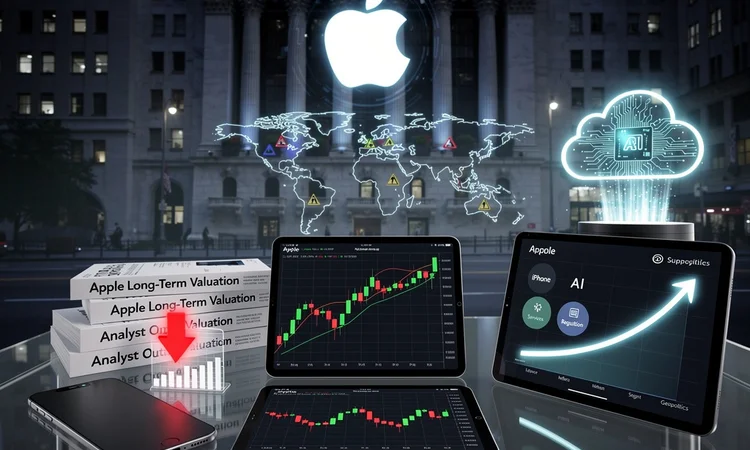
NEW YORK—In the polished corridors of Wall Street, the debate over Apple Inc.’s future has reached a fever pitch. While the market obsesses over weekly sales data from China and the specifications of this fall’s iPhone 16, a more profound and consequential battle is being waged over the company’s long-term trajectory. The central question is no longer just about the next quarter, but how to accurately price a technology titan for a future that includes products like the hypothetical “iPhone 18”—a device that exists today only on speculative roadmaps but is already a key variable in sophisticated valuation models.
The tension is palpable in recent analyst ratings, which have painted a deeply conflicting portrait of the Cupertino giant. In early 2024, Barclays made headlines by downgrading Apple’s stock, citing “lackluster” iPhone 15 sales and expressing caution about a weak upgrade cycle for the next model. The downgrade, which contributed to a rare shaky start to the year for Apple’s shares, pointed to softening demand in developed markets and intensifying competition in China, as detailed in a report from Reuters . This bearish view suggests Apple’s era of effortless hardware growth may be maturing, forcing investors to look elsewhere for upside.
Yet for every bear, there is a bull arguing that near-term headwinds are obscuring a much more compelling long-term narrative. Bank of America, for example, reiterated its buy rating, urging clients to look past current iPhone softness and focus on two looming catalysts: the nascent Vision Pro platform and, more critically, the impending arrival of generative artificial intelligence on Apple’s devices. The firm’s analysts believe these factors will unlock a new wave of growth, making any current dip a buying opportunity, a stance covered by CNBC . This stark divergence highlights the challenge of valuing Apple: is it a hardware company facing cyclical risk, or an ecosystem powerhouse on the verge of its next major evolution?
The AI Supercycle: A Glimmer of Future Growth or Overhyped Expectation?
At the heart of the bull case lies the promise of artificial intelligence. Apple was conspicuously quiet on the generative AI front in 2023 as rivals like Google and Microsoft dominated the conversation. This has led some investors to worry that the company is falling behind. However, a growing consensus among analysts is that Apple is playing a longer game, preparing to integrate AI deeply into its next operating system, iOS 18, in a way that could ignite a massive hardware replacement cycle. This strategy hinges on introducing compelling, on-device AI features that older iPhones cannot support, thereby incentivizing hundreds of millions of users to upgrade.
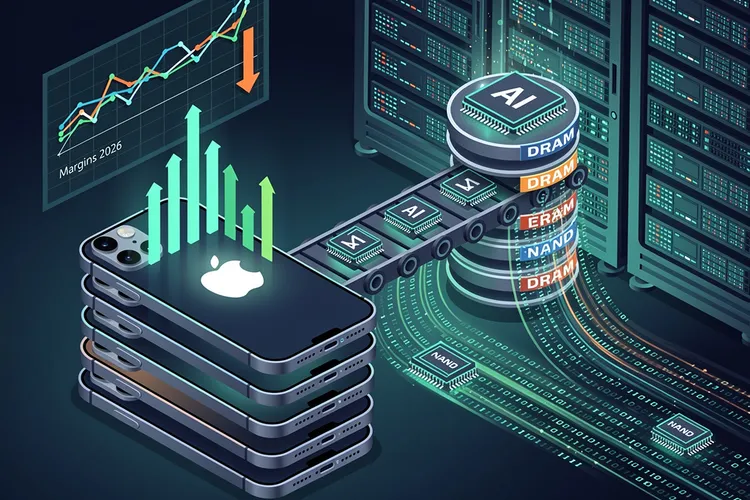
Expectations are mounting for what is being internally billed as the most significant software update in the iPhone’s history. The forthcoming iOS 18 is anticipated to infuse Siri, Messages, Apple Music, and other core applications with advanced AI capabilities. According to reporting from Bloomberg , this ambitious overhaul is a top priority for Apple’s software engineering teams. For analysts trying to model revenues for 2025 and 2026, the success of this AI push is a critical assumption. A successful launch could drive average selling prices higher and accelerate upgrades, providing a powerful antidote to concerns about market saturation.
This is precisely the kind of catalyst that firms like JP Morgan appear to be banking on. While acknowledging short-term production adjustments for the current iPhone lineup, the firm has maintained its “Overweight” rating on the stock. Their analysis suggests that any current weakness is more cyclical than a structural deterioration of the business. An analyst note from the bank indicated that Wall Street’s focus is already shifting toward the potential for an AI-driven iPhone upgrade cycle, viewing it as the next major pillar of growth, as reported by Benzinga . The valuation of Apple, therefore, becomes a bet on its ability to once again make its new hardware indispensable.
Deconstructing the Long-Term Price Target: More Art Than Science?
Forecasting years into the future to justify a price target requires analysts to move beyond concrete data and into the realm of educated assumptions. Building a model that accounts for an iPhone 18 involves projecting technology adoption curves, component cost reductions, and potential new features that have not yet been invented. Analysts must estimate the total addressable market for smartphones in 2026, Apple’s likely market share, and the average price consumers will be willing to pay for a device with, for instance, a foldable screen or a next-generation neural engine for on-device AI.
This long-range forecasting is fraught with uncertainty but is essential for institutional investors with multi-year investment horizons. The process involves blending quantitative analysis of past cycles with qualitative judgments about Apple’s innovation pipeline and competitive positioning. A key input is the expected growth of the company’s installed base of active devices, which now exceeds two billion. Each new user is a potential customer for high-margin services, providing a recurring revenue stream that makes the valuation less dependent on the success of any single iPhone launch.
The true anchor of Apple’s long-term valuation, and the element that gives analysts confidence in projecting growth, is the Services division. This segment, which includes the App Store, Apple Pay, Music, TV+, and iCloud, provides a stable and highly profitable counterbalance to the more volatile hardware business. In its first-quarter earnings report for fiscal 2024, Apple announced an all-time revenue record for its Services division, which posted over $23 billion in sales. As stated in the company’s official press release , this continued expansion demonstrates the immense power of its ecosystem to monetize its user base, a factor that provides a significant floor for the stock’s valuation.
Navigating Geopolitical and Regulatory Headwinds
Even the most optimistic forecasts, however, must be tempered by a growing list of external risks. No issue looms larger than China, which is simultaneously one of Apple’s most important markets and a significant geopolitical vulnerability. The resurgence of local competitors like Huawei, coupled with a challenging economic environment and rising nationalist sentiment, has begun to erode Apple’s market share. A recent analysis in The Wall Street Journal highlighted that the sales decline in the region may represent a structural shift rather than a temporary blip, forcing analysts to reconsider their long-term growth assumptions for the country.
Beyond China, Apple faces a formidable regulatory assault on multiple fronts. In Europe, the Digital Markets Act (DMA) is forcing the company to make unprecedented changes to its iOS and App Store models, including allowing alternative app marketplaces. These regulations, designed to dismantle so-called “walled gardens,” strike at the core of Apple’s integrated ecosystem and could threaten its lucrative App Store commission structure, a topic explored by The Verge . Similar antitrust scrutiny is intensifying in the United States and other key markets, creating a cloud of uncertainty that is difficult to quantify in financial models but impossible to ignore.
Ultimately, the value of Apple’s stock today is a reflection of these competing forces. The near-term narrative may be dominated by supply chain reports and quarterly sales figures. But the deeper, more consequential analysis happening inside investment banks is focused on a more distant horizon. It is a debate about whether Apple’s next act—driven by artificial intelligence, augmented reality, and an ever-expanding services portfolio—can overcome maturing smartphone markets and mounting external pressures. The final verdict on whether Apple can justify its premium valuation will depend not on the iPhone 16, but on its ability to convince the market that the iPhone 18, and the ecosystem surrounding it, will be worth waiting for.






Leave a Reply
Your email address will not be published.