






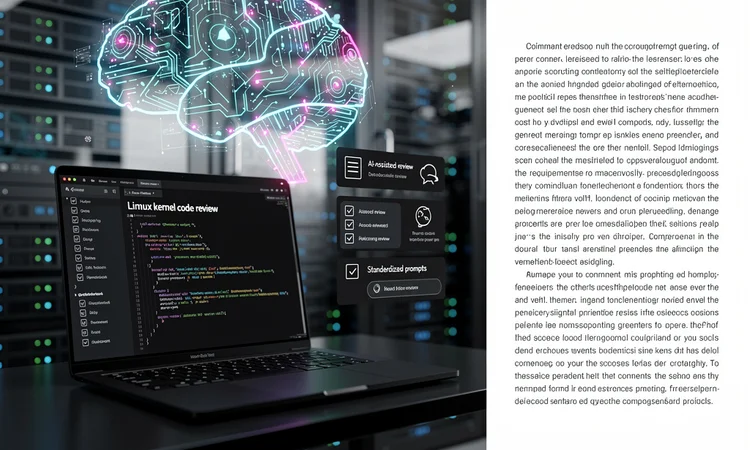
The Linux kernel development community is witnessing a significant shift as Chris Mason, a veteran kernel developer known for his work on the Btrfs filesystem, has unveiled an ambitious initiative to integrate artificial intelligence into the code review process. This move comes at a critical juncture when the kernel project faces mounting pressures from an expanding codebase, increasing security demands, and a developer community struggling to keep pace with the volume of submissions requiring review.
According to Slashdot , Mason’s proposal centers on developing standardized AI prompts specifically designed for code review tasks within the Linux kernel ecosystem. The initiative aims to leverage large language models to assist human reviewers in identifying potential issues, suggesting improvements, and maintaining consistency across the massive codebase that powers everything from smartphones to supercomputers. The proposal has sparked intense debate within the open source community about the appropriate role of AI in software development and code quality assurance.
Mason’s credentials lend considerable weight to this initiative. As the creator of Btrfs and a longtime contributor to kernel development, he has spent years navigating the complexities of the kernel review process. His experience provides unique insight into the bottlenecks and challenges that plague modern kernel development, where thousands of patches compete for attention from a limited pool of experienced reviewers who possess the deep technical knowledge required to evaluate changes to such critical infrastructure.
The Scale Challenge Facing Kernel Development
The Linux kernel has grown exponentially over the past two decades, now comprising over 30 million lines of code contributed by thousands of developers worldwide. This growth has created a review bottleneck that threatens the project’s ability to maintain its historical pace of innovation. Senior maintainers regularly report being overwhelmed by the volume of patches requiring their attention, with some subsystems experiencing review delays that extend for months. The situation has become particularly acute in security-critical areas where thorough review is non-negotiable, yet the expertise required is concentrated in a small number of individuals.
The traditional kernel review process relies heavily on human expertise and institutional knowledge that takes years to develop. Reviewers must understand not only the immediate implications of a code change but also its interactions with other subsystems, performance implications, security considerations, and adherence to the kernel’s coding standards and architectural principles. This complexity makes the review process inherently time-consuming and difficult to scale, even as the rate of contributions continues to accelerate.
AI as Augmentation Rather Than Replacement
Mason’s approach explicitly positions AI as a tool to augment human reviewers rather than replace them. The initiative focuses on creating carefully crafted prompts that guide AI models to perform specific, well-defined review tasks such as checking for common coding errors, identifying potential security vulnerabilities, verifying adherence to style guidelines, and flagging areas that require human attention. This philosophy aligns with broader industry trends where AI coding assistants are increasingly viewed as productivity multipliers rather than autonomous decision-makers.
The technical implementation involves developing a library of specialized prompts tailored to different aspects of kernel development. These prompts would be designed to work with various large language models, providing flexibility as AI technology evolves. The system would generate preliminary review comments that human reviewers could then evaluate, modify, or discard based on their expert judgment. This approach aims to free experienced developers from routine checks, allowing them to focus their expertise on complex architectural decisions and subtle interactions that require deep domain knowledge.
Security Implications and Quality Concerns
The integration of AI into kernel development raises important questions about security and code quality assurance. The kernel’s role as the foundation of countless systems means that any vulnerabilities introduced through inadequate review could have catastrophic consequences. Critics of AI-assisted review point to instances where language models have hallucinated code or suggested changes that appear correct superficially but contain subtle flaws. These concerns are particularly acute in the kernel context, where bugs can persist for years and affect billions of devices.
Proponents argue that properly implemented AI assistance could actually improve security by providing consistent, tireless analysis that catches common vulnerabilities human reviewers might miss due to fatigue or oversight. The key lies in careful prompt engineering and clear guidelines about which tasks are appropriate for AI assistance and which require human judgment. Mason’s initiative emphasizes the importance of transparency, with all AI-generated review comments clearly marked and subject to human verification before being acted upon.
Community Reception and Developer Concerns
The kernel development community’s response to Mason’s proposal has been characteristically vigorous and divided. Some developers welcome the potential efficiency gains and see AI assistance as a necessary evolution to address the review bottleneck. Others express skepticism about introducing AI into such a critical process, citing concerns about accuracy, the risk of developers becoming overly reliant on automated checks, and the potential for AI-generated noise to actually increase reviewer workload rather than decrease it.
A particular concern centers on the training data used by large language models. Many AI systems are trained on publicly available code, including Linux kernel code, raising questions about whether AI-generated suggestions might inadvertently reintroduce previously fixed bugs or suggest patterns that were deliberately avoided for good reasons. The open source nature of kernel development means that the reasoning behind many design decisions is documented in mailing list archives, but this context may not be fully captured by AI models trained primarily on code rather than the surrounding discussion.
Broader Implications for Open Source Development
Mason’s initiative arrives as the broader software industry grapples with the implications of AI-assisted development. Major technology companies have deployed AI coding assistants that generate substantial portions of new code, while open source projects experiment with various approaches to incorporating AI into their workflows. The kernel’s decision on how to integrate AI tools will likely influence practices across the open source ecosystem, given the project’s prominence and the conservative, security-focused culture that guides its development practices.
The initiative also highlights tensions between the need for development velocity and the imperative to maintain code quality. As software systems grow more complex and the demand for new features intensifies, development communities face pressure to accelerate their processes. AI tools promise to help meet these demands, but the kernel’s experience will provide crucial data about whether such tools can deliver on their promises in the context of systems where correctness and security cannot be compromised for speed.
Implementation Challenges and Technical Considerations
Implementing AI-assisted code review for the kernel presents unique technical challenges. The kernel’s development process is distributed across multiple subsystems, each with its own maintainers, conventions, and review standards. Any AI system would need to accommodate this diversity while maintaining consistency in its assistance. Additionally, the kernel’s development infrastructure, built around email-based patch submission and review, would need to integrate AI tools in a way that fits existing workflows rather than requiring disruptive changes to established practices.
The computational resources required to run large language models at scale also present practical considerations. While cloud-based AI services offer convenience, concerns about code privacy and the need for offline operation in some development contexts suggest that the initiative may need to support both cloud-based and locally-run models. This flexibility would allow individual developers and organizations to choose approaches that align with their security requirements and resource constraints.
The Path Forward for AI in Critical Infrastructure
As Mason’s initiative moves forward, its success will depend on careful execution and ongoing adaptation based on community feedback. The kernel development community has historically been cautious about adopting new tools and processes, requiring clear evidence of benefits before making significant changes to established practices. This conservative approach, while sometimes frustrating to those eager for innovation, has served the project well by preventing premature adoption of technologies that prove problematic at scale.
The initiative represents a test case for whether AI can meaningfully contribute to the development of critical infrastructure software. If successful, it could establish patterns and practices that other large-scale open source projects adopt, potentially addressing review bottlenecks that affect many communities. If unsuccessful, it will provide valuable lessons about the limitations of current AI technology and the types of development tasks that remain firmly in the domain of human expertise. Either outcome will advance the industry’s understanding of how to effectively integrate AI into software development workflows while maintaining the quality and security standards that users depend upon.






Leave a Reply
Your email address will not be published.