






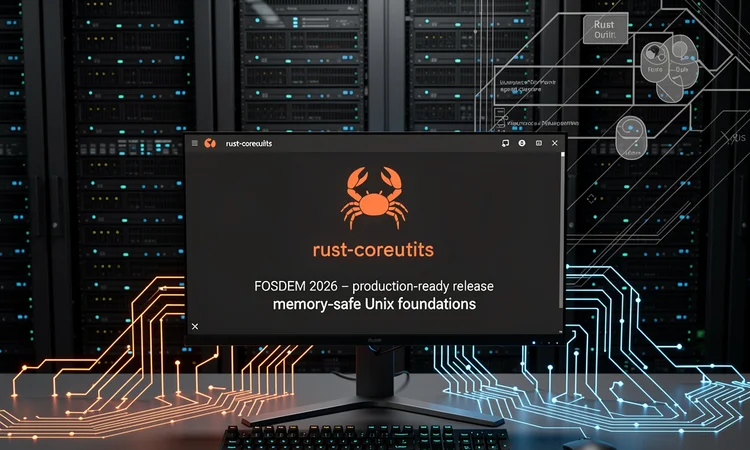
The decades-old foundation of Unix-like operating systems faces its most significant transformation in a generation as developers working on Rust implementations of core utilities set their sights on a comprehensive demonstration at FOSDEM 2026. According to Phoronix , the Rust coreutils project has established an ambitious timeline to showcase a production-ready alternative to the GNU coreutils that have powered Linux systems since the 1990s. This development represents more than a technical curiosity—it signals a fundamental shift in how the open-source community approaches system-level software development in an era where memory safety vulnerabilities constitute the majority of critical security flaws.
The initiative comes at a pivotal moment when government agencies and major technology companies are increasingly mandating memory-safe programming languages for critical infrastructure. The GNU coreutils package, comprising essential command-line tools like ls, cat, cp, and mv, has served as the bedrock of Linux and Unix systems for over three decades. Written primarily in C, these utilities have accumulated technical debt and occasional security vulnerabilities inherent to languages without built-in memory safety guarantees. The Rust implementation promises to maintain full compatibility while eliminating entire classes of bugs that have plagued systems programming since the dawn of computing.
According to the Phoronix report , project maintainers have committed to delivering a feature-complete implementation that passes the extensive GNU coreutils test suite by the time FOSDEM 2026 convenes in Brussels. This timeline gives developers approximately two years to close remaining compatibility gaps, optimize performance, and ensure the Rust versions can serve as drop-in replacements across diverse Linux distributions. The project has already achieved significant milestones, with many core utilities reaching functional parity with their C counterparts, though performance optimization and edge-case handling remain ongoing challenges.
Performance Parity and the Challenge of Decades of Optimization
One of the most significant technical hurdles facing the Rust coreutils project involves matching the raw performance of GNU utilities that have benefited from decades of optimization by some of the world’s most talented systems programmers. While Rust’s zero-cost abstractions promise performance comparable to C, the GNU coreutils have accumulated countless micro-optimizations, platform-specific tweaks, and algorithmic refinements that represent thousands of developer-hours. Early benchmarks have shown mixed results, with some Rust implementations matching or exceeding their C counterparts while others lag behind in specific workloads, particularly those involving intensive I/O operations or complex text processing.
The performance question extends beyond raw speed to encompass memory usage, startup time, and behavior under resource constraints. System administrators running containerized workloads or embedded systems pay close attention to these metrics, as even minor regressions multiplied across thousands of container instances can translate to meaningful infrastructure costs. The Rust implementations benefit from the language’s sophisticated ownership system, which can eliminate certain classes of runtime overhead, but they must also contend with Rust’s larger binary sizes and different memory allocation patterns. Project contributors have been methodically profiling both implementations to identify optimization opportunities without sacrificing the memory safety guarantees that justify the rewrite in the first place.
Security Imperatives Driving Adoption Beyond Technical Merit
The push toward memory-safe alternatives has gained unprecedented momentum following high-profile security incidents and policy directives from government agencies. The United States Cybersecurity and Infrastructure Security Agency (CISA) has repeatedly emphasized the need to transition away from memory-unsafe languages in critical infrastructure, while the National Security Agency (NSA) has published guidance recommending memory-safe languages for new development. These policy shifts reflect a growing consensus that the endemic memory safety vulnerabilities in C and C++ codebases represent an unacceptable systemic risk that cannot be fully mitigated through defensive programming practices or static analysis tools alone.
Major technology companies have echoed these concerns with concrete actions. Google has reported that memory safety issues account for approximately 70% of severe security vulnerabilities in Chrome, while Microsoft has attributed a similar proportion of security patches to memory corruption bugs. Both companies have invested heavily in Rust adoption, with Google integrating Rust into Android and the Linux kernel, while Microsoft has begun rewriting portions of Windows components in memory-safe languages. The Rust coreutils project exists within this broader ecosystem shift, representing a grassroots effort to apply these principles to the foundational tools that every Linux system depends upon daily.
Compatibility Challenges and the Test Suite Gauntlet
Achieving bug-for-bug compatibility with GNU coreutils presents a paradoxical challenge for the Rust implementation team. The GNU utilities have accumulated numerous quirks, undocumented behaviors, and edge cases over three decades of development. While some of these represent genuine bugs that should be fixed, others have become de facto standards that existing scripts and automation tools depend upon. The Rust coreutils developers must navigate the tension between creating a cleaner, more correct implementation and maintaining the compatibility necessary for widespread adoption in production environments where breaking changes can cascade through complex toolchains.
The GNU coreutils test suite comprises thousands of test cases covering everything from basic functionality to obscure corner cases involving unusual file systems, locale settings, and platform-specific behaviors. Passing this comprehensive test battery represents the minimum bar for considering the Rust implementation production-ready. Beyond the official test suite, the project must also contend with the informal testing that occurs when real-world scripts encounter edge cases their authors never anticipated. This organic compatibility testing can only happen through gradual adoption, creating a chicken-and-egg problem where widespread deployment requires proven stability, but proven stability requires widespread deployment.
Distribution Adoption Strategies and Ecosystem Integration
The path to mainstream adoption for Rust coreutils will likely follow a gradual, distribution-specific trajectory rather than a sudden wholesale replacement. Forward-thinking distributions may begin by offering Rust coreutils as an optional alternative, allowing adventurous users and organizations to opt in while maintaining the traditional GNU tools as the default. This approach mirrors the strategy used for other major system-level transitions, such as the gradual migration from SysV init to systemd or the ongoing shift from X11 to Wayland. Package maintainers will need to carefully manage dependencies, ensure consistent behavior across the transition, and provide clear migration paths for users with specialized requirements.
Some distributions focused on security or embedded systems may prove more aggressive in their adoption timelines. Projects like Alpine Linux, which already uses musl libc instead of glibc and emphasizes minimal attack surfaces, might embrace Rust coreutils earlier than more conservative distributions. Similarly, container-focused distributions that prioritize security and can more easily manage breaking changes might serve as early adopters. The FOSDEM 2026 target provides a rallying point for coordinating these adoption efforts across the broader open-source ecosystem, potentially leading to synchronized releases from multiple distributions in the months following the conference.
Developer Experience and Contribution Velocity
One often-overlooked advantage of the Rust rewrite involves the developer experience for contributors. Rust’s strong type system, comprehensive error handling, and excellent tooling lower the barrier to entry for new contributors while reducing the likelihood of introducing subtle bugs. The GNU coreutils codebase, while well-maintained, carries the accumulated complexity of decades of development in C, a language notorious for its sharp edges and undefined behaviors. New contributors to the Rust project can leverage the compiler’s helpful error messages and the language’s built-in testing framework to make meaningful contributions with greater confidence.
This improved developer experience could translate to higher contribution velocity and faster feature development over time. The Rust ecosystem’s modern development practices, including comprehensive documentation through rustdoc, integrated benchmarking, and a vibrant package ecosystem through crates.io, provide infrastructure that the GNU coreutils project has had to build and maintain separately. While the GNU project has served the community admirably for decades, the Rust implementation benefits from standing on the shoulders of a modern language ecosystem designed from the ground up to support collaborative open-source development at scale.
Industry Implications and the Future of Systems Programming
The Rust coreutils initiative represents a microcosm of larger trends reshaping systems programming and infrastructure software. If the project succeeds in delivering a production-ready implementation by FOSDEM 2026, it will provide a powerful proof point for memory-safe languages in the most conservative and performance-critical domains of computing. Success here could accelerate similar rewrites of other foundational components, from shell interpreters to network utilities, potentially triggering a cascade of modernization across the entire Unix userland over the next decade.
However, the project’s success is far from guaranteed. The technical challenges remain substantial, and the conservative nature of systems administration means that adoption curves for infrastructure software tend to span years or decades rather than months. Even if the Rust implementation achieves technical parity, overcoming institutional inertia and the ‘if it ain’t broke, don’t fix it’ mentality prevalent in production environments will require sustained effort from the entire open-source community. The FOSDEM 2026 milestone represents not an endpoint but rather the beginning of what will likely be a multi-year transition period as the ecosystem gradually evaluates, adopts, and adapts to this new foundation for Unix-like systems.






Leave a Reply
Your email address will not be published.