









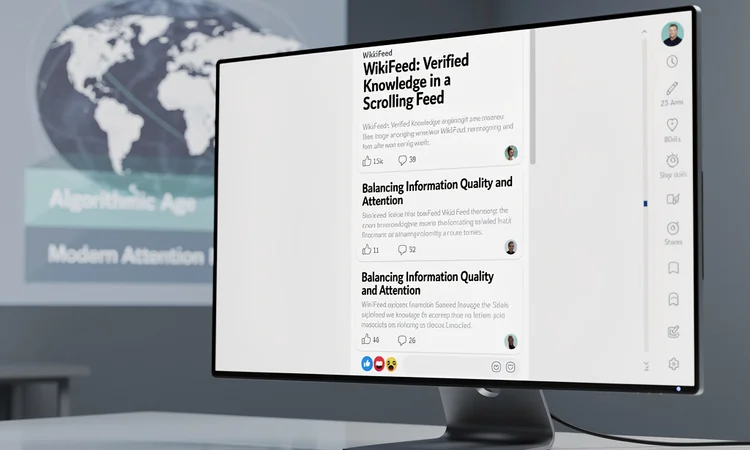
In an era where algorithmic feeds dominate how billions of people consume information, one developer has embarked on an audacious experiment: transforming Wikipedia, the internet’s most comprehensive knowledge repository, into a social media-style scrolling experience. The project, dubbed “WikiFeed,” represents a fascinating collision between the democratized knowledge of the wiki model and the addictive, personalized content delivery mechanisms that have come to define modern digital life.
Developer Amit Agarwal has created a tool that converts Wikipedia’s traditional hyperlinked article format into an infinite scroll feed reminiscent of Twitter, Instagram, or TikTok. According to Engadget , the application pulls content from Wikipedia’s vast archives and presents it in bite-sized chunks, complete with images and summaries that users can quickly consume as they scroll through their personalized knowledge feed. The interface maintains Wikipedia’s commitment to factual information while borrowing the engagement mechanics that have made social platforms so compelling—and controversial.
The timing of this innovation is particularly noteworthy. As concerns mount about misinformation, echo chambers, and the quality of information circulating on traditional social media platforms, WikiFeed offers an alternative model: what if the addictive scroll could be redirected toward verified, crowd-sourced knowledge rather than viral content of questionable provenance? The experiment raises fundamental questions about how we balance engagement with accuracy, and whether the format that delivers information is as important as the information itself.
The Architecture of Attention in the Digital Age
The transformation of Wikipedia into a feed-based platform is more than a technical curiosity; it represents a broader reckoning with how information architecture shapes human behavior. Traditional Wikipedia requires intentional navigation—users must actively search for topics or follow hyperlinks from article to article. This deliberate approach has been both a strength and a limitation, ensuring that readers engage purposefully while potentially limiting the platform’s reach among users conditioned to passive consumption.
WikiFeed inverts this model entirely. By implementing an algorithmic feed that surfaces articles based on user interests and reading history, Agarwal has created a system that meets users where their attention patterns already exist. The feed can be customized by topic, allowing users to create streams focused on history, science, culture, or any combination of Wikipedia’s 60 million articles across more than 300 languages. This personalization engine draws on the same principles that power recommendation systems across the technology industry, but applies them to educational content rather than entertainment or commerce.
Reimagining Educational Content Delivery
The implications for education and knowledge dissemination are profound. Traditional educational models have long struggled with engagement, particularly in an era when students arrive in classrooms already trained by thousands of hours of optimized, dopamine-triggering content delivery. WikiFeed suggests a potential bridge: maintaining the rigor and verifiability of encyclopedic content while packaging it in formats that align with contemporary attention patterns.
Critics might argue that this approach risks trivializing serious knowledge, reducing complex topics to scrollable snippets that sacrifice depth for digestibility. However, proponents note that WikiFeed functions as a discovery mechanism rather than a replacement for deep reading. Users who encounter an intriguing topic in their feed can still click through to the full Wikipedia article, potentially using the feed as an entry point to more substantial engagement rather than an endpoint in itself.
The Technical Implementation and User Experience
From a technical standpoint, WikiFeed leverages Wikipedia’s robust API and Creative Commons licensing to pull and reformat content in real-time. The application preserves Wikipedia’s citation structure, ensuring that each feed item maintains links to sources and references. This technical decision is crucial—it means that even in a scrollable format, the content retains the verifiability and attribution that distinguishes Wikipedia from less rigorous information sources.
The user interface borrows liberally from established social media conventions: infinite scroll, quick-view cards with prominent images, and simple interaction mechanics. However, it notably excludes certain social features that have proven problematic on traditional platforms. There are no like counts, no comment sections, and no viral sharing mechanisms. This selective adoption of social media features suggests a thoughtful approach to format innovation—embracing engagement mechanics while avoiding the dynamics that tend to promote sensationalism and conflict.
The Wikipedia Foundation’s Broader Digital Strategy
While WikiFeed is an independent project not officially affiliated with the Wikimedia Foundation, it arrives at a moment when the foundation itself is grappling with questions of accessibility and engagement. Wikipedia has long prioritized accuracy and comprehensiveness over user experience optimization, a principled stance that has sometimes left the platform feeling dated compared to more modern web applications.
The foundation has undertaken various initiatives to modernize Wikipedia’s interface and expand its reach, particularly in developing markets where mobile-first design is essential. WikiFeed can be understood as part of this broader ecosystem of experimentation around how Wikipedia’s content might be packaged and delivered. The project demonstrates that Wikipedia’s open architecture and licensing enable innovation even when that innovation originates outside the foundation’s official channels.
Algorithmic Curation and the Knowledge Commons
The introduction of algorithmic curation to Wikipedia content raises important questions about neutrality and bias. Wikipedia’s editorial model, while imperfect, relies on transparent discussion and consensus among volunteer editors. An algorithmic feed, by contrast, makes decisions about what content to surface based on opaque criteria. Even well-intentioned algorithms can introduce biases through their selection and ranking mechanisms.
Agarwal’s implementation attempts to address these concerns through transparency and user control. The feed’s algorithms are relatively simple, prioritizing recency, topic relevance, and article quality ratings from Wikipedia’s own assessment systems. Users can adjust their preferences, exclude topics, or switch to chronological rather than algorithmic sorting. This design philosophy suggests awareness of the pitfalls that have plagued algorithmic curation on commercial platforms, where engagement optimization has sometimes conflicted with user welfare.
The Attention Economy Meets the Knowledge Commons
WikiFeed exists at the intersection of two powerful forces shaping contemporary digital culture: the attention economy and the knowledge commons. The attention economy, driven by advertising revenue and user engagement metrics, has created platforms optimized for capturing and monetizing human attention. The knowledge commons, exemplified by Wikipedia, represents a counter-model based on collaborative knowledge creation and free access to information.
By bringing feed-based mechanics to Wikipedia content, WikiFeed attempts to harness the engagement power of the attention economy while serving the goals of the knowledge commons. This synthesis is delicate—the very features that make feeds engaging can also make them manipulative. The absence of advertising in WikiFeed is crucial to this balance. Without revenue pressures driving ever-more-aggressive engagement optimization, the feed can remain focused on genuine utility rather than addiction.
Implications for the Future of Information Consumption
The WikiFeed experiment offers a glimpse of how information consumption might evolve beyond the current paradigm of social media feeds filled with user-generated content, advertising, and algorithmic amplification of controversial material. It suggests that the feed format itself is neutral—a tool that can be applied to different types of content with different outcomes.
If successful, WikiFeed could inspire similar approaches to other knowledge repositories and educational resources. Imagine feed-based interfaces for academic journals, museum collections, or archival materials—making specialized knowledge more accessible without sacrificing rigor. The model could be particularly valuable in educational contexts, where teachers might curate feeds of Wikipedia articles aligned with curriculum goals, creating personalized learning pathways that feel familiar to students raised on social media.
The project also raises questions about sustainability and scale. Wikipedia itself operates on donations and volunteer labor, a model that has proven remarkably durable but faces ongoing challenges. If feed-based access significantly increases Wikipedia’s usage, it could strain both technical infrastructure and the volunteer editor community responsible for maintaining content quality. These practical considerations will shape whether WikiFeed remains a interesting experiment or evolves into a widely-adopted way of accessing Wikipedia’s content.
The Broader Context of Platform Innovation
WikiFeed emerges during a period of intense scrutiny of social media platforms and growing interest in alternative models for online interaction. From federated social networks to paid subscription platforms without advertising, developers and users are exploring options beyond the dominant model of free, ad-supported services optimized for engagement above all else. WikiFeed contributes to this exploration by demonstrating that familiar interface patterns can be decoupled from the business models and content types with which they’re typically associated.
The project also highlights the value of open platforms and permissive licensing. Because Wikipedia’s content is freely available under Creative Commons licenses, developers like Agarwal can experiment with new ways of presenting and delivering that content without requiring permission or partnership agreements. This openness has been fundamental to Wikipedia’s impact, enabling countless applications, research projects, and derivative works. WikiFeed is simply the latest example of innovation enabled by the knowledge commons model.
As digital platforms continue to evolve and society grapples with questions about information quality, attention, and engagement, projects like WikiFeed offer valuable data points. They demonstrate that the formats and mechanics we associate with social media are not inherently problematic—the issues arise from how those mechanics are deployed and what incentives drive their optimization. By applying feed-based design to educational content within a non-commercial framework, WikiFeed suggests paths forward that preserve engagement while serving rather than exploiting users. Whether this particular implementation gains widespread adoption matters less than the questions it raises and the possibilities it illuminates for reimagining how we discover and consume knowledge in the digital age.






Leave a Reply
Your email address will not be published.